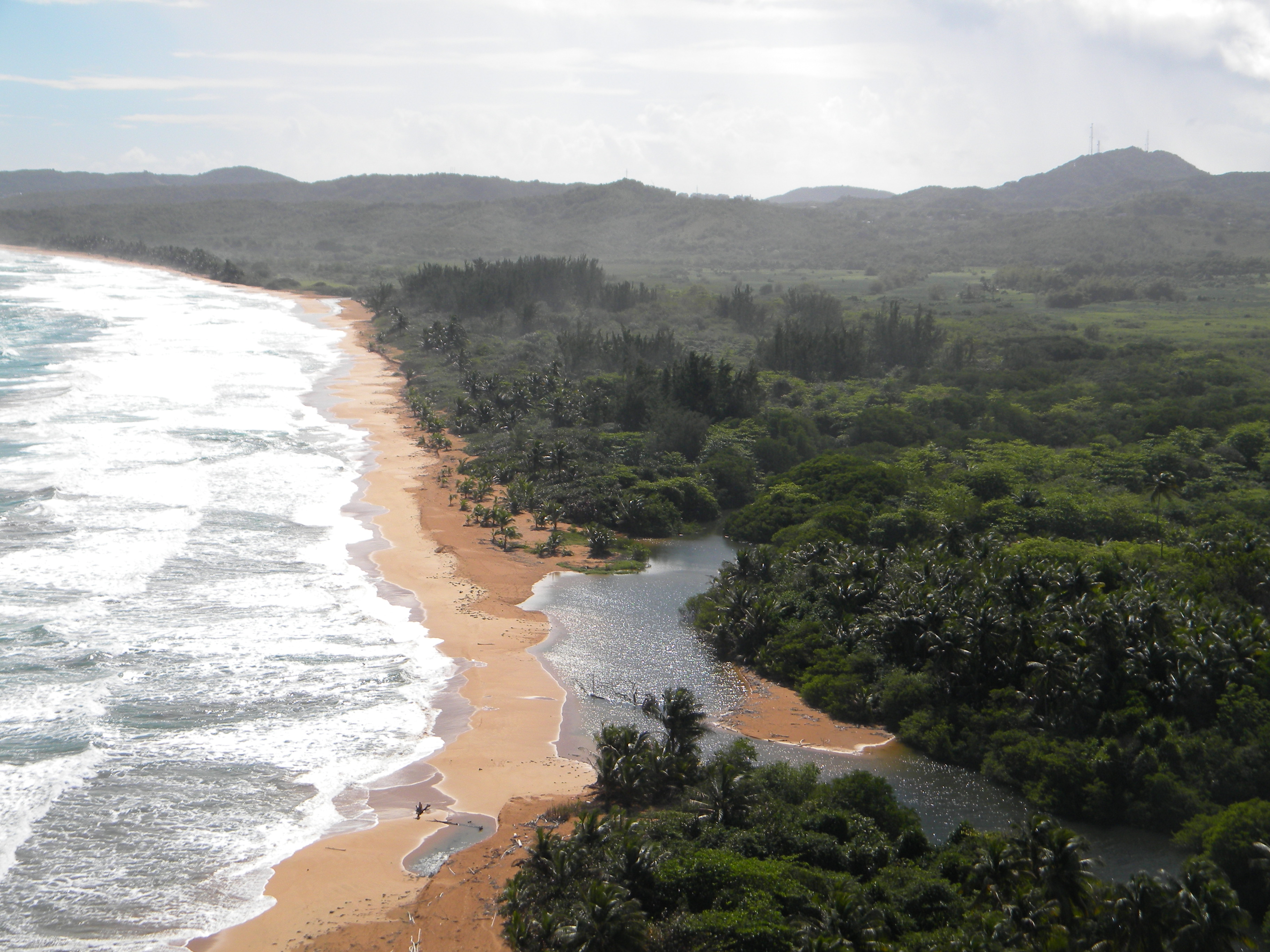
Northeast Ecological Corridor
Every spring, leatherback sea turtles haul themselves onto the beaches between Luquillo and Fajardo to lay their eggs in the sand. They have been doing this for millions of years. In the 1990s, developers proposed building two mega-resorts with thousands of residential units and multiple golf courses on the same stretch of coast. What followed was not a quick regulatory decision but a twenty-year fight -- waged by fishermen, students, lawyers, and conservation groups -- that became one of Puerto Rico's defining environmental battles. The Northeast Ecological Corridor Nature Reserve, all 2,970 acres of it, exists today because ordinary people refused to let it be paved over.
Where the Rainforest Meets the Sea
The Corridor stretches from Luquillo's town square to Seven Seas Beach in Fajardo, bounded by Route 3 to the south and the Atlantic Ocean to the north. What makes the site extraordinary is not just its size but its ecological compression. Within this strip and the adjacent Las Cabezas de San Juan Nature Reserve and El Yunque National Forest, all six of Puerto Rico's ecological life zones are represented in a stretch of just 13 miles -- one of the most pronounced environmental gradients in the Caribbean. The NEC alone contains 866 documented species of flora and fauna, 54 of them classified as critical elements: rare, threatened, endangered, or endemic. Among the residents are federally endangered species including the plain pigeon, the Puerto Rican boa, the hawksbill sea turtle, and the West Indian manatee. The Aguas Prietas Lagoon, tucked within the Corridor, sometimes glows with bioluminescence when salinity conditions align.
Dos Mares, Four Seasons, and the Water They Would Have Consumed
The two proposed developments were enormous. Dos Mares Marriott Resort planned 3,450 residential and tourist units plus two golf courses. San Miguel Four Seasons Resort proposed 1,450 units and two more golf courses. Opponents pointed out that over 80 percent of the proposed units were purely residential, undercutting the developers' claims that these were tourism projects. The environmental stakes were concrete: deforestation, wetland filling, river channelization, and toxic herbicides from golf course maintenance threatening surface and groundwater. Puerto Rico's own Water Plan showed the region already faced a deficit of 3.6 million gallons per day. Dos Mares actually began clearing land without permits, damaging tributaries to the Aguas Prietas Lagoon and increasing sedimentation in the bioluminescent waters. The developers were fined $140,000 by the PR Department of Natural Resources and the U.S. Fish and Wildlife Service -- a penalty that barely registered against the scale of the proposed investment.
A Coalition Built From the Ground Up
The resistance started at public hearings in 1998, where fishermen's associations, residents, and university professors began exchanging phone numbers. By 2004, more than twenty groups had coalesced into the Coalition for the Northeast Ecological Corridor, formalized in April 2005 with organizational support from the newly chartered Puerto Rico Chapter of the Sierra Club. The Coalition's membership was remarkably broad: the Federation of Fisherpersons, the Brotherhood of Eastern Artisans, 4H clubs, the Camping Association, university students, and professional planners. Their cause attracted support from actors Benicio Del Toro and Edward James Olmos, environmental lawyer Robert F. Kennedy Jr., and international organizations including the World Wildlife Fund and the Surfrider Foundation. Since 2006, the Coalition has held the annual Leatherback Turtle Festival at Luquillo's town square each April, turning the start of nesting season into a celebration and a lobbying event.
Protected, Unprotected, Protected Again
The path to protection was anything but straight. Governor Anibal Acevedo-Vila signed an executive order establishing the nature reserve in April 2008. Governor Luis Fortuno reversed it in October 2009. The Coalition shifted tactics, targeting the public lands within the Corridor through legislative action. Senate Bill 2282 passed unanimously in April 2012, and Law No. 126 was signed in June 2012, protecting 1,957 acres of publicly owned land -- about two-thirds of the original designation. After the 2012 elections brought a new administration, the Coalition pushed for the rest. On April 13, 2013, Governor Alejandro Garcia-Padilla signed Law No. 13 at the 8th annual Leatherback Turtle Festival, declaring the entire Northeast Ecological Corridor a nature reserve. The University of Puerto Rico's Environmental Law Clinic, led by Pedro Saade Llorens, had fought every permit application in court for years, ensuring that neither mega-resort ever broke ground within the Corridor proper.
From the Air
Located at 18.35N, 65.65W along Puerto Rico's northeast coast between Luquillo and Fajardo. From the air, the Corridor is visible as a continuous band of green coastline between the developed areas of both towns, stretching approximately 5.4 miles along beaches. El Yunque National Forest rises directly to the south. The Cape San Juan headland marks the eastern boundary. Nearest airports: Jose Aponte de la Torre (TJRV) in Ceiba, approximately 8nm southeast. Best viewed at low to medium altitude where the contrast between protected coastline and surrounding development is striking.