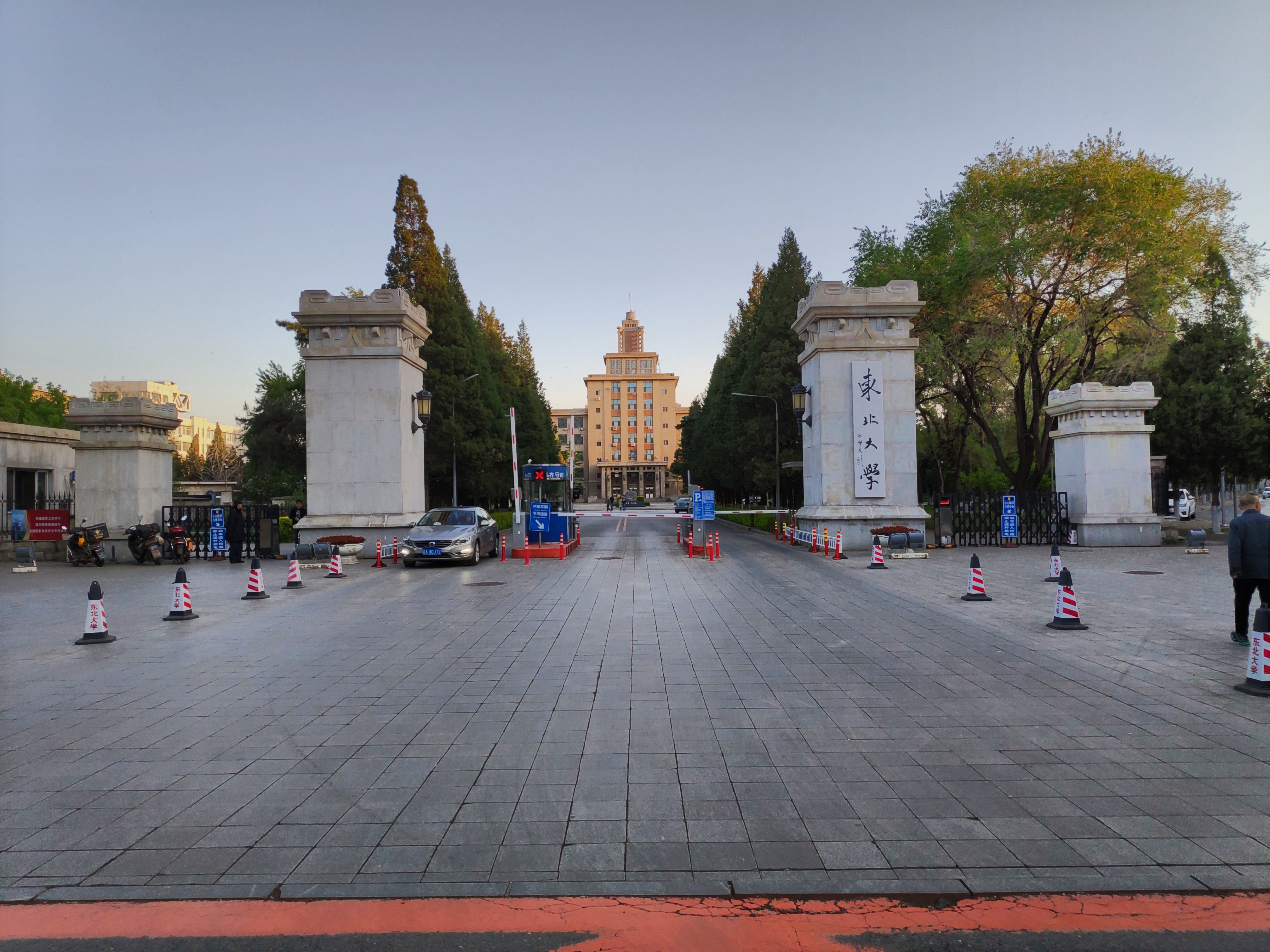
Northeastern University (China)
When General Zhang Xueliang became president of Northeastern University in 1928, he did something unusual for a warlord: he hired a poet and a linguist to write the school song. Liu Bannong composed the lyrics and Zhao Yuanren set them to music. Three years later, Japanese soldiers seized the campus, and that song became an anthem of exile. The university spent the next fifteen years on the run, holding classes in borrowed buildings across China while its home city burned.
Born of Ambition
The university began in 1923 as a project of provincial pride. Wang Yongjiang, the acting governor of Fengtian Province, established it by unifying educational resources from Jilin and Heilongjiang to create something the northeast had never had: a comprehensive university capable of training the engineers, lawyers, and scientists the region desperately needed. The campus grew quickly in the grounds of the former Shenyang Higher Normal School. Lin Huiyin, China's first female modern architect, joined the faculty and designed the university's original logo, featuring Changbai Mountain and the Heilongjiang River. For a brief period in the late 1920s, Northeastern University was one of the best-funded institutions in China.
Years of Exile
The Mukden Incident of September 18, 1931 ended everything. Japanese forces seized Shenyang overnight, and the university was forced into exile. By October, classes resumed in Beiping, but instability followed. In 1936, the engineering school relocated to Xi'an. When Zhang Xueliang was imprisoned after the Xi'an Incident that December, the university lost its patron and protector. The new acting president, Zang Qifang, moved the entire institution to Xi'an, then further south to Santai in Sichuan province when Japanese bombers began hitting Xi'an in 1938. For seven years, a university built to serve Manchuria operated from a small town in China's interior, keeping its identity alive through sheer stubbornness.
Dissolution and Rebirth
In May 1946, faculty and students finally returned to Shenyang after Japan's defeat. But peace brought its own disruption. In March 1949, the Northeast Administrative Commission dissolved the university entirely. Its engineering and science schools were reorganized into the Northeastern Engineering College under the Ministry of Metallurgical Industry, and the campus moved to the Nanhu district of Shenyang. The institution spent decades as a specialized technical college before gradually expanding back toward comprehensiveness. In 1997, the Shenyang Gold College merged in, and the university reclaimed its original name along with broader academic ambitions.
A Campus Spread Across Cities
Today Northeastern University operates four campuses across two cities. The main Nanhu Campus sits beside the Hun River in Shenyang, covering over two million square meters. The newer Hunnan Campus, 16 kilometers south, adds another 890,000 square meters of research facilities and student housing. A third campus in Shenyang's Shenhe district handles continuing education. The fourth, in Qinhuangdao on the Bohai coast, operates almost as an independent university with 36 undergraduate programs and its own graduate school. The university is home to two national key laboratories, five members of the Chinese Academy of Engineering or Sciences, and research rankings that place it among the top 300 universities worldwide.
From the Air
Located at 41.76°N, 123.42°E in Shenyang's Nanhu district, adjacent to the Hun River. The campus is visible from low altitude as a large institutional complex south of central Shenyang. Nearest major airport is Shenyang Taoxian International Airport (ZYTX), approximately 15 km to the south.