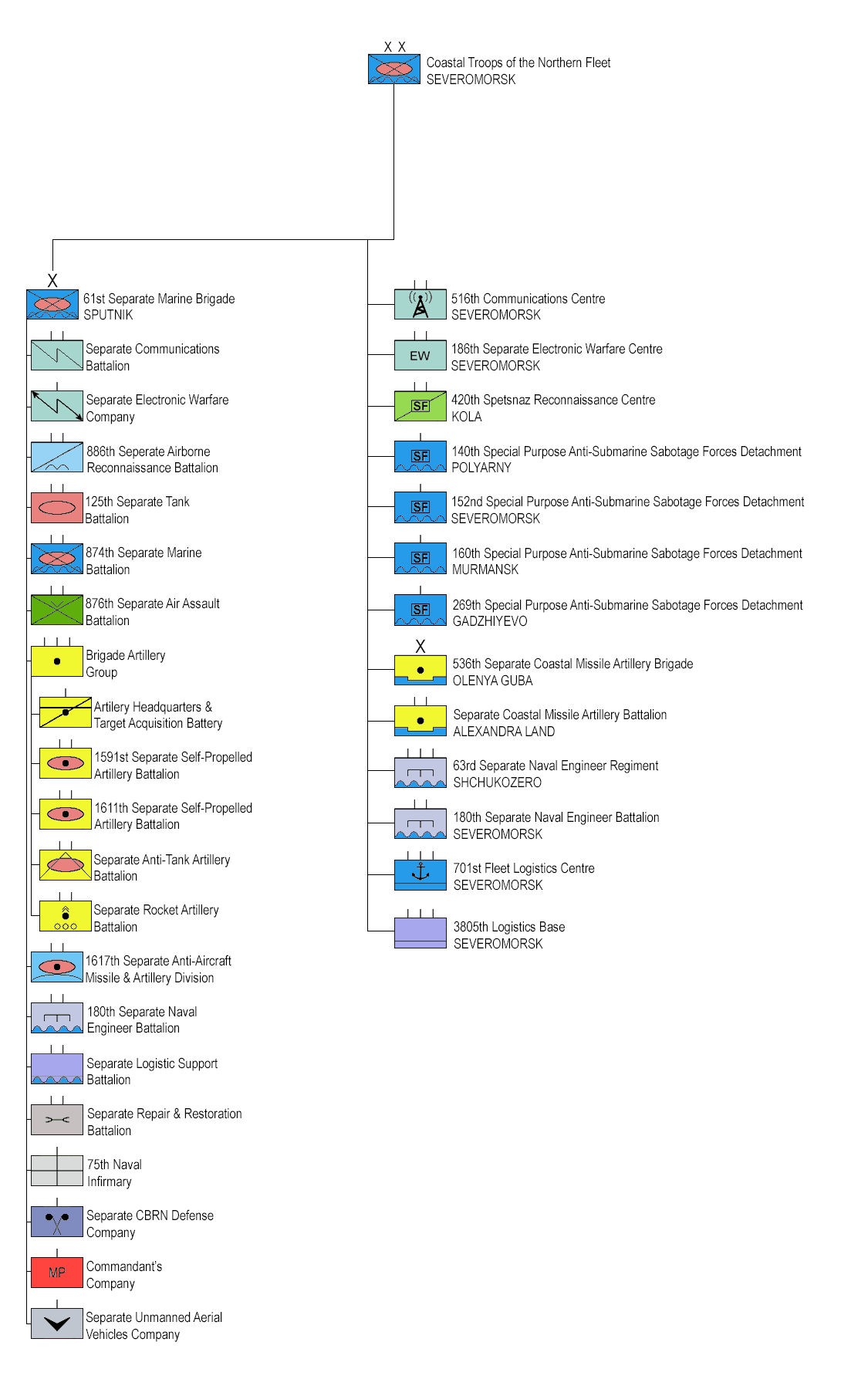
Northern Fleet
Somewhere beneath the gray swells of the Barents Sea, a submarine runs silent. It has done so for decades, in one form or another, since the Soviet Union planted its naval flag on the Kola Peninsula and decided the Arctic was worth defending. The Northern Fleet, headquartered in the closed city of Severomorsk just north of Murmansk, is Russia's most powerful naval formation -- home to its nuclear-armed ballistic missile submarines, its sole aircraft carrier, and a tradition of Arctic operations stretching back nearly three centuries to a squadron Empress Anna created in 1733 to protect White Sea fisheries and trade routes.
From Fishing Boats to Nuclear Arsenals
The Northern Fleet traces its origins to 1733, when a squadron was established to guard Russian Empire territories, sea trade, and fisheries along the Kola Peninsula coast. For two centuries it remained a minor posting. That changed in 1933, when the Soviet Navy formally established the Northern Flotilla, recognizing that the ice-free ports of the Kola inlet offered something the frozen harbors of the White Sea could not: year-round access to the Atlantic. By the late 1930s, the flotilla was growing fast. When Germany invaded the Soviet Union in 1941, the Northern Fleet found itself defending the Arctic convoy routes that would become lifelines for the Allied war effort -- the same waters where convoy PQ-17 met its catastrophic fate in July 1942.
The Great Patriotic War in Arctic Waters
Between 1941 and 1945, the Northern Fleet defended the Rybachy and Sredny peninsulas, escorted Allied convoys carrying tanks and aircraft to Murmansk and Arkhangelsk, and supported the 14th Army's ground operations along the Norwegian border. Naval infantry fought ashore as well as at sea -- up to 10,000 fleet personnel joined land campaigns, including the Petsamo-Kirkenes Operation of 1944 that drove German forces out of the Arctic. Eighty-five Northern Fleet sailors earned the title Hero of the Soviet Union, three of them twice. The destroyer Gremyashchiy and eight submarines received Guards status, the Soviet military's highest unit distinction. More than 48,000 personnel were decorated for their service in waters where winter darkness lasted months and convoy runs meant running a gauntlet of U-boats, Luftwaffe bombers, and polar storms.
Cold War Beneath the Ice
The nuclear age transformed the Northern Fleet from a regional force into a global one. On 1 July 1958, the fleet raised the Soviet naval ensign over K-3 Leninskiy Komsomol, the country's first nuclear-powered submarine. Four years later, that boat traveled beneath the Arctic ice cap and surfaced at the North Pole. Russian submarines have visited the polar region more than 300 times since. At the height of the Cold War, the fleet operated over 200 submarines -- diesel-electric boats, nuclear attack submarines, and ballistic missile carriers capable of striking any continent on Earth. The Kola Peninsula became one of the most heavily militarized stretches of coastline in the world, its fjords sheltering submarine pens, its airfields home to long-range maritime patrol and bomber aviation.
Decline and Arctic Revival
The Soviet Union's collapse devastated the fleet. By 1996, half of its nuclear submarines had been decommissioned. Entire divisions were disbanded, aircraft regiments dissolved, and the Kola bases fell into disrepair. A Chatham House analysis noted that throughout the 1990s, the Russian Arctic was considered "a burden fraught with socio-economic problems." The reversal began in the 2000s. In 2014, the fleet became the core of the newly established Northern Fleet Joint Strategic Command, responsible for all Russian military forces across the Arctic. Its jurisdiction spans from Murmansk and Arkhangelsk oblasts to Russia's offshore Arctic islands, covering the Barents Sea, Kara Sea, Norwegian Sea, and the northwestern Atlantic approaches.
The Closed City on Kola Bay
Severomorsk, the fleet's headquarters, remains a closed city -- no civilian may enter without a special permit. Six additional naval bases dot the Kola Peninsula at Polyarnyy, Olenya Bay, Gadzhiyevo, Vidyayevo, Bolshaya Lopatka, and Gremikha. Nuclear icebreakers berth at Murmansk. Shipyards at Severodvinsk, Roslyakovo, and elsewhere maintain the fleet's vessels, while spent nuclear fuel storage facilities at Andreyeva Bay and Gremikha stand as reminders of the environmental cost of decades of nuclear naval operations. From above, the Kola inlet reveals its military geography clearly: a narrow fjord opening to the Barents Sea, lined with the infrastructure of a fleet that considers these Arctic waters home.
From the Air
Coordinates: 71.37°N, 24.57°E (Severomorsk area). The Northern Fleet's main base at Severomorsk sits on the eastern shore of the Kola Bay, visible as a concentration of military infrastructure along the fjord. Nearest civilian airport: Murmansk Airport (ULMM). The area is restricted airspace. From cruising altitude, the Kola inlet is clearly visible as a deep fjord cutting south from the Barents Sea coast, with Murmansk at its head and military installations lining both shores.