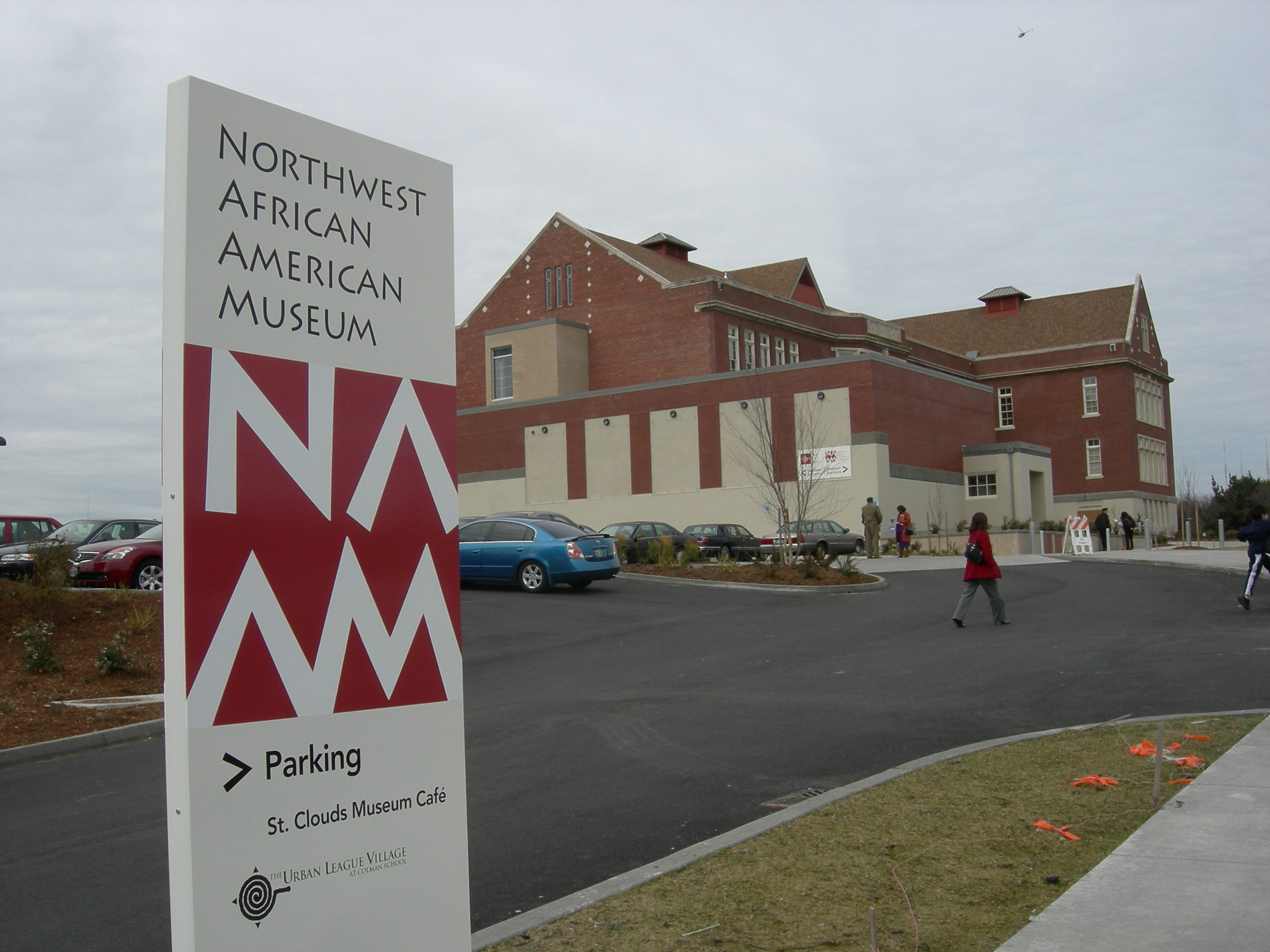
Northwest African American Museum
In 1985, four community activists walked into the abandoned Colman School in Seattle's Central District and refused to leave. Earl Debnam, Michael Greenwood, Charlie James, and Omari Tahir-Garrett believed the shuttered building -- a 1909 Jacobean-style landmark sitting empty while the neighborhood's African American community lacked a cultural institution of its own -- should become a museum. The occupation lasted eight years. Tahir-Garrett's son, Wyking Kwame Garrett, grew up participating in it. That act of defiance planted the seed for what eventually became the Northwest African American Museum, or NAAM -- a place that exists not because a benefactor wrote a check, but because people physically claimed the space and held it until the city listened.
A Building Worth Fighting For
The Colman School was designed by architect James Stephen and built in 1909, its Jacobean architecture giving it a stately presence on the hillside. The school served generations of Central District families before closing, and its official designation as a City of Seattle landmark only deepened the community's conviction that this particular building mattered. The first organized push for an African American museum began in 1981, led by a multiracial coalition called Community Exchange. A formal task force followed in 1984, and then the occupation in 1985. While activists held the building, the city and Seattle School District explored alternative sites, but the community kept returning to Colman. In 1993, a nonprofit called the African American Heritage Museum and Cultural Center formed under Mayor Norman Rice's administration. Rice appointed Bob Flowers as board chairman in 1995, and ground was finally broken in spring 2006 -- more than two decades after the first occupation.
Kindred Spirits on the Walls
When NAAM opened in 2008, its inaugural exhibition paired the work of two towering African American artists who had made Seattle their home: Jacob Lawrence and James W. Washington, Jr. Lawrence contributed a series of five panels depicting the life of George Washington Bush, Washington State's first African American settler. Washington's piece, The Young Queen of Ethiopia, carved from Mexican volcanic stone in 1956, stood as a counterpoint in medium and mood. The two artists came from different backgrounds and worked in different forms, but as the exhibit noted, they shared "a firm belief in their own direction as artists" and had done "the painful work of finding their authentic voice" in a country marked by racial divides. The pairing set NAAM's curatorial tone: art as evidence of resilience, not decoration.
Reopening and Renewal
The COVID-19 pandemic shuttered NAAM's physical building for roughly three years, though the museum remained active through virtual programming throughout. The doors reopened on Martin Luther King Jr. Day, January 16, 2023, with a suite of exhibitions that showcased the breadth of Black artistic expression in the Pacific Northwest. Colors of Life: African American Abstract Art and the Regathering of Community featured work by four regional artists -- Vincent Keele, Shantell Jackson, Lo Mar Metoyer, and Yeggy Michael. A companion show, Freedom of Expression, pushed against narrow definitions of what Black art can be, while A Long Walk to Hope documented Seattle's annual Martin Luther King Jr. march through the photography of Susan Fried. The building today also houses 36 units of affordable housing, making it both a cultural anchor and a practical investment in the neighborhood it serves.
Next Door to a Guitar Legend
NAAM sits adjacent to Jimi Hendrix Park, placing the museum in conversation with another dimension of Black cultural history in the Pacific Northwest. The architectural conversion from school to museum was designed by Donald King Architects, a local Black-owned firm, with Rico Quirindongo serving as lead architect. The building's programs extend well beyond its galleries: interactive story times, movie nights, book talks, lectures, and writing workshops fill the calendar, alongside the Dr. Carver Gayton Youth Curator Program. In 2009, NAAM established an annual nine-month curatorial internship in partnership with the University of Washington's museology program, building a pipeline for the next generation of museum professionals. From an occupied schoolhouse to a Smithsonian-caliber cultural institution, NAAM's trajectory is as much the story as anything hanging on its walls.
From the Air
NAAM sits at 47.589°N, 122.302°W in Seattle's Central District, on the eastern side of the city. From the air, look for the neighborhood east of Interstate 5 and south of Capitol Hill. Jimi Hendrix Park is immediately adjacent. The nearest general aviation airport is Boeing Field/King County International (KBFI), approximately 3.5 nautical miles to the south-southwest. Seattle-Tacoma International (KSEA) is about 10 nautical miles south. Recommended viewing altitude: 2,000-3,000 feet AGL to pick out the historic school building among the residential streets.