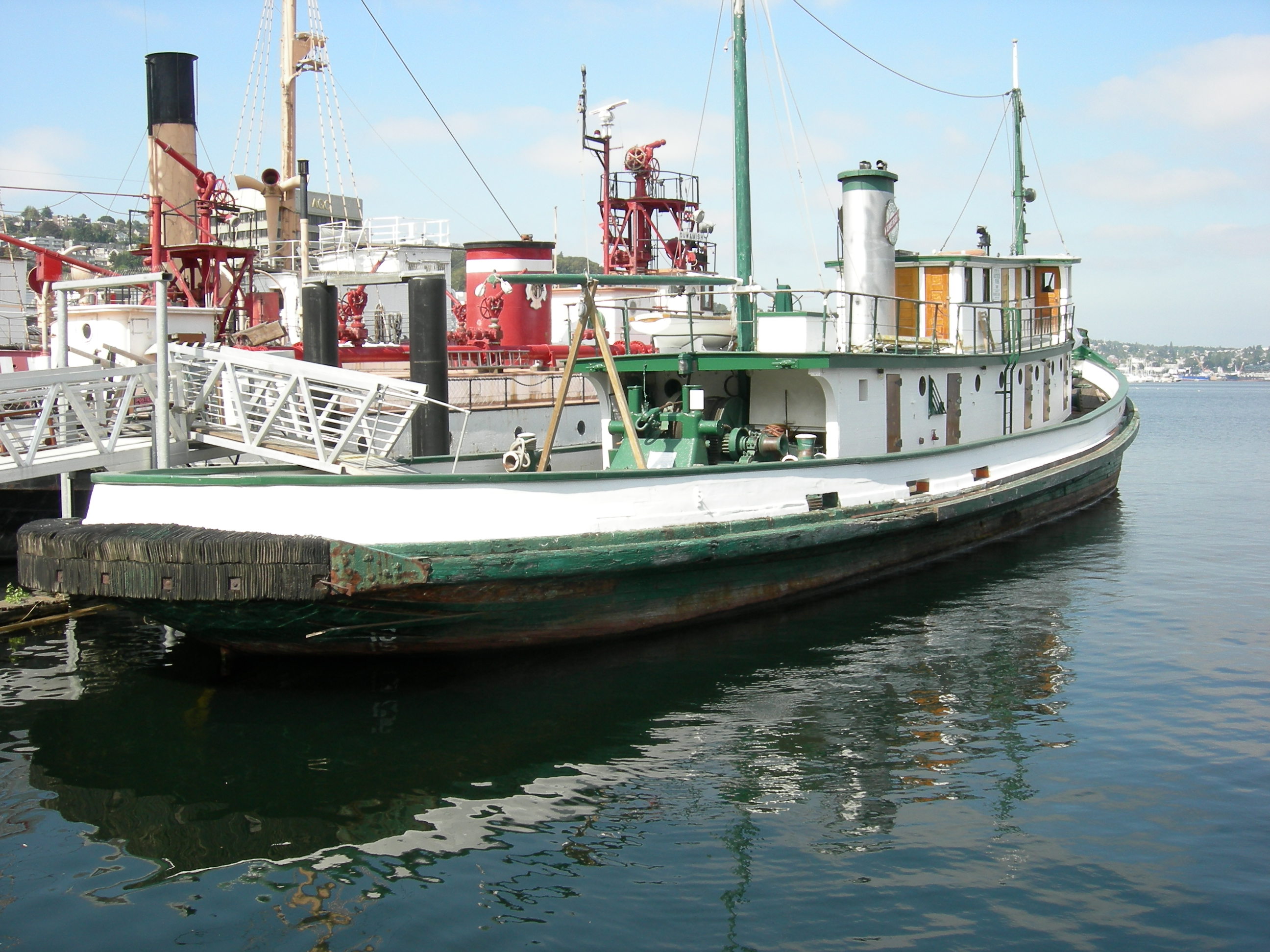
Northwest Seaport
The tugboat Arthur Foss has been working since 1889, which makes her older than the state of Washington itself. In 1898, she hauled barges packed with gold-seekers up the Inside Passage to Alaska during the Klondike Rush. In 1933, Metro-Goldwyn-Mayer cast her in the film Tugboat Annie. In December 1941, she was the last vessel to escape before the Battle of Wake Island began. After the war, she towed timber until retirement in 1968. Today she sits at the Historic Ships Wharf on Lake Union, her wooden hull still afloat, the oldest vessel of her kind in the United States. She is the flagship of Northwest Seaport, a nonprofit maritime heritage center that has spent more than half a century proving that old ships are not relics -- they are classrooms, stages, and living connections to the water that built the Pacific Northwest.
Save Our Ships
Northwest Seaport began as an act of rescue. In the early 1960s, a group of volunteers formed a project called Save Our Ships to prevent the 1897 schooner Wawona from being scrapped. They purchased her in 1964, then acquired Lightship 83 -- then called Relief -- in 1966, and received the tugboat Arthur Foss as a donation from the Foss company in 1970. The organization spent the 1970s based in Kirkland, on Lake Washington, before eventually changing its name to Northwest Seaport and relocating to the south shore of Lake Union in the early 1980s. For most of its existence, Northwest Seaport has been powered almost entirely by volunteers. It was the gradual decline of the Wawona by the early 2000s that pushed the board to hire professional staff, transforming a scrappy preservation group into a functioning heritage institution.
A Lightship's Long Voyage
Lightship 83, known by her station name Swiftsure, was launched in Camden, New Jersey in 1904. Her first assignment required steaming around the tip of South America to reach Blunts Reef off the California coast, where she saved 150 people when their ship ran aground in dense fog. She served with the United States Lighthouse Service until 1939, then transferred to the Coast Guard. During World War II she operated as an armed patrol boat before returning to lightship duty. In 1951 she was assigned to Seattle as the relief vessel for stations on the Columbia River bar, Umatilla Reef, and Swiftsure Bank -- the latter near the entrance to the Strait of Juan de Fuca. At 129 feet long with a 668-ton displacement, she carried a 1,000-watt primary light, a 140-decibel diaphone foghorn, and a 1,000-pound foredeck fog bell. She is the only lightship in the country that retains her original steam engine. Decommissioned in 1960 and purchased by Northwest Seaport in 1966, she was declared a National Historic Landmark in 1989.
The Schooner That Became a Sculpture
The vessel that started it all -- the three-masted schooner Wawona -- sailed from 1897 to 1947, first as a lumber carrier running between Grays Harbor and California ports, then as a fishing vessel on Puget Sound. Built in Fairhaven on California's Humboldt Bay by H.D. Bendixsen, one of the West Coast's most important shipbuilders of the late 19th century, she inspired popular novels through her captain, Ralph E. "Matt" Peasley. Listed on both the National Register of Historic Places and the Washington State Heritage Register, Wawona was berthed at Lake Union Park for years. But restoration efforts ultimately failed, and in March 2009 the schooner was carefully deconstructed in a local shipyard. Key artifacts -- wooden knees, beams, paneling -- were preserved for future exhibits. Some of her timbers went to the C.A. Thayer in San Francisco. Others found their way into a 64-foot-tall sculpture by artist John Grade, now hanging in the nearby Museum of History and Industry.
A Wharf That Teaches
Northwest Seaport sits alongside the Center for Wooden Boats and the Museum of History and Industry on Lake Union's south shore, forming an informal cultural cluster that has partnered on public programs and festivals, though the three organizations remain independent. The wharf today hosts four vessels on the National Register of Historic Places, two belonging to Northwest Seaport, with a third -- the halibut schooner Tordenskjold, built in 1911 -- in the process of nomination. Programs range from public tours and restoration workshops to toddler story times and traditional maritime music sing-alongs, plus vocational training in the marine trades. Arthur Foss was declared a National Historic Landmark in 1989 and is recognized as a Seattle city landmark. After more than sixty years of volunteer-driven preservation, Northwest Seaport remains proof that a city's relationship with its waterfront is best understood not from the shore, but from the deck of a ship that has seen the century turn.
From the Air
Northwest Seaport is at 47.627°N, 122.337°W on the south shore of Lake Union in Seattle. From the air, the Historic Ships Wharf is visible as a cluster of moored vessels just west of the MOHAI building at Lake Union Park. The Space Needle is roughly half a mile to the northwest. The nearest general aviation airport is Boeing Field/King County International (KBFI), about 4.5 nautical miles south. Seattle-Tacoma International (KSEA) is approximately 11 nautical miles south. Recommended viewing altitude: 1,500-2,500 feet AGL to spot the individual historic vessels at the wharf.