Norwegian Aviation Museum
You can drive under it. The Norwegian Aviation Museum in Bodø straddles Olav V gate so completely that motorists heading from Bodø Airport toward the town of Fauske pass beneath the building itself. The structure is shaped like an enormous propeller -- a detail best appreciated from the air, which seems fitting for a museum dedicated to flight. Opened by King Harald V on May 15, 1994, it covers approximately 10,000 square meters, making it the largest aviation museum in the Nordic countries. But the building's most remarkable quality is not its size or its architecture. It is the way a museum in this particular Norwegian city manages to connect the machines on display to the history that happened directly overhead.
A Battle Over Bodø's Claim
For decades, the question of where to locate Norway's national aviation museum provoked fierce debate. The aviation community around Gardermoen, near Oslo, where the Norwegian Armed Forces Aircraft Collection was already established, argued that the museum belonged in the south, close to the country's population center and existing military aviation heritage. Bodø's advocates countered that their city's deep ties to both military and civilian aviation -- including its strategic importance during World War II and the Cold War -- made it the natural home. The argument ran for years, drawing in politicians, military figures, and aviation enthusiasts across the country. On March 31, 1992, the Storting, Norway's parliament, settled the matter by voting to build the museum in Bodø. The decision was not just about aviation history. It was an investment in the identity of a northern city that had rebuilt itself from wartime destruction and wanted to tell its own story.
Wings of War
The military collection reads like a compressed history of 20th-century aerial combat. A Focke-Wulf Fw 190 represents the German occupation. A Gloster Gladiator -- the biplane that Norwegian pilots flew against overwhelming odds during the 1940 invasion -- sits near a Supermarine Spitfire, the type that Norwegian pilots flew with the RAF from exile in Britain. A Junkers Ju 88 is displayed in a crashed configuration, a reminder that the skies above Bodø were contested airspace. The Cold War collection is equally striking. A Lockheed U-2 spy plane -- serial number 56-6953, one of the aircraft that defined superpower surveillance -- stands alongside Northrop F-5 Freedom Fighters that served as Norway's frontline defense along the NATO northern flank. A Canadair CF-104 Starfighter represents the supersonic interceptor era. Perhaps the most poignant artifact is the engine of a Douglas SBD Dauntless dive bomber, salvaged in 1993 from the sea off Bodø, where it was shot down during Operation Leader in October 1943 -- the only offensive US Navy action in northern European waters during World War II.
Civilian Skies
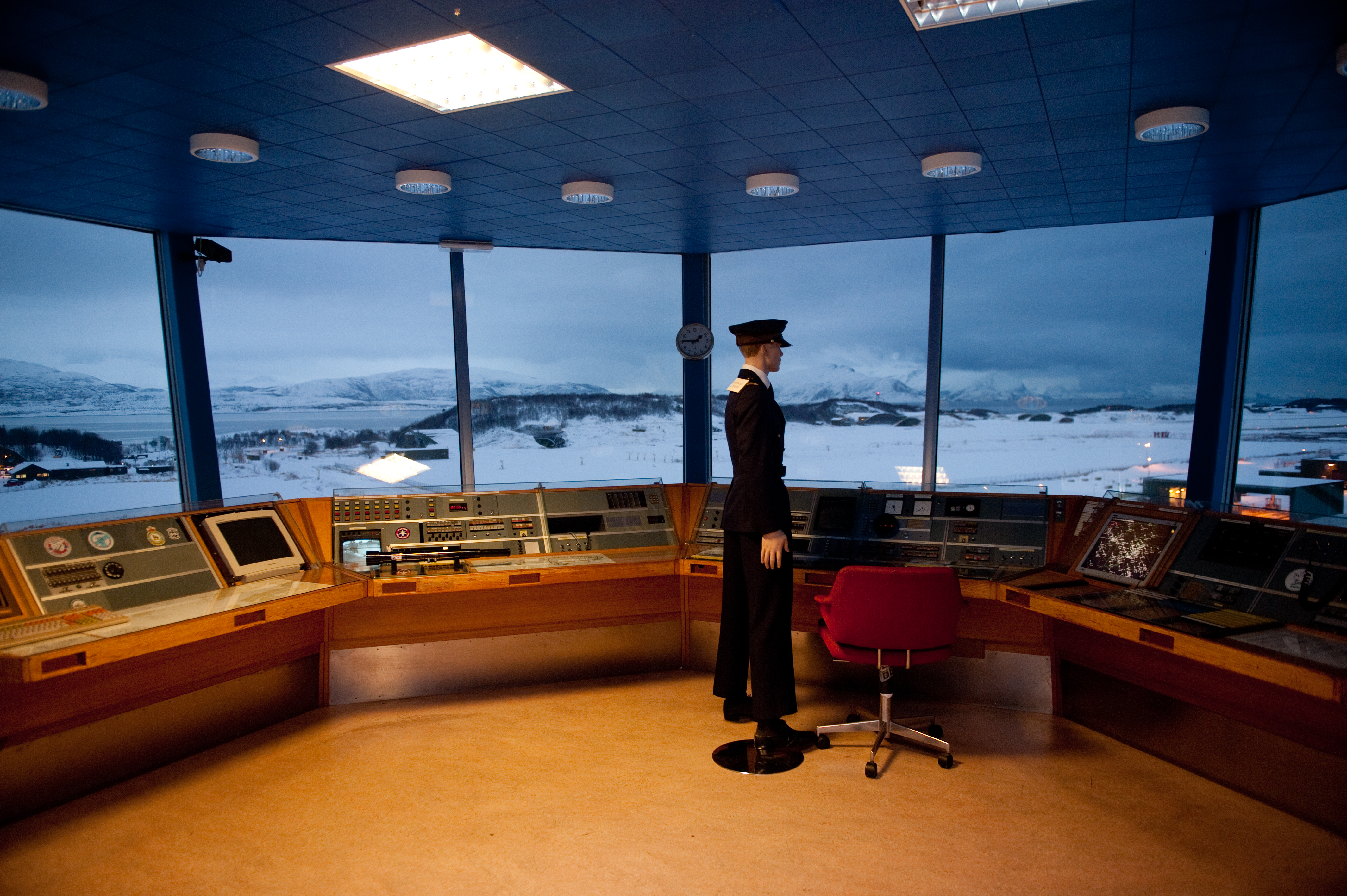
The museum's civilian wing traces Norway's aviation story from its earliest days through the development of commercial routes that connected isolated northern communities to the wider world. In a country where mountains, fjords, and vast distances made surface travel difficult or impossible, aviation was not a luxury -- it was infrastructure. Bush planes and floatplanes opened regions that had been accessible only by boat or on foot, transforming life in places like Bodø from seasonal isolation to year-round connectivity. The collection includes artifacts from regional carriers and displays on how aviation reshaped the social and economic geography of northern Norway. A former Bodø air traffic control tower, preserved within the museum, offers a tangible connection to the airport next door. Bodø Airport itself has served as both a civilian hub and a major NATO air base, and the museum does not separate these histories -- military and civilian aviation in northern Norway have always been intertwined, sharing runways, personnel, and purpose.
A Propeller Seen from Above
The museum's location, roughly 1.5 kilometers from Bodø's town center and immediately adjacent to the airport, is no accident. Visitors arriving by air can see the propeller-shaped building from their window. The proximity to a working airfield gives the museum a living context that static displays alone cannot provide -- the sound of aircraft taking off and landing is the permanent soundtrack. Inside, the collection spans from an Avro 504 trainer of the First World War era to a Westland Lynx helicopter of the modern Norwegian navy. A Consolidated PBY Catalina flying boat, the type used for maritime patrol and search-and-rescue missions along Norway's enormous coastline, anchors one section. A Petlyakov Pe-2 cockpit section recalls the Soviet front that bordered Norway's far north. In all, the museum holds more than thirty aircraft, each connected to a chapter of Norwegian aviation history. For a building shaped like a propeller in a city rebuilt from bombing rubble, the collection feels less like a static exhibit and more like an argument: that what happens in the air above a place is inseparable from the life lived on the ground below.
From the Air
Located at 67.28°N, 14.41°E in Bodø, Nordland county, Norway, immediately adjacent to Bodø Airport (ENBO). The propeller-shaped museum building is visible from the air on approach, straddling Olav V gate about 1.5 km from the city center. Bodø Airport serves as both a civilian hub and former NATO air base. The museum is on the inland side of the airport. From altitude, the distinctive building shape is best seen directly overhead. The Lofoten Islands stretch across the western horizon beyond Vestfjorden.