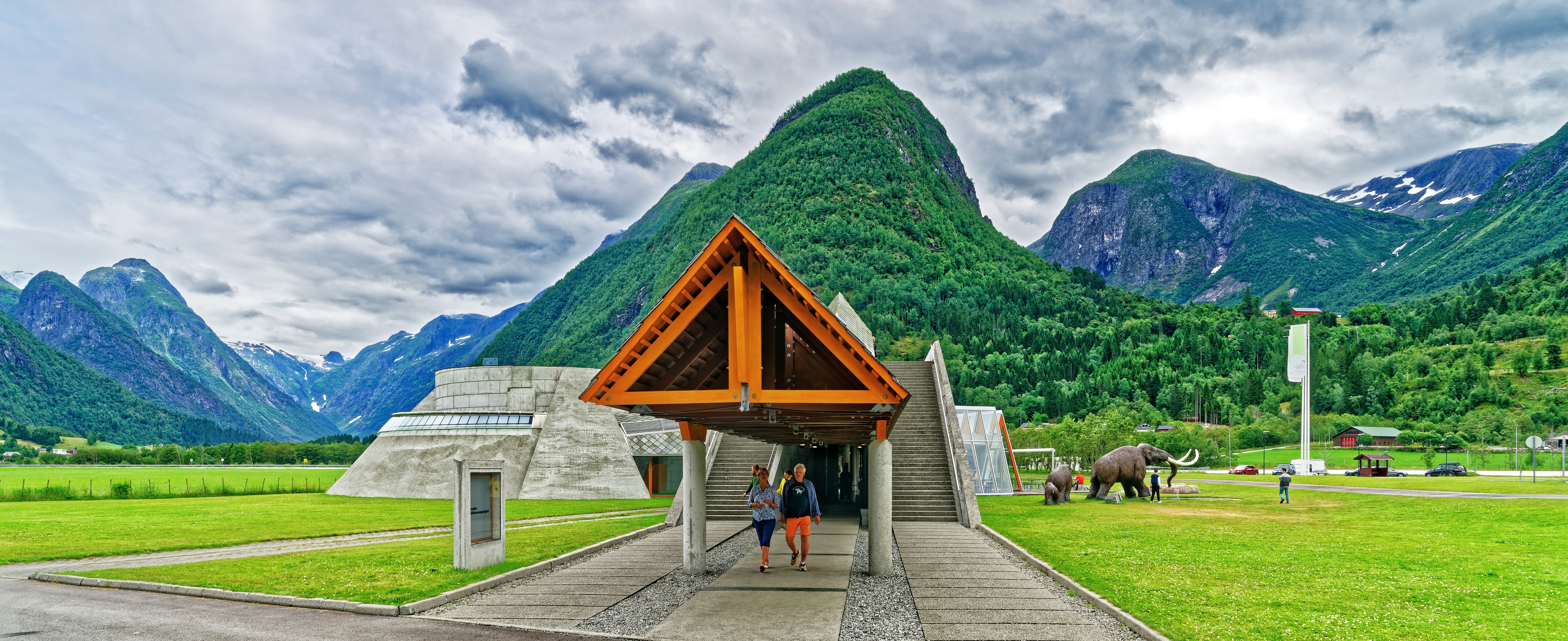
Norwegian Glacier Museum
The building looks like it fell from the mountains above it. Sharp angles of white-and-gray concrete slope and tilt against the valley floor, their geometry echoing the fractured ridgelines and glacial tongues of the landscape surrounding Fjaerland. This was deliberate. When Sverre Fehn designed the Norwegian Glacier Museum, completed in 1991, he gave the structure the irregular, angular shapes of the ice and rock it was built to explain. Fehn would go on to win the Pritzker Architecture Prize in 1997, architecture's highest honor, and the Glacier Museum is considered one of the works that earned it. The building stands on the plain carved out by the Jostedalsbreen glacier, at the mouth of the Fjaerlandsfjord, a branch of the Sognefjord. The museum exists because the glacier exists, and Fehn made sure the architecture never lets you forget that relationship.
Where Light Becomes a Building Material
Fehn was a Norwegian modernist who believed that light was as much a construction material as concrete or steel. At the Glacier Museum, daylight enters through calculated openings that shift the interior atmosphere throughout the day, turning the experience of the exhibits into something that changes with the weather and the season. The original building was joined in 2007 by the Ulltveit-Moe Climate Centre, also designed by Fehn, which extended the museum's mission from glaciology into the broader science of climate change. The addition maintains the same architectural language: angular, grounded, deferential to the landscape while refusing to blend into it. The entire complex reads as a conversation between human design and natural forces, the kind of building that makes you aware of the horizon line and the weight of the sky above the mountains.
The Glacier Next Door
The museum's subject matter is not abstract. Jostedalsbreen, mainland Europe's largest glacier, looms above Fjaerland with its arms reaching down into the surrounding valleys. The Boyabreen glacier arm is visible from the village itself, a river of ice descending between waterfalls and rock faces. The museum provides the context that transforms seeing the glacier into understanding it: how glaciers form, flow, and retreat, how they carved the fjords that define western Norway, and what their shrinking means for the future. Founded as a joint project among seven institutions, including the Norwegian Trekking Association, the Norwegian Polar Institute, and the universities of Bergen and Oslo, the museum bridges the gap between academic glaciology and public understanding. Its stated purpose is to collect, create, and disseminate knowledge about glaciers and climate, a mission that has grown more urgent as the ice it documents continues to diminish.
A Village That Found the World
Fjaerland itself is an unlikely location for a world-class museum. The village at the head of the Fjaerlandsfjord was accessible only by boat until 1986, when a road tunnel finally connected it to the outside world. The isolation preserved its character: a scattering of farms and houses in a valley where glaciers press close and the fjord provides the only flat ground. In recent decades, Fjaerland has reinvented itself as a cultural destination. The village is known as Norway's book town, with secondhand bookshops occupying old farm buildings throughout the valley. The Glacier Museum anchors this cultural identity with architecture and science, drawing visitors who come for the ice and stay for the books. In July 2007, former US Vice President Walter Mondale opened the museum's climate change exhibit, Our Fragile Climate, a moment that linked a tiny Norwegian fjord village to the global conversation about the planet's future.
Architecture as Argument
What makes the Glacier Museum exceptional is not just what it teaches but how the building itself teaches it. Fehn's design places visitors in a structure that feels geological, its concrete surfaces and angular forms creating spaces that evoke crevasses, ice caves, and exposed rock faces. The Pritzker jury praised Fehn for pursuing his vision of modernism steadily and patiently for fifty years, eschewing the clever, the novel, and the sensational. The Glacier Museum embodies that philosophy. It does not compete with its surroundings. Instead, it translates them into a language of walls and light, making the landscape legible to visitors who might otherwise drive through Fjaerland without understanding what they were seeing. The glacier, the fjord, the mountains, the museum: Fehn built them into a single experience where architecture and nature explain each other.
From the Air
Located at 61.42N, 6.76E in Fjaerland, Vestland county, at the head of the Fjaerlandsfjord, a branch of the Sognefjord. The museum building is a distinctive angular white-gray structure visible near the valley floor. The Boyabreen glacier arm of Jostedalsbreen is visible descending into the valley nearby. Nearest airport: Sogndal/Haukasen (ENSG) approximately 30 km southeast. Bergen/Flesland (ENBR) approximately 190 km south. Best viewed below 2,000 meters. The Sognefjord and Jostedalsbreen ice cap are major landmarks for orientation.