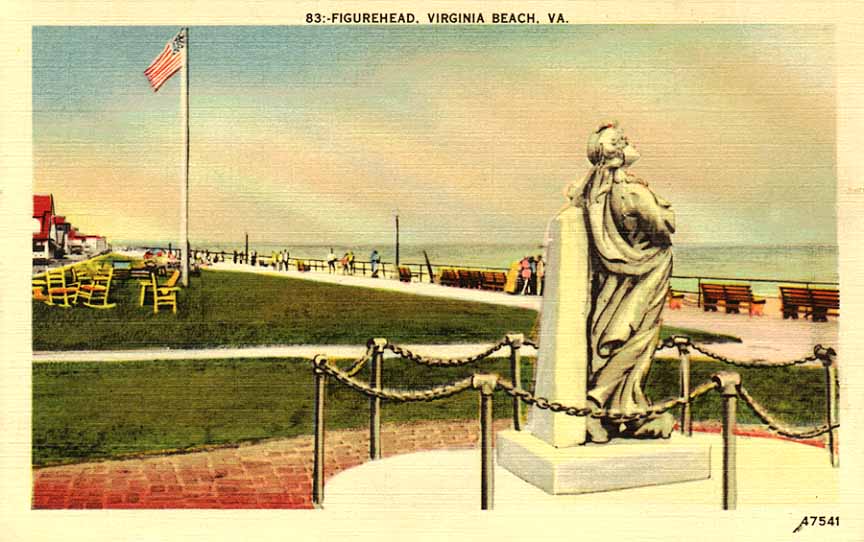
Norwegian Lady Statues
On the pedestal at Virginia Beach's oceanfront, the inscription reads: "I am the Norwegian Lady. I stand here, as my sister before me, to wish all men of the sea safe return home." Nine feet of bronze, arms at her sides, gazing east across the Atlantic toward Norway. Three thousand miles away in the coastal town of Moss, her identical twin gazes back. The two statues appear to watch each other across the ocean, though in truth their lines of sight miss by nearly ninety degrees. No matter. The bond between them is real, forged in tragedy on a Good Friday morning in 1891 when a Norwegian barque named Dictator broke apart in the surf just three hundred yards from shore.
Good Friday on the Graveyard
March 27, 1891. The Norwegian barque Dictator, homeported in Moss, Norway, had been fighting storms for days along the East Coast. She carried fifteen crew and the captain's family, hauling Georgia pine lumber from Pensacola toward West Hartlepool, England. Battered and leaking, Captain Jorgen Jorgensen turned north for Hampton Roads to make repairs. He never arrived. Gale-force winds drove the ship aground on a sandbar just south of Cape Henry, barely three hundred yards from Virginia Beach near present-day 37th Street.
Guests at the Princess Anne Hotel watched from shore. Members of the Seatack and Cape Henry Lifesaving Stations launched rescue efforts at 10:45 in the morning. The ship's two lifeboats had already been smashed when the mast and rigging crashed onto the deck. Rescuers managed to save eight of the seventeen aboard using a breeches buoy before darkness halted the operation. Johanne Jorgensen, the captain's pregnant wife, and their four-year-old son Carl drowned in a final desperate escape attempt as the ship broke apart. Five sailors also perished. Captain Jorgensen, somehow, washed ashore alive.
The Lady Who Watched the Sea
After the Dictator sank, her wooden figurehead - a carved female form, the kind once believed to ensure safe passage - washed up on the beach. A young hotel guest spotted it, and the manager of the Princess Anne Hotel retrieved it. He set it upright near the boardwalk at 16th Street, facing the ocean, an impromptu memorial to the lost.
The figurehead became known as the Norwegian Lady, and for more than sixty years she stood as Virginia Beach's most beloved landmark. She watched the tiny resort town incorporate in 1906, grow into a small city by 1923, and expand along the oceanfront through the decades. But the salt air and Atlantic storms slowly ate away at the wood. Hurricane Barbara in 1953 dealt the final blow, damaging the figurehead badly enough that it was removed to a city building for safekeeping. A few years later, when officials went looking for it, the figurehead had vanished - stolen, perhaps, or accidentally destroyed. No one ever found out.
Sisters Across the Atlantic
The loss of the figurehead sparked something unexpected. In Virginia Beach, people mourned the disappearance of their memorial. Across the ocean in Moss, where the Dictator had been homeported, the story of the lost Norwegian Lady resonated deeply. A fundraising campaign began on both sides of the Atlantic. The Norwegian Shipping Association made a substantial contribution, and the community raised enough not for one replacement, but for two.
Norwegian sculptor Ornulf Bast was commissioned to create twin nine-foot bronze statues modeled after the original figurehead. On September 22, 1962, both were unveiled - one presented as a gift to Virginia Beach, the other erected in Moss. The two cities officially became sisters in 1974. Every year on the anniversary of the wreck, the Ladies Auxiliary of the Virginia Beach Volunteer Fire Department lays a wreath at the statue's base. In 1995, Queen Sonja of Norway visited the Virginia Beach statue during a state visit and placed memorial flowers. Virginia Beach officials have traveled to Moss to pay their respects to the other Norwegian Lady.
Where the Graveyard Begins
The wreck of the Dictator was not unusual for this stretch of coast. Virginia Beach sits at the northern edge of what mariners long called the Graveyard of the Atlantic, a treacherous corridor of shallow sandbars, shifting currents, and violent storms stretching south along the Outer Banks of North Carolina. Hundreds of vessels met their end in these waters before modern navigation made the passage safer.
The Dictator's story endured where others faded because of the figurehead - that simple piece of carved wood that refused to be forgotten. First as a weathered sentinel on the boardwalk, then as a pair of bronze sisters standing vigil on opposite shores. What began as a maritime disaster became a bridge between two communities separated by an ocean but united by the memory of seventeen people on a ship that almost made it home.
From the Air
Located at 36.85°N, 75.98°W on the Virginia Beach oceanfront boardwalk. The statue stands near the intersection of the boardwalk and 25th Street, visible from low altitude along the beachfront. Virginia Beach's oceanfront stretches as a long barrier beach with the wide sandy shore clearly visible. Cape Henry and the mouth of the Chesapeake Bay are visible to the north. The approximate site of the Dictator wreck is offshore near 37th Street. Nearest airports: Norfolk International (KORF) 12nm northwest, NAS Oceana (KNTU) 6nm south. The area sits at the northern edge of the Graveyard of the Atlantic, where the Chesapeake Bay meets the open ocean.