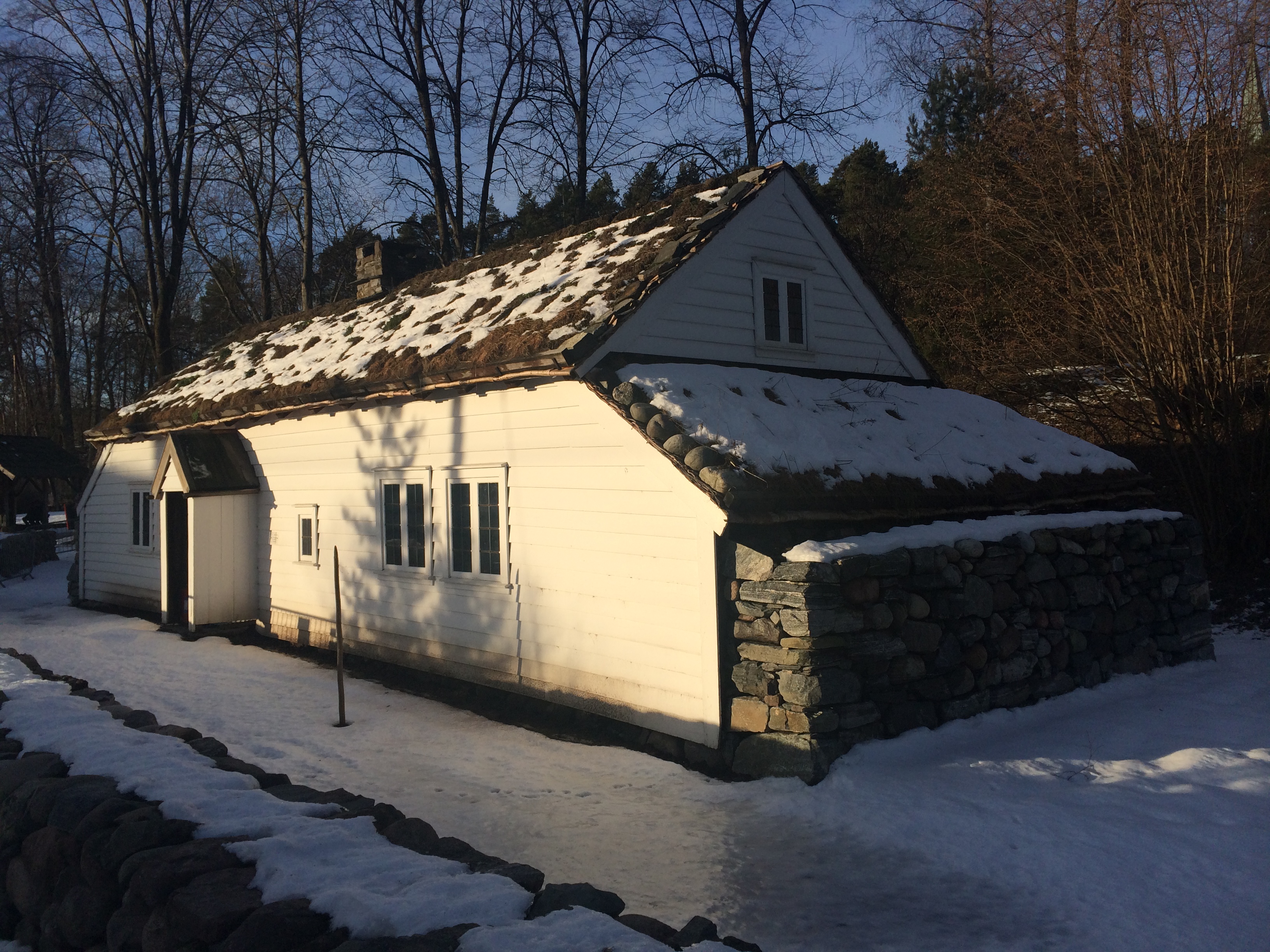
Norwegian Museum of Cultural History
One of the apartments in the Norwegian Museum of Cultural History is furnished exactly as a Pakistani immigrant family had it in 2002 -- prayer rug on the floor, satellite dish for channels from home, children's toys on the shelves. It sits inside an 1865 tenement building that was physically relocated from 15 Wessels gate in central Oslo, where seven of its nine flats display typical interiors from different periods of the 19th and 20th centuries. The juxtaposition is deliberate. This is a museum that defines Norwegian cultural history not as a finished narrative but as an ongoing one, where a medieval stave church and a Pakistani living room belong to the same story.
A Librarian's Grand Vision
Hans Aall was 25 years old when he founded the Norsk Folkemuseum in 1894. A librarian and historian, Aall recognized that Norway's rapid modernization was destroying the physical evidence of how ordinary people had lived for centuries. Rural buildings were being demolished, traditional crafts were disappearing, and the artifacts of daily life -- tools, textiles, furniture -- were vanishing into attics or onto refuse heaps. Aall spent the next half century collecting. He acquired the museum's core property in 1898 and began the painstaking work of dismantling historic buildings across Norway, transporting them to the Bygdoy peninsula, and re-erecting them on the museum grounds. By the time Aall died in 1946, still serving as director, his museum had grown into one of Europe's most important ethnographic collections, a place where an entire country's material culture had been gathered, organized, and made available to the public.
The World's First Open-Air Museum
The museum's claim to a historical first rests on its 1907 incorporation of King Oscar II's collections, which had been established on the neighboring Bygdoy royal estate in 1881. Oscar's collection of five relocated buildings, with the 13th-century Gol Stave Church at its center, is recognized as the world's first open-air museum. When the king's collections merged with Aall's growing institution, the stave church became the museum's symbolic heart. It remains nominally the property of the Norwegian monarch, though the museum manages it. Today more than 150 buildings fill the museum grounds -- log farmsteads from Osterdal, working-class houses from the former Enerhaugen settlement in Oslo, a 1904 liquor store from Holmestrand, a 1928 Standard Oil gas station, and a vicarage from Leikanger. Walking through them is less like visiting a museum than traveling through time, each building a portal to a different century, region, and social class.
From Sami Drums to Darkroom Negatives
The museum's collections extend far beyond its buildings. In 1951, the Sami collections from the University of Oslo's Ethnographic Museum were transferred to the Norsk Folkemuseum, adding an essential dimension to the institution's representation of Norwegian cultural diversity. The museum also holds a vast photographic archive, including a significant portion of the work of Anders Beer Wilse, one of Norway's most important early photographers. Wilse documented Norwegian landscapes, city life, and traditional culture from the 1890s through the 1940s, and his images now serve as primary sources for understanding the country's visual transformation over half a century. Research at the museum has historically focused on building construction and furniture, clothing and textiles, agriculture, and working-class life -- the material dimensions of how people actually lived, rather than the grand narratives of kings and wars.
Five Medieval Survivors
Among the 150-plus buildings on the museum grounds, five date to the Middle Ages, a remarkable concentration of medieval wooden architecture. The Gol Stave Church, dendrochronologically dated to between 1157 and 1216, is the most celebrated, its dragon-headed gables and carved portals representing Norway's most distinctive architectural tradition. But the 14th-century Rauland farmhouse -- the Raulandstua -- is equally revealing: a domestic building from the same era as the great stave churches, showing how ordinary families lived in timber structures insulated against Scandinavian winters. These buildings survived not by luck but by determined intervention. The Gol Stave Church was rescued from demolition by a preservation society and a king willing to fund its relocation. Each medieval structure in the collection has its own rescue story, its own near-miss with destruction.
A Living Collection
In 2004, the administration of the adjacent Bygdoy Royal Estate was transferred to the museum, expanding its responsibilities to include the management of one of Oslo's most significant green spaces. The museum sits at the center of a dense cluster of institutions -- the Viking Ship Museum, the Fram Museum, the Kon-Tiki Museum, and the Norwegian Maritime Museum are all within walking distance. But where those museums focus on specific narratives -- Viking seafaring, polar exploration, Pacific voyaging -- the Norwegian Museum of Cultural History attempts something more ambitious: a portrait of an entire society across a millennium. From the stave church's medieval carvings to the Pakistani family's satellite dish, the museum argues that culture is not a fixed inheritance but a living process, constantly remade by the people who inhabit it.
From the Air
Located at 59.907N, 10.686E on the Bygdoy peninsula in western Oslo. The museum grounds cover a large area visible from the air as a mix of green space and scattered historic buildings, with the dark wooden form of the Gol Stave Church at the center. Nearest airport is Oslo Gardermoen (ENGM), approximately 50 km northeast. The Bygdoy peninsula extends into the Oslofjord west of central Oslo and is identifiable from the air by the concentration of museum buildings along its southern shore. Recommended viewing altitude: 1,500-2,500 feet AGL.