Nosy Be
The main town is called Hell-Ville, and most visitors leave as quickly as they can -- not because it is unpleasant, but because the beaches elsewhere on the island are that much better. Nosy Be, off Madagascar's northwest coast, is the country's tourism capital, a volcanic island fringed with sand where the economy runs on sunlight, warm water, and the extraordinary biodiversity that has made Madagascar famous. It is also the gateway to a constellation of smaller islands, each with its own character: Nosy Komba for lemurs and handicrafts, Nosy Tanikely for snorkeling, Nosy Iranja for a sand spit that joins two islands at low tide, and the Mitsio archipelago for diving that draws people from across the world.
Hell-Ville and the Beaches Beyond
Hell-Ville -- officially Andoany -- is Nosy Be's port town and commercial center, a bustling place where speedboats from Ankify on the mainland discharge passengers alongside car ferries slow enough to test anyone's patience. The town has its charms, but most travelers push through to the beaches that ring the island's coast. Madirokely, on the southwest, is where the nightlife concentrates. Accommodation ranges from basic guesthouses to resorts that charge twice mainland prices and sometimes lack the conveniences that pricing implies. The currency is the Malagasy ariary, and visitors are advised to convert before departing -- there is no foreign exchange counter past check-in at the airport. Ethiopian Airlines connects through Addis Ababa, Airlink flies from Johannesburg, Air Austral routes via Reunion, and EWA Air hops from Dar es Salaam through Mayotte. For those arriving by sea, the speedboat from Ankify takes 45 minutes and costs roughly 20,000 ariary.
Lokobe and the Living Forest
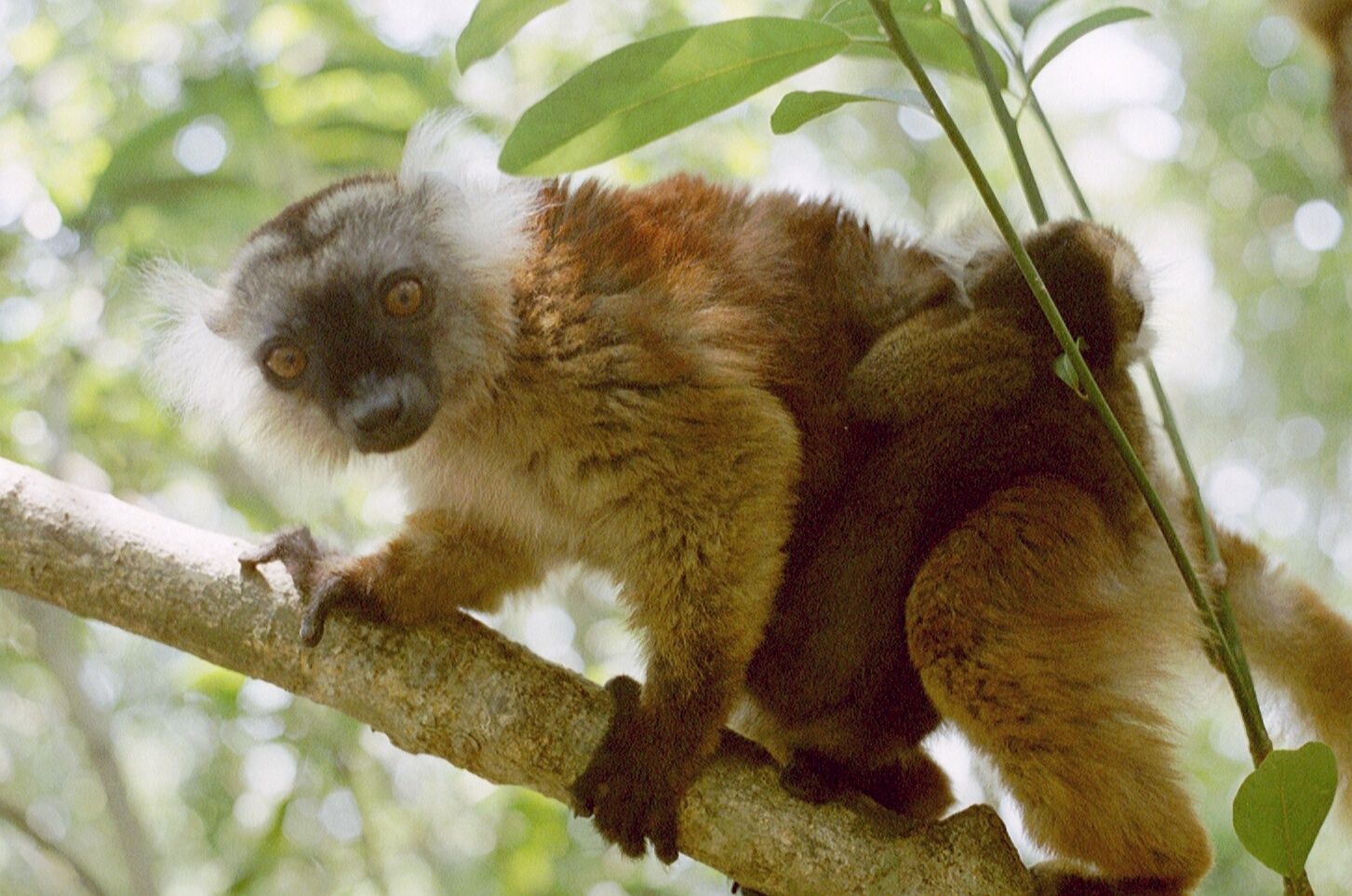
Nosy Be's interior tells a different story from its coastline. Lokobe National Park, in the island's southeast, is one of the finest remnants of Sambirano rainforest -- the moist, species-dense ecosystem unique to northwestern Madagascar. Inside, panther chameleons shift through their repertoire of colors on branches overhead. Black lemurs move through the canopy with an ease that suggests they have never heard of gravity. The park is a superb example of what Madagascar's forests contain when they are allowed to persist, and it explains why Nosy Be hosts nearly twice as many frog species as neighboring Nosy Komba, which lost most of its forest to colonial-era clearing. Beyond Lokobe, the island offers lakes, waterfalls, and sacred trees -- enormous old specimens that local communities have protected through fady, the Malagasy system of taboos that functions as an informal conservation framework. Sacred trees are not fenced or signed. They are simply left alone, which turns out to be remarkably effective.
The Satellite Islands
Nosy Be's greatest asset may be the islands it gives access to. Nosy Komba, three kilometers to the south, has no cars and no roads -- just villages, black lemurs, and a laid-back rhythm that serves as a counterpoint to Nosy Be's relative bustle. Nosy Tanikely, a tiny uninhabited marine sanctuary to the southwest, offers snorkeling that consistently ranks among the best in the Indian Ocean, with healthy coral and near-certain sea turtle sightings. Nosy Iranja, farther south, becomes a single island at low tide when a 750-meter sand spit emerges to connect its two halves -- an excursion universally described as unmissable. The Mitsio Islands to the north are world-famous among divers, and Tsarbanjina, a private island within the group, offers luxury accommodation for those with the budget. Nosy Sakatia, close to the main island, is where local villagers will teach you to weave and cook you a meal on the beach. Each island is a day trip, and together they make Nosy Be less a destination than a base camp.
Paradise with Edges
Nosy Be is not without its complications. In 2013, a vigilante mob killed two Europeans over a belief that they were responsible for the murder of an eight-year-old boy -- an incident grim enough to prompt travel warnings from France and Italy. The episode was an anomaly in what is generally a safe and welcoming place, but it served as a reminder that Nosy Be exists within Madagascar's broader social and economic realities, not apart from them. Accommodation outside Hell-Ville can be expensive and sometimes lacks basic amenities. Getting around requires taxis-brousses -- shared bush taxis -- that are cheap at around 2,000 ariary per person but operate on schedules best described as aspirational. The island's appeal endures despite these rough edges, or perhaps partly because of them. Nosy Be has not yet been polished into the seamless resort experience that erases all sense of place. What you encounter here -- the chameleons, the sacred trees, the sand spits, the complicated human stories layered beneath the tourism -- is still recognizably Madagascar.
From the Air
Located at 13.32S, 48.27E off the northwest coast of Madagascar. From altitude, Nosy Be appears as a large volcanic island with a green interior and beaches ringing the coast. Fascene Airport (FMNN) is the island's commercial airport, served by international carriers from Addis Ababa, Johannesburg, and Reunion. The satellite islands are clearly visible: Nosy Komba's prominent cone to the south, tiny Nosy Tanikely to the southwest, and the Mitsio archipelago to the north. Hell-Ville (Andoany) port is on the southern coast. The Madagascan mainland and Ankify port are visible approximately 8 km to the east.