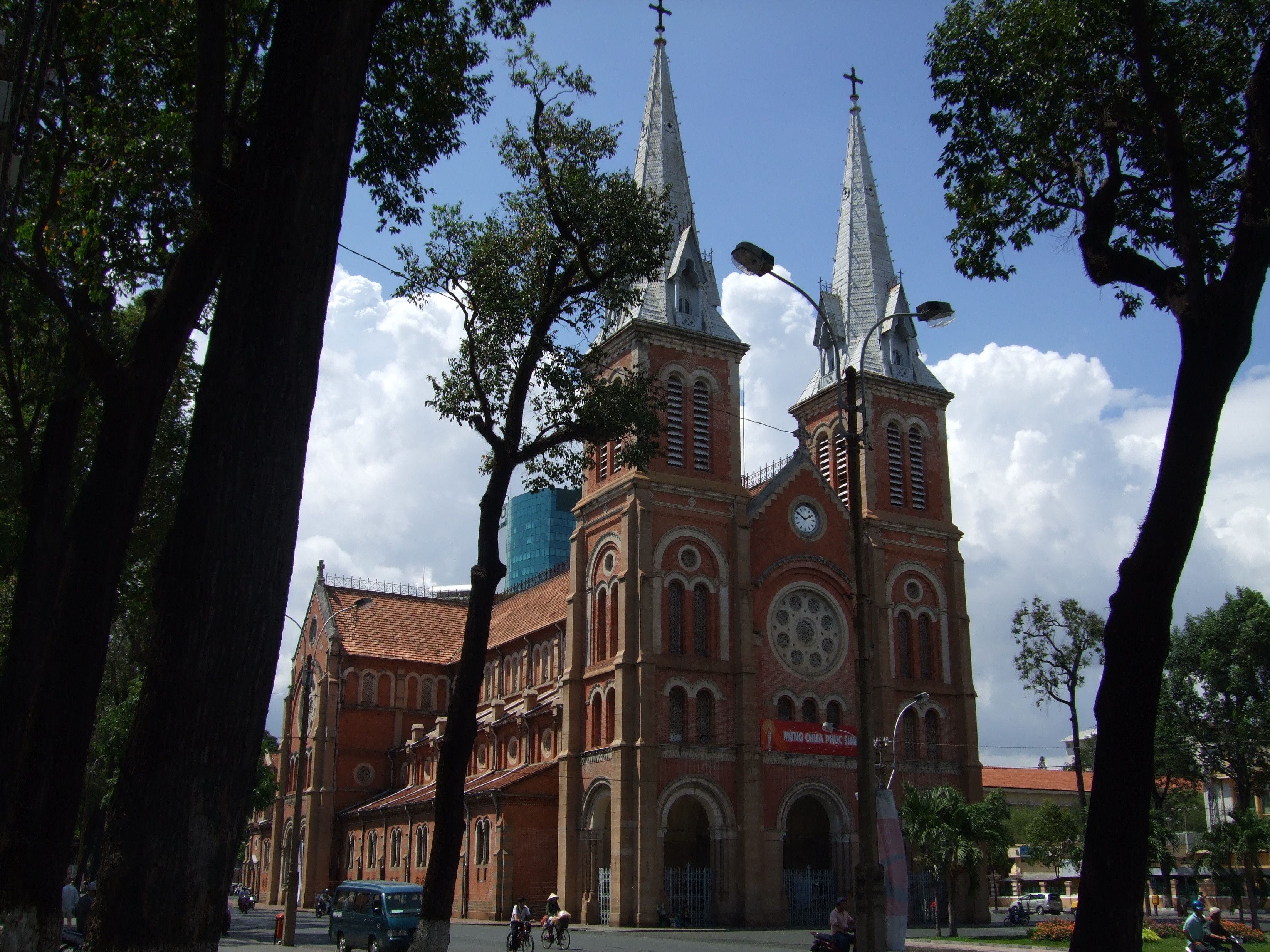
Notre-Dame Cathedral Basilica of Saigon
Every brick in the walls of Notre-Dame Cathedral Basilica of Saigon was shipped from Toulouse. Every tile was stamped with the name of its maker in Marseille. The 56 stained-glass panels came from the Lorin workshop in Chartres, the same French town whose medieval cathedral windows are among the most celebrated in the world. When the French built this church between 1877 and 1880, they imported not just a religion but an entire material vocabulary, and after nearly a century and a half in Saigon's tropical humidity, the Toulouse bricks have never been painted or coated -- they still glow the same warm red they did the day they arrived by ship.
Before the Bricks: A Wooden Church and Termites
The French conquest of Cochinchina created an immediate demand for Catholic worship spaces. The first church, built on what is now Ngo Duc Ke Street, was too small. In 1863, Admiral Bonard ordered a wooden church constructed on the bank of the Charner Canal, and Bishop Lefevre laid the first stone on March 28 of that year. The wooden building served as Saigon's primary church for over a decade, until termites devoured its structure. With no usable church, services moved into the guest chamber of the French Governor's Palace, which doubled as a seminary. It was an undignified arrangement for a colonial power that saw Catholicism as central to its civilizing mission, and the decision to build something permanent -- something monumental -- followed naturally. A design competition produced a winning bid from J. Bourard, and three possible sites were considered before the present location was selected.
2.5 Million Francs of Imperial Ambition
Bishop Isidore Colombert laid the cathedral's first stone on October 7, 1877. Three years of construction later, on Easter Day 1880 -- April 11 -- the completed cathedral received its blessing in the presence of Charles Le Myre de Vilers, Governor of Cochinchina. The total cost reached 2,500,000 French francs, all from state funds, which is why locals initially called it the State Cathedral. The building's engineering was as ambitious as its budget: the foundation was designed to bear ten times the weight of the structure above it. In 1895, two bell towers were added, each rising 57.6 meters and housing six bronze bells with a combined weight of 28.85 metric tonnes. Iron crosses crown each tower -- 3.5 meters tall, 2 meters wide, 600 kilograms each -- bringing the cathedral's total height to 60.5 meters. For decades, those twin spires were the tallest structures in Saigon.
The Statue That Changed the Name
For its first eight decades, the cathedral was simply the Church of Saigon. A bronze statue of Pigneau de Behaine, the French bishop who helped Emperor Gia Long consolidate his dynasty, once stood in the forecourt garden, depicted leading the emperor's young son Prince Canh by the hand. That statue was removed in 1945, leaving an empty pedestal. It stayed empty for fourteen years. In 1959, Bishop Joseph Pham Van Thien attended the Marian Congress in Vatican City and commissioned a granite statue of Our Lady of Peace to be carved in Rome. When it arrived in Saigon on February 16, 1959, the bishop installed it on the vacant base and gave it the title "Regina Pacis" -- Queen of Peace. He personally wrote the prayer inscribed beneath it: "Notre-Dame, bless the peace to Vietnam." The next day, Cardinal Agagianian traveled from Rome to preside over the closing ceremony of the Marian Congress and consecrate the statue. From that moment, the church bore the name Notre-Dame Cathedral.
Tears on the Right Cheek
In October 2005, visitors reported something extraordinary: the granite statue of Our Lady of Peace appeared to be weeping. A visible streak, described as a tear, ran down the right cheek of the Virgin Mary's face. Within hours, thousands of people gathered around the cathedral, and authorities had to close surrounding streets to manage the crowd. The senior clergy of the Catholic Church in Vietnam investigated but could not confirm a miraculous origin for the phenomenon. Their caution did nothing to thin the crowds, which continued to flock to the statue for days. Whether moisture, condensation, or something beyond explanation, the incident revealed how deeply the cathedral remains embedded in the spiritual life of the city -- no longer a colonial import but a genuinely Vietnamese sacred space.
Brick, Glass, and Borrowed Light
Walk inside and you enter a space defined by materials that crossed an ocean. The floor tiles, carved with the words "Guichard Carvin, Marseille St Andre France," name the Marseille district where they were fired. Some tiles bear a different inscription -- "Wang-Tai Saigon" -- replacements manufactured locally after war damage. The 56 stained-glass panels from the Lorin workshop in Chartres filter tropical sunlight into the same jeweled tones their designers intended for the gray skies of northern France, and the effect in Saigon's equatorial brightness is even more intense. Pope John XXIII elevated the cathedral to basilica status in 1962, making it one of the few basilicas in Southeast Asia. As of 2025, the building is undergoing renovation -- a process complicated by the same quality that makes it remarkable: nearly every original component was imported from France, making authentic restoration a logistical puzzle that spans two continents.
From the Air
Notre-Dame Cathedral Basilica sits at 10.780N, 106.699E in the heart of District 1, Ho Chi Minh City. The twin 57.6-meter bell towers topped with iron crosses are identifiable from the air, rising above the surrounding urban landscape near the intersection of Le Duan Boulevard and Hai Ba Trung Street. The cathedral faces Paris Commune Square. Tan Son Nhat International Airport (VVTS) is approximately 7 km northwest.