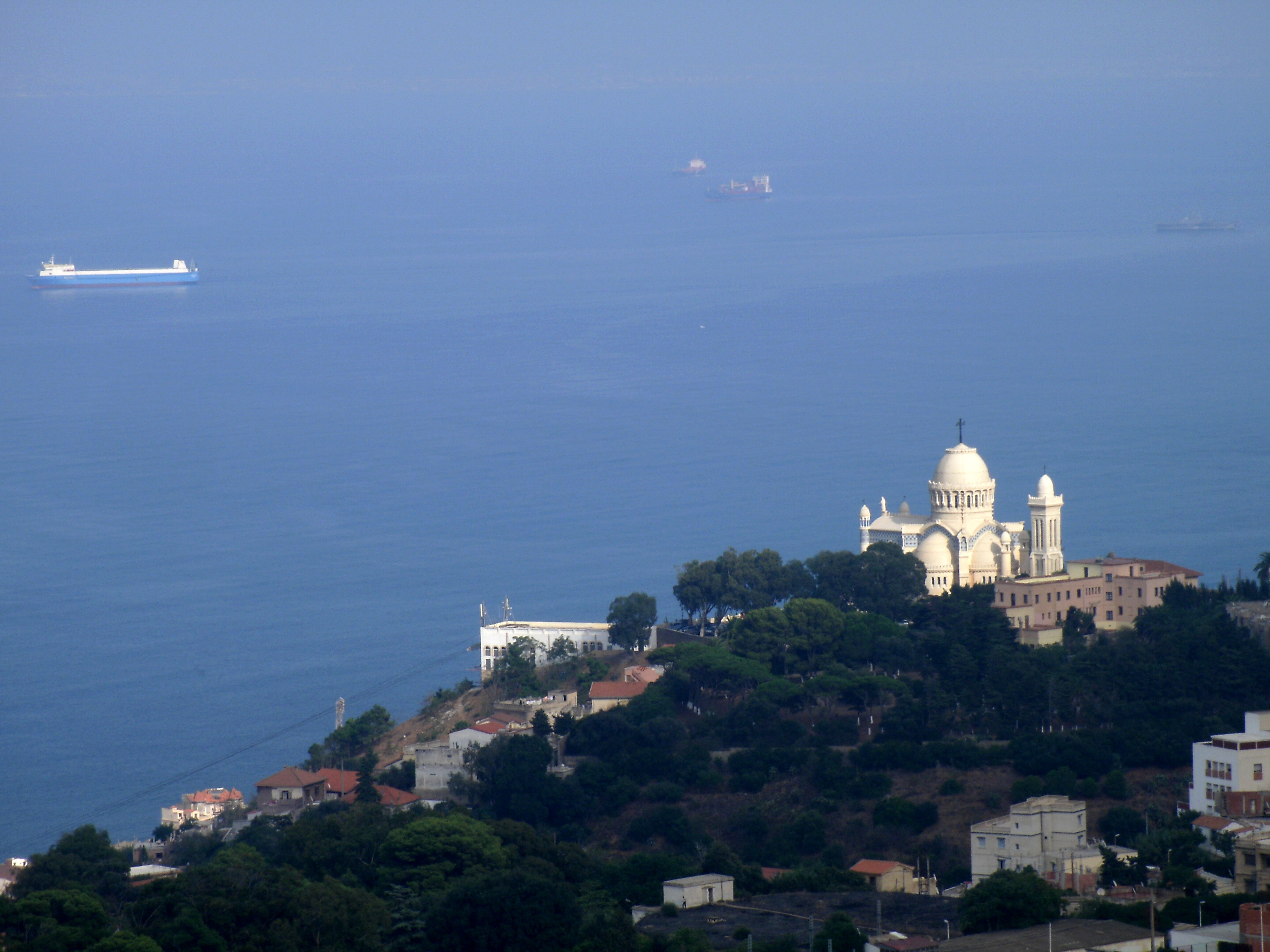
Notre-Dame d'Afrique
Carved into the apse of a basilica perched 124 meters above the Bay of Algiers, an inscription reads: Notre Dame d'Afrique priez pour nous et pour les Musulmans -- "Our Lady of Africa, pray for us and for the Muslims." In a city where the colonial era left deep scars, where churches were repurposed and religious tensions simmered for generations, these words have endured since the 19th century. They remain the most concise expression of what this building has always tried to be: a place where the Mediterranean's fractured faiths might find common ground.
Fourteen Years of Stone
The basilica was the vision of Louis-Antoine-Augustin Pavy, Bishop of Algiers from 1846 to 1866, who championed its construction on the northern cliffs of the city. Architect Jean-Eugene Fromageau, appointed chief architect for ecclesiastical buildings in French Algeria in 1859, chose a Neo-Byzantine style that drew from the eastern Mediterranean rather than the Gothic traditions of metropolitan France. The choice was deliberate -- a recognition that this church belonged to Africa, not Europe. Fourteen years of construction followed, and the basilica was inaugurated in 1872 under the patronage of Charles Lavigerie, who would later crown its venerated Marian image with papal authority in 1876. Pope Pius IX elevated the sanctuary to basilica status that same year, and the building became the origin of the modern Catholic devotion to Our Lady of Africa.
Shattered Glass, Borrowed Music
The basilica's 46 stained glass windows, installed in the 19th century, were blown out during a bombing in April 1943 and have been restored twice since the end of World War II. The building has survived not only wartime damage but also the 2003 Boumerdes earthquake, which left cracks severe enough to require a 5.1-million-euro restoration project initiated by Archbishop Henri Teissier. That project, delayed until 2007, took three years to complete. Among the building's quieter treasures is an organ built in 1911 and donated in 1930 by the wife of Albert Weddell, a wealthy English resident of Algiers whose friendship with the French composer Camille Saint-Saens had led Saint-Saens to inaugurate the instrument at Weddell's home before it found its permanent place in the basilica.
The Cliff and the Mirror
Notre-Dame d'Afrique sits on the north side of Algiers, on a cliff that drops to the Mediterranean. The city once connected it to the center by cable car, though that link no longer operates. From the basilica's terrace, the Bay of Algiers spreads below in a wide arc, the white buildings of the city stacked against the hillside. The church is sometimes described as the counterpiece to Notre-Dame de la Garde in Marseille -- two basilicas facing each other across the Mediterranean, two port cities linked by history, migration, and faith. The parallel is apt. Both sit on commanding heights. Both watch over harbors that have carried people in both directions for centuries.
Still Open, Still Praying
Today the basilica hosts cultural activities alongside its religious services -- concerts, exhibitions, gatherings that draw from the broader community rather than the diminished Catholic population of post-independence Algeria. The building endures as something more than a church. It is a monument to the possibility, however fragile, of coexistence in a region where that word has often meant little. The inscription on the apse does not qualify its prayer or hedge its welcome. It asks intercession for Christians and Muslims alike, in a single breath, carved in stone above the altar of a basilica that has outlasted the empire that built it.
From the Air
Located at 36.80N, 3.04E on the northern cliffs of Algiers, 124 meters above the Bay of Algiers. The white Neo-Byzantine dome is a prominent visual landmark when approaching from the sea. Nearest airport: DAAG (Houari Boumediene Airport), approximately 20 km southeast. Best viewed at 1,500-2,500 feet from over the bay.