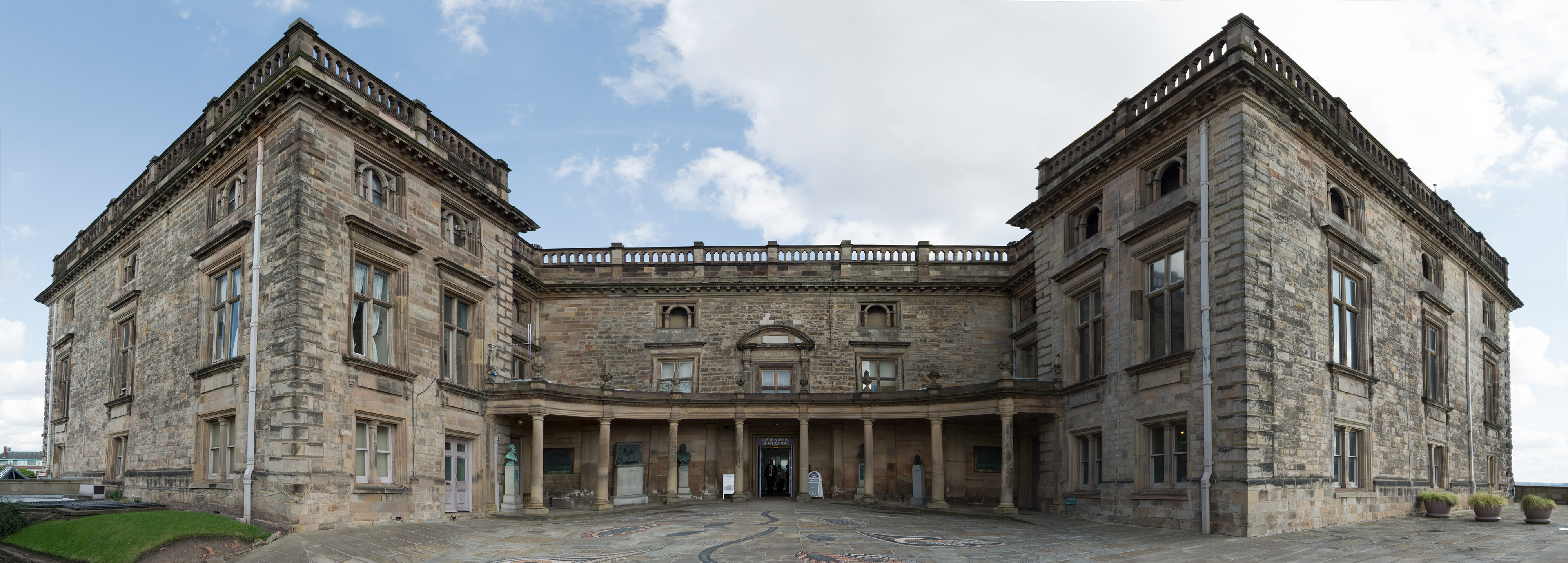
Nottingham Castle
On the night of 19 October 1330, a group of armed men entered a tunnel beneath Nottingham Castle. They climbed through the dark, emerged through a door that had been secretly unlocked, overpowered the guards, and seized Roger Mortimer -- the most powerful man in England -- from the room where he slept beside the Queen Mother. The leader of this conspiracy was seventeen years old. He was King Edward III, and he was taking back his throne. The tunnel, carved through Castle Rock's sandstone, still exists. It is one of many layers at a site where Norman fortification, Robin Hood legend, ducal ambition, mob violence, and modern financial collapse have accumulated over nearly a thousand years.
The Rock and the Conqueror
The strategic logic of Nottingham Castle begins with geology. Castle Rock is a natural sandstone promontory rising 130 feet above the city, with sheer cliffs to the south and west. William the Conqueror recognized its value immediately after the Battle of Hastings, ordering a wooden motte-and-bailey castle built there in 1068. Henry II replaced it with stone, creating a complex fortress of three baileys -- upper, middle, and outer -- that became one of England's most important royal strongholds. Its position near a crossing of the River Trent made it strategically vital, while its proximity to the royal hunting grounds of Sherwood Forest made it a place of leisure too. In the legends of Robin Hood, Nottingham Castle is the seat of the Sheriff and the scene of the outlaw's final showdown. The legends drew on real history: when Richard the Lionheart returned from the Third Crusade in 1194, he found the castle held by supporters of his rebellious brother Prince John. Richard besieged it with siege machines modeled on those he had used in the Holy Land. The garrison surrendered within days.
A Young King's Tunnel
The coup of 1330 was the castle's most dramatic moment. Edward III had been king in name since the murder of his father, Edward II, but real power lay with his mother Isabella of France and her lover Roger Mortimer. The young king's allies, led by Sir William Montagu, needed a way past Mortimer's guards. William Eland, the castle's overseer, knew of a secret tunnel through the rock. On the night of 19 October, Montagu and his companions crept through the passage, climbed to a door that Edward or a trusted servant had unlocked, and burst into Mortimer's quarters. They killed his personal guards, bound and gagged Mortimer, and dragged him out through the tunnel. He was sent to the Tower of London and hanged a month later. Isabella was forced into retirement. Edward III's personal reign had begun. A chronicle written around 1331 recast the tunnel in Arthurian terms, describing it as carved by Lancelot to hide Guinevere from King Arthur -- what may be the earliest surviving reference to their adultery.
Fire, Slums, and Cigarette Packets
By the 17th century the medieval castle was obsolete. Charles I raised his standard at Nottingham in 1642 to begin the Civil War, but the castle was held by Parliamentarians under Colonel John Hutchinson, who repulsed every Royalist attack. After the king's execution, the castle was razed in 1651. What stands on Castle Rock today is not a castle at all but a ducal mansion, built in the 1670s for the 1st Duke of Newcastle in an Italianate style influenced by Rubens's engravings of Genoese palaces. Ian Fleming, in Thunderball, described its image on millions of Player's cigarette packets as 'that extraordinary trademark of a dolls house swimming in chocolate fudge.' The mansion's elegant days ended violently. By the early 19th century, Nottingham's slums were among the worst in the British Empire. When the 4th Duke of Newcastle opposed the Reform Bill of 1832, rioters from those slums burned his mansion to the ground in October 1831. The gutted shell stood as a ruin for over forty years.
Museum, Collapse, and Rebirth
In 1875, the architect Thomas Chambers Hine restored the mansion, and three years later the Prince of Wales opened it as Nottingham Castle Museum -- the first municipal art gallery in the UK outside London. The interior was redesigned with a top-lit picture gallery modeled on the Grand Gallery of the Louvre, ignoring the original floor plan entirely. The museum housed an eclectic collection: 15th-century Nottingham alabaster carvings, Roman votive offerings from the Temple of Diana at Lake Nemi, and works by Bonington, Delacroix, and L.S. Lowry. On Christmas Day 1996, a leaking water main caused 80 tonnes of earth and retaining wall to collapse from the terrace, revealing fragments of the original castle foundations beneath. A major renovation beginning in 2018 cost 30 million pounds. When the site reopened in 2021 under the newly formed Nottingham Castle Trust, it lasted barely seventeen months before the trust went into liquidation, owing the city council 2.68 million pounds. The castle closed again. It reopened in June 2023 under council management -- the latest chapter in a history defined by cycles of ambition, destruction, and uncertain renewal.
From the Air
Nottingham Castle sits at 52.95°N, 1.15°W on Castle Rock, a prominent sandstone promontory rising 130 feet above the city of Nottingham. The Italianate ducal mansion on the summit is visible from lower altitudes. East Midlands Airport (EGNX) is approximately 12nm to the southwest. The River Trent flows to the south of the city.