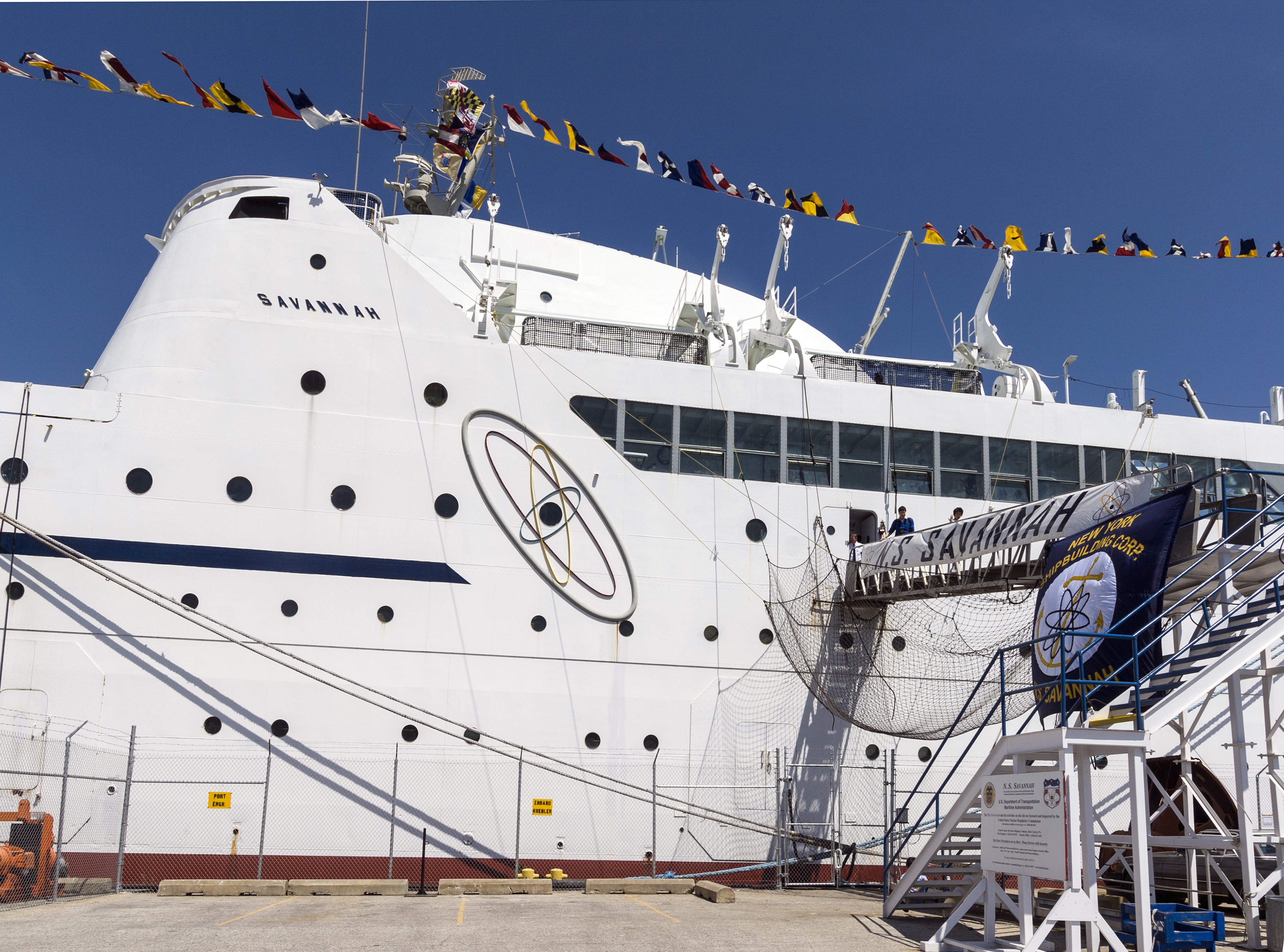
NS Savannah
She was christened by a First Lady, powered by split atoms, and designed to prove that nuclear energy could serve peace instead of war. NS Savannah slid into the water on July 21, 1959, carrying on her sleek white hull the full weight of Cold War optimism. Built at a cost of $46.9 million -- $28.3 million of that for the reactor and fuel core alone -- she was the first nuclear-powered merchant ship ever constructed, a floating demonstration project meant to show the world what American ingenuity could do when it turned away from bombs. Named after the SS Savannah, the first steamship to cross the Atlantic, this new Savannah bore a new prefix: "NS" for Nuclear Ship, replacing the traditional "SS" forever in the maritime lexicon.
Atoms for Peace, Steel for the Sea
The idea was President Dwight D. Eisenhower's. In 1955, he proposed building a nuclear-powered merchant vessel as a centerpiece of his Atoms for Peace initiative, a program designed to redirect nuclear technology toward civilian purposes at a time when the world lived in fear of the bomb. Congress authorized the project the following year, and three agencies -- the Atomic Energy Commission, the Maritime Administration, and the Department of Commerce -- joined forces to make it real. George G. Sharp, Inc. drew up the plans. The New York Shipbuilding Corporation in Camden, New Jersey, laid the keel. Babcock & Wilcox built the reactor. On a summer day in 1959, First Lady Mamie Eisenhower smashed the bottle against the bow, and Savannah was born.
A Reactor at Sea
What set Savannah apart was not just symbolism but engineering. Her reactor contained 32 fuel elements, each holding 164 fuel rods clad in stainless steel and packed with uranium oxide pellets enriched to an average of 4.4 percent U-235. Twenty-one control rods could be fully inserted in just 1.6 seconds by electric drive. A conscious decision was made to design the propulsion system to commercial standards with no connection to military programs -- this would be a civilian ship, through and through. The turbines were specially adapted for the saturated steam produced by a nuclear source. Emergency backup systems included a diesel generator and an electric motor geared to the high-pressure turbine, upgraded to provide enough torque to move the ship away from a pier in the event of a reactor accident. She was one of only four nuclear-powered cargo ships ever built.
The World Tour
Full reactor power came in April 1962, and Savannah set sail on her maiden voyage that August, heading first to her namesake city of Savannah, Georgia. The trip was not without drama: a faulty instrument triggered a reactor shutdown that was breathlessly misreported as a major accident. She pressed on through the Panama Canal, visited Hawaii and the West Coast, and spent three weeks as a star attraction at the Century 21 Exposition in Seattle. In 1963, a labor dispute in Galveston, Texas, over compensation for nuclear-qualified engineers led to a reactor shutdown and crew strike, forcing a change of operators. That summer she crossed the Atlantic for the first time, calling at Bremerhaven, Hamburg, Rotterdam, Dublin, and Southampton. Some 150,000 people toured the ship during that European visit alone.
Twilight of an Atomic Dream
Savannah operated between 1962 and 1972, but the economics of nuclear merchant shipping never quite worked out. The ship was always more ambassador than workhorse. After decommissioning, she drifted through decades of bureaucratic limbo. She was listed on the National Register of Historic Places in 1982 and designated a National Historic Landmark in 1991 -- well ahead of the usual fifty-year waiting period -- because of her exceptional significance as one of the most visible and intact examples of the Atoms for Peace program. By 2020, she had returned to Baltimore, where she rests today. In December 2023, the Maritime Administration announced plans to decommission the nuclear power plant entirely, terminating her NRC license and opening the door for potential preservation or conveyance to a new steward.
Baltimore's Atomic Relic
NS Savannah sits in Baltimore's harbor at roughly 39.26 degrees north, 76.56 degrees west, her distinctive white profile visible from the waterfront. Residual radiation levels were reported as very low in 2011, but the reactor and ship remain under regulation until 2031. She is a vessel out of time -- a sleek ambassador from an era when the atom promised a brighter future, before the economics of nuclear power and the complexities of crewing and regulation brought the dream to an end. Only three other nuclear merchant ships were ever built worldwide. Savannah remains the most intact, the most visited, and the most storied of them all. Her fate is still being written.
From the Air
NS Savannah is berthed in Baltimore Harbor at approximately 39.258°N, 76.555°W. From the air, look for a distinctive white-hulled cargo vessel in the harbor area south of Canton and east of the Inner Harbor. The ship's elongated profile and white superstructure are identifiable at lower altitudes. Baltimore/Washington International (KBWI) is approximately 10 nm south. Martin State Airport (KMTN) lies about 8 nm to the northeast. The Inner Harbor, Fort McHenry, and the Francis Scott Key Bridge site are all visible nearby landmarks.