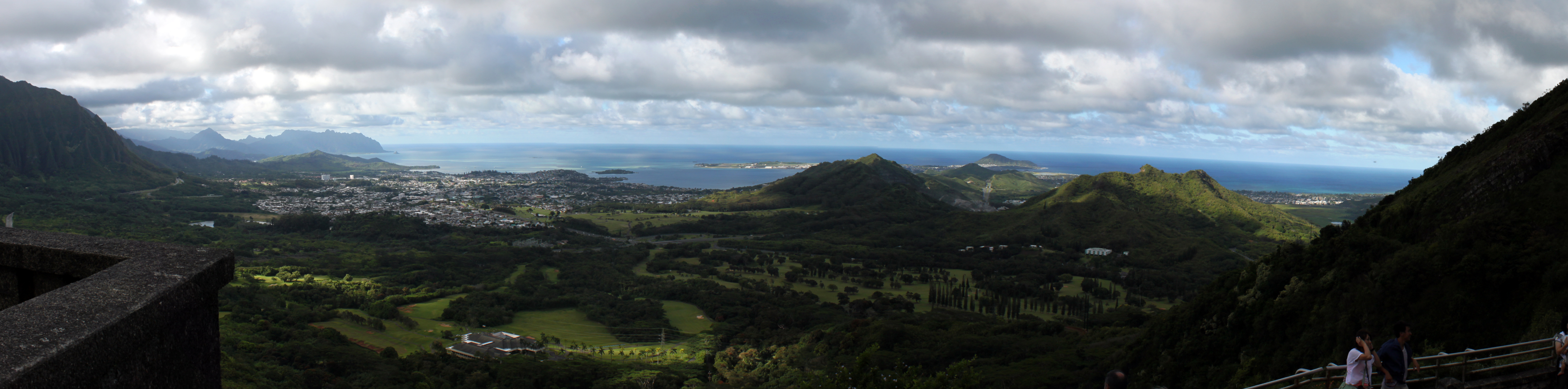
Nuʻuanu Pali
In 1898, workers widening the road over the Nuuanu Pali unearthed 800 human skulls. They had been lying in the undergrowth for a century, the remains of warriors who were driven off the cliff's edge during one of the bloodiest battles in Hawaiian history. The skulls confirmed what oral tradition had always maintained: this narrow gap in the Koolau Mountains, where trade winds howl through at speeds that can flatten a person, was a place where the fate of an island was decided in a single afternoon.
The Battle That Unified an Island
In 1795, Kamehameha I sailed from his home island of Hawaii with an army of 10,000 warriors, including a handful of foreign advisors and Western weapons. He had already conquered Maui and Molokai. Oahu was next. The island's defenders, led by Chief Kalanikupule, made their stand in Nuuanu Valley, a lush corridor that narrows as it climbs toward the Koolau ridge. Kamehameha's forces pushed them steadily upward, compressing the battle into an ever-tighter space. At the head of the valley, the cliff drops away -- a sheer pali with no retreat. Roughly 400 of Kalanikupule's warriors were forced over the edge or leapt rather than surrender. The Battle of Nuuanu gave Kamehameha control of Oahu and was a decisive step in his unification of the Hawaiian Islands under a single kingdom.
Guardians, Ghosts, and Forbidden Pork
The Pali has accumulated layers of legend as thick as the moss on its rocks. Two large stones near the back of Nuuanu Valley, called Hapuu and Ka-lae-hau-ola, were believed to represent a pair of goddesses who guarded the pass. Travelers left offerings of flowers or kapa -- bark cloth -- to ensure safe passage, and parents buried the umbilical cords of newborns beneath the stones for protection against evil. The pass is also said to be home to a moo wahine, a lizard spirit who takes the form of a beautiful woman and lures male travelers to their deaths off the cliff. Perhaps the most widely observed superstition involves pork: Hawaiian folklore holds that you should never carry it over the Pali, especially at night. The prohibition traces to the rivalry between the volcano goddess Pele and the half-pig god Kamapuaa. Pele would not allow his form -- even as cooked meat -- to cross into her territory.
A Thousand Years of Footsteps
Long before the battle, the Pali served as one of the few traversable crossings in the Koolau range, connecting leeward Honolulu with windward Kailua and Kaneohe. Villages grew along the route, populating Nuuanu Valley for a thousand years. The ancient trail began at Kalanikahua and wound past Kaumakapili Church, along taro patches and streams, up through forest to the gap in the ridge. In 1845, the first formal road was built over the pass. It remained the primary route until 1959, when the Pali Highway and its tunnels bored through the cliff rendered the old road obsolete. Today, the decaying remnants of that old road make for a popular hike through thick tropical vegetation, with roots cracking through the asphalt and the canopy closing overhead.
Standing in the Wind
The Nuuanu Pali Lookout sits above the highway tunnels at roughly 1,200 feet elevation, and the experience of standing there is as much physical as visual. Trade winds funnel through the gap with enough force to hold an outstretched jacket like a sail. On strong days, the gusts can genuinely stagger visitors. The panoramic view from the lookout sweeps across the entire windward coast of Oahu -- the town of Kailua, the turquoise expanse of Kaneohe Bay, and the deeply corrugated green ridges of the Koolau range stretching north and south. Clouds often pile against the mountains here, and the light shifts constantly. Jimi Hendrix named a track on his posthumous 1971 album Rainbow Bridge "Pali Gap," translating the Hawaiian into English. The gap deserves the tribute: it is one of those rare places where geology, history, and weather converge with such intensity that you feel all three at once.
From the Air
Located at 21.370N, 157.797W on the Koolau ridge of Oahu. The Pali gap is a prominent notch in the mountain range visible from both the windward and leeward sides. Expect turbulence and strong updrafts near the pass due to trade wind compression. The Nuuanu Pali Tunnels are visible below the lookout. Honolulu International Airport (PHNL) is 7 miles to the southwest. Marine Corps Base Hawaii (PHNG) at Kaneohe Bay is 5 miles to the northeast on the windward side.