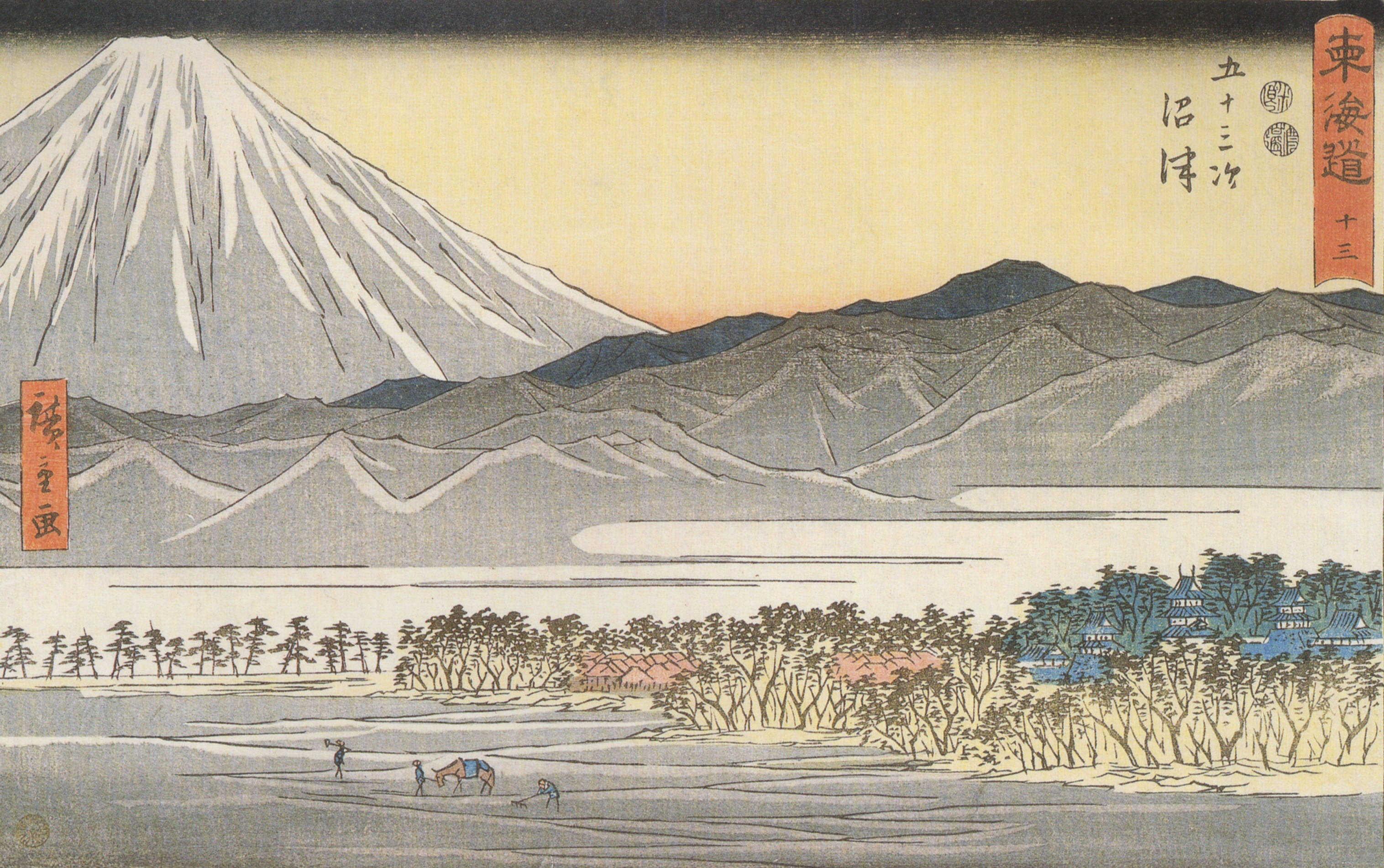
Numazu Castle
Where the foothills of Mount Fuji crowd down toward the Pacific, leaving only a narrow corridor between mountain and ocean, travelers on the Tokaido highway had no choice but to pass through Numazu. Whoever held this bottleneck at the northern tip of the Izu Peninsula controlled the main artery between Kyoto and Edo. Takeda Shingen understood this when he built a fortress here in the Sengoku period. The Tokugawa shogunate understood it when it stationed the Mizuno clan here for eight generations. And the Meiji government understood it well enough to tear the whole thing down in 1873, fill in the moats, and sell off the land. Today, a small park with a monument and a fragment of old stone wall are all that remain of a castle that was built, abandoned, rebuilt, and finally erased beneath the streets of modern Numazu.
The Tiger of Kai's Gambit
The original fortress at this site was not called Numazu Castle. It was Sanmaibashi Castle, built by Takeda Shingen during the Sengoku period as a defensive position against the Odawara Hojo during his invasion of Suruga Province. Shingen designed it with three concentric enclosures, each ringed by moats fed from the Kano River, with umadashi-style gates that forced attackers through narrow, deadly approaches. The castle proved its worth in 1578, after the death of the great Uesugi Kenshin threw regional alliances into chaos. Takeda Katsuyori, Shingen's son and heir, held Sanmaibashi Castle against repeated Hojo assaults launched from nearby Nagahama Castle. The fortress Shingen had designed as a shield held firm.
Changing Hands, Changing Fortunes
The defeat of the Takeda clan in 1582 by the combined forces of Oda Nobunaga and Tokugawa Ieyasu sent Sanmaibashi Castle into a long decline. Ieyasu held it briefly until Toyotomi Hideyoshi transferred him to the Kanto region in 1590 and gave Numazu to Nakamura Kazuuji, one of Hideyoshi's retainers. After the Battle of Sekigahara in 1600, Ieyasu reclaimed his old Suruga territories and placed his veteran general Okubo Tadasuke in command at Numazu in 1601. But Okubo died without an heir in 1613, his domain was abolished, and Sanmaibashi Castle was left to crumble. For over 150 years, the fortress that Shingen built sat abandoned, its moats silting up, its earthworks slowly dissolving back into the landscape.
A Castle for Peaceful Times
In April 1777, the former wakadoshiyori Mizuno Tadatomo received orders to relocate from Ohama Domain in Mikawa Province to Numazu, bringing revenues of 20,000 koku and authorization to build a castle. He chose the ruins of Sanmaibashi Castle as his site, but the fortress he built bore little resemblance to Shingen's war machine. This was the era of the "Great Peace" under Tokugawa rule, and the new Numazu Castle occupied only a portion of the old footprint, ignoring the former third bailey entirely. Its defenses were nominal -- the Tokaido highway ran directly between the castle and the Kano River, a configuration no Sengoku-era builder would have tolerated. Eight generations of the Mizuno clan lived here as their domain revenues grew to 50,000 koku, governing a prosperous post town on Japan's most important road.
From Samurai Fortress to Military Academy
The Meiji Restoration swept the Mizuno clan away in 1868 when the new government abolished Numazu Domain and created Shizuoka Domain for the retired ex-Shogun Tokugawa Yoshinobu. The castle found an unexpected second life that December as the home of the Numazu Military Academy, one of the first Western-style public schools in Japan and a forerunner of the Imperial Japanese Army Academy. For three years, the walls that once housed feudal lords sheltered cadets learning Western military science. But the reprieve was brief. In 1873, the Meiji government ordered the dismantling of all castles and fortifications across Japan. Numazu Castle was torn apart, its moats filled with rubble, its land parceled off and sold.
Buried Beneath the City
The destruction was thorough. Unlike many Japanese castles that left behind dramatic stone foundations or reconstructed towers, Numazu Castle simply disappeared under the growing city. Streets and buildings covered the site where three concentric moats once ringed Shingen's fortress and where the Mizuno clan held court for nearly a century. Today, a small park marks the location of the donjon in the inner bailey, and a short section of stone wall from the original Sanmaibashi Castle moats survives -- the oldest remnant, predating the Edo-period castle by two centuries. Standing at that fragment of wall in a modern Japanese city, with Mount Fuji rising to the west and the Izu Peninsula stretching south, the visitor is left to imagine the fortress that once commanded the most strategic bottleneck on the Tokaido.
From the Air
Located at 35.099N, 138.867E in the city of Numazu, Shizuoka Prefecture, at the northern tip of the Izu Peninsula where the Kano River meets the coast. Best viewed from 3,000-5,000 feet AGL. The castle site is now entirely urban, identifiable only as a small park area within the city grid. Mount Fuji dominates the western skyline and serves as the primary visual landmark. The Tokaido Shinkansen line runs through the area. Nearby airports include RJNS (Shizuoka Airport) approximately 40 nm to the southwest and RJTY (Yokota Air Base) to the northeast. Suruga Bay is visible to the south.