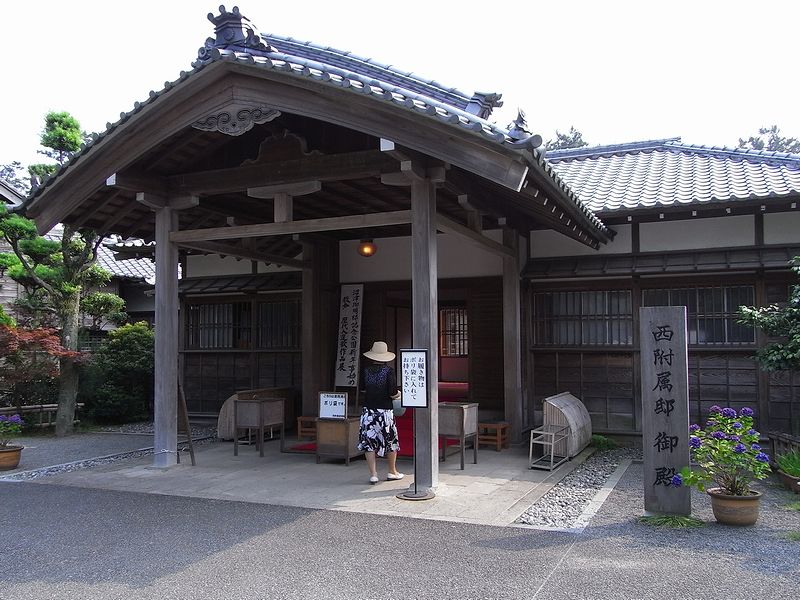
Numazu Imperial Villa
Three emperors vacationed here, where a thousand pines whisper between Mount Fuji and the sea. The Numazu Imperial Villa sits at the edge of Senbon Matsubara, a roughly ten-kilometer stretch of pine forest so striking that it ranks among Japan's 100 most scenic landscapes. Emperor Meiji chose this spot in 1893 not for its grandeur but for its serenity: a single-story wooden residence facing Suruga Bay, with Japan's most famous volcano framed in the windows to the north-northwest. What began as one man's summer escape became the favorite retreat of a dynasty, witnessed a world war, and now opens its gates to anyone willing to walk among the ghosts of the Meiji, Taisho, and Showa eras.
A Summer Court by the Sea
The original villa was modest by imperial standards: 1,200 square meters of single-story wooden construction, surrounded by grounds covering more than 104,000 square meters. But its neighborhood was anything but ordinary. The area around Numazu had become a favored retreat for Japan's most powerful figures during the rapid modernization of the Meiji era. Nearby stood the private villas of Field Marshal Oyama Iwao, who had commanded Japanese forces in the Russo-Japanese War, along with those of Saigo Judo and Oki Takato, political architects of modern Japan. It was a seaside corridor of power, where the country's future was shaped as casually over summer dinners as in the halls of Tokyo.
Three Emperors, One Retreat
Crown Prince Yoshihito, the future Emperor Taisho, loved the villa most. While his father Meiji had built it, Yoshihito made it his own, returning summer after summer to the pine-shaded coast. The villa grew to match its expanding role, with an east annex added in 1903 and a west annex in 1905. The east annex had once stood on the grounds of the Akasaka Palace in Tokyo, serving the high steward to the crown prince before being carefully dismantled and reassembled here. The west annex came from a different world entirely: the personal villa of Count Kawamura Sumiyoshi, a naval commander who helped build Japan's modern fleet. Even the young Hirohito, who would one day lead Japan through its most turbulent century, spent 70 days at the villa as a child, walking these same pine-lined paths beside Suruga Bay.
Fire from the Sky
The main building survived earthquakes, typhoons, and decades of salt air from the bay. It did not survive the bombing of Numazu during World War II. An American incendiary bomb struck the original Meiji-era structure and it burned to the ground, taking with it the rooms where three emperors had slept, the verandas where they had watched Fuji turn pink at sunset. But the two annexes, the transplanted buildings from Tokyo and Count Kawamura's estate, endured. They stand today as the oldest surviving structures on the grounds, carrying within their wooden frames the layered history of imperial Japan's relationship with this coastline.
A Park for the People
In 1969, the imperial household relinquished the villa grounds to the city of Numazu, and in 1970 the gates opened to the public as the Numazu Goyotei Memorial Park. The transformation was deliberate: a place once reserved for emperors and their closest advisors became a public garden where families picnic beneath the same pines that shaded Meiji-era statesmen. In 2016, the Japanese government designated the villa's gardens as a national scenic spot, formally recognizing what the emperors had understood for more than a century: that this particular meeting of mountain, forest, and bay creates something worth preserving. The west and east annexes remain open for visitors to explore, their tatami rooms and wooden corridors still holding the proportions and craftsmanship of a Japan that was rushing headlong into modernity yet paused here, at the edge of the water, to breathe.
Between Fuji and the Waves
Senbon Matsubara stretches roughly ten kilometers along the coast from the Kano River estuary to Tagonoura, originally planted as a windbreak and tidal barrier. Unlike many of Japan's famous pine groves that rise from bare white sand, the trees here grow thick and forest-like, their canopy dense enough to block the summer sun entirely. Literary figures have long been drawn to the dramatic contrast this landscape creates: the 6,000-meter vertical drop from Fuji's summit to the floor of Suruga Bay, with the dark green band of ancient pines running between them. The villa sits within this corridor, a place where the natural world compresses distance and scale into something almost theatrical. From above, the grounds appear as a clearing in the forest, the remaining annexes like stepping stones between the mountain and the sea.
From the Air
Located at 35.072N, 138.873E on the Suruga Bay coastline in Numazu, Shizuoka Prefecture. The villa grounds appear as a clearing within the distinctive Senbon Matsubara pine forest, a dark green band stretching along the coast. Mount Fuji is visible to the north-northwest in clear weather, creating a dramatic backdrop. Best viewed at 2,000-3,000 feet AGL when flying along the Suruga Bay coast. Nearest airport: Mt. Fuji Shizuoka Airport (RJNS), approximately 60 km to the west. Tokyo's Haneda Airport (RJTT) lies roughly 100 km to the northeast.