Numidia
In 170 BC, King Masinissa of Numidia shipped 70,000 tonnes of wheat to the Roman army in Macedonia. It was not a gift. It was a fraction of what his kingdom could produce, and Masinissa was offended when Rome insisted on paying for it. That a Berber king in North Africa could casually provision an army on the other side of the Mediterranean reveals a power that most accounts of ancient history overlook. Numidia was not a minor client state. It was a kingdom that fed empires, built cities, maintained a war navy, and produced a culture that blended Berber, Punic, and Greek traditions into something entirely its own.
The Breadbasket Nobody Expected
The numbers are staggering. In 200 BC, Numidia sent 14,000 tonnes of wheat and 10,500 tonnes of barley to Roman forces in Macedonia. In 191 BC, the shipments reached 56,000 tonnes of wheat and 28,900 tonnes of barley, split between Rome and Greece. By 143 AD, Numidian olive oil exports rivaled its grain shipments throughout the Roman Empire. These were not the outputs of a pastoral backwater. Numidia's agricultural capacity, built on the fertile soil of its mountain valleys and coastal plains, made it one of the most productive regions in the ancient Mediterranean. Barley thrived in the light, hilly soil of the Aures Mountains, while wheat and olives flourished on the plains that Masinissa's kingdom absorbed over decades of expansion.
Cirta's Cosmopolitan Heart
The capital, Cirta, modern-day Constantine, embodied a cultural fusion that defied easy categorization. Votive stelae dedicated to the Punic gods Baal Hammon and Tanit, discovered in the suburb of El-Hofra and dated to the 3rd and 2nd centuries BC, bear inscriptions in both Punic and Greek. Rhodian amphorae from the 2nd century BC have been found in Cirtan burial sites. Greek and Italian merchants lived in the city. The official language of the Numidian court was Punic, used for royal inscriptions, coin legends, and religious dedications. Even centuries after Carthage fell in 146 BC, Punic persisted: Saint Augustine testified that farmers around Hippo still spoke it in his era. Alongside Punic, the Libyco-Berber script survived, an alphabet that lives on today among the Tuareg as Tifinagh.
Gods, Ships, and Stolen Pillars
Masinissa's religious policy reflected his kingdom's syncretic character. Baal Hammon and Tanit were worshiped in urban centers, while rural communities venerated local gods and celestial bodies. When receiving the Roman consul, Masinissa offered thanks not to Jupiter but to the Great Sun and the gods of the heavens, an invocation that highlighted his African roots. He introduced the Greek cult of Demeter and Persephone, a fertility religion linked to agricultural productivity. His navy protected Numidian trade routes across the central Mediterranean. Cicero records a story in which Masinissa's fleet sailed to Malta, confiscated ivory elephant pillars from a temple of Juno, and brought them back as a prize. When the king learned the pillars' sacred origin, he dispatched five ships to return them. The anecdote reveals both Numidian naval capability and a king who understood the difference between power and wisdom.
Monuments for the Ages
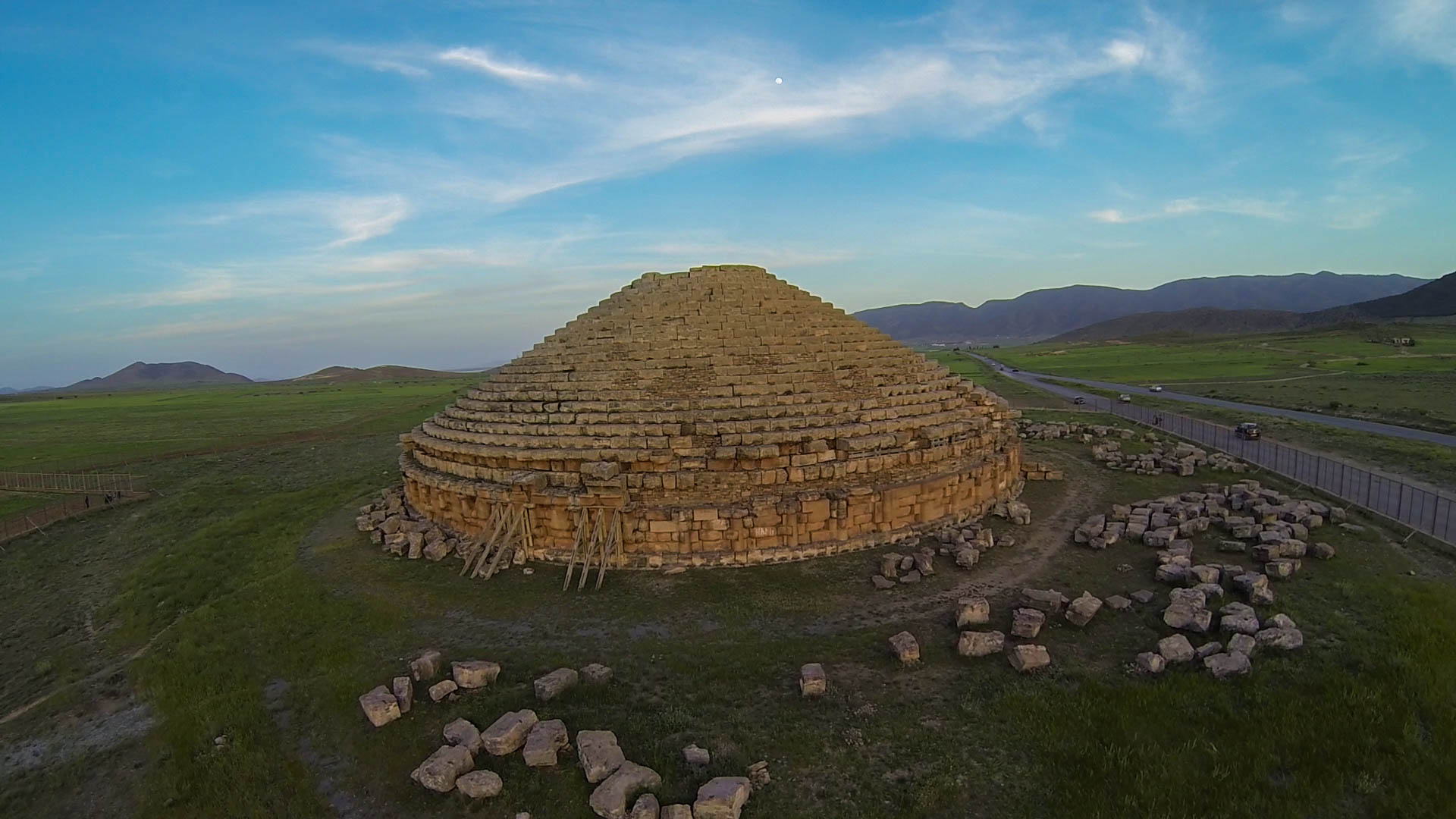
The Numidian kings expressed their ambitions in architecture. The Royal Mausoleum of Mauretania, the Madghacen tomb, and the Libyco-Punic Mausoleum at Dougga represent what scholars call Royal Numidian Architecture, a tradition of monumental tombs, tumuli, and sanctuaries that drew on both Punic and indigenous forms. At Dougga, Numidian kings attempted to use the Libyco-Berber script in official inscriptions, demonstrating that both linguistic traditions coexisted at the highest levels of the state. These were not provincial imitations of foreign models. They were original expressions of a North African civilization that absorbed influences from Carthage, Greece, and Rome without losing its own identity. Numidia's cities, at their peak, numbered over 120 episcopal sees. The kingdom that once fed Rome's legions had become, under Roman rule, one of the most urbanized regions of the empire.
From the Air
Located at 35.50N, 7.30E, the heartland of ancient Numidia corresponds to northeastern Algeria and parts of Tunisia. The capital Cirta is modern Constantine (36.37N, 6.61E). Key archaeological sites include Timgad, Lambaesis, and Dougga (in Tunisia). Best appreciated at cruise altitude as a regional overview. Nearest airports: Batna-Mostefa Ben Boulaid (DABT), Mohamed Boudiaf Constantine (DABC). Terrain varies from coastal plains to the Aures Mountains at 1,000+ meters elevation.