Nuruosmaniye Mosque
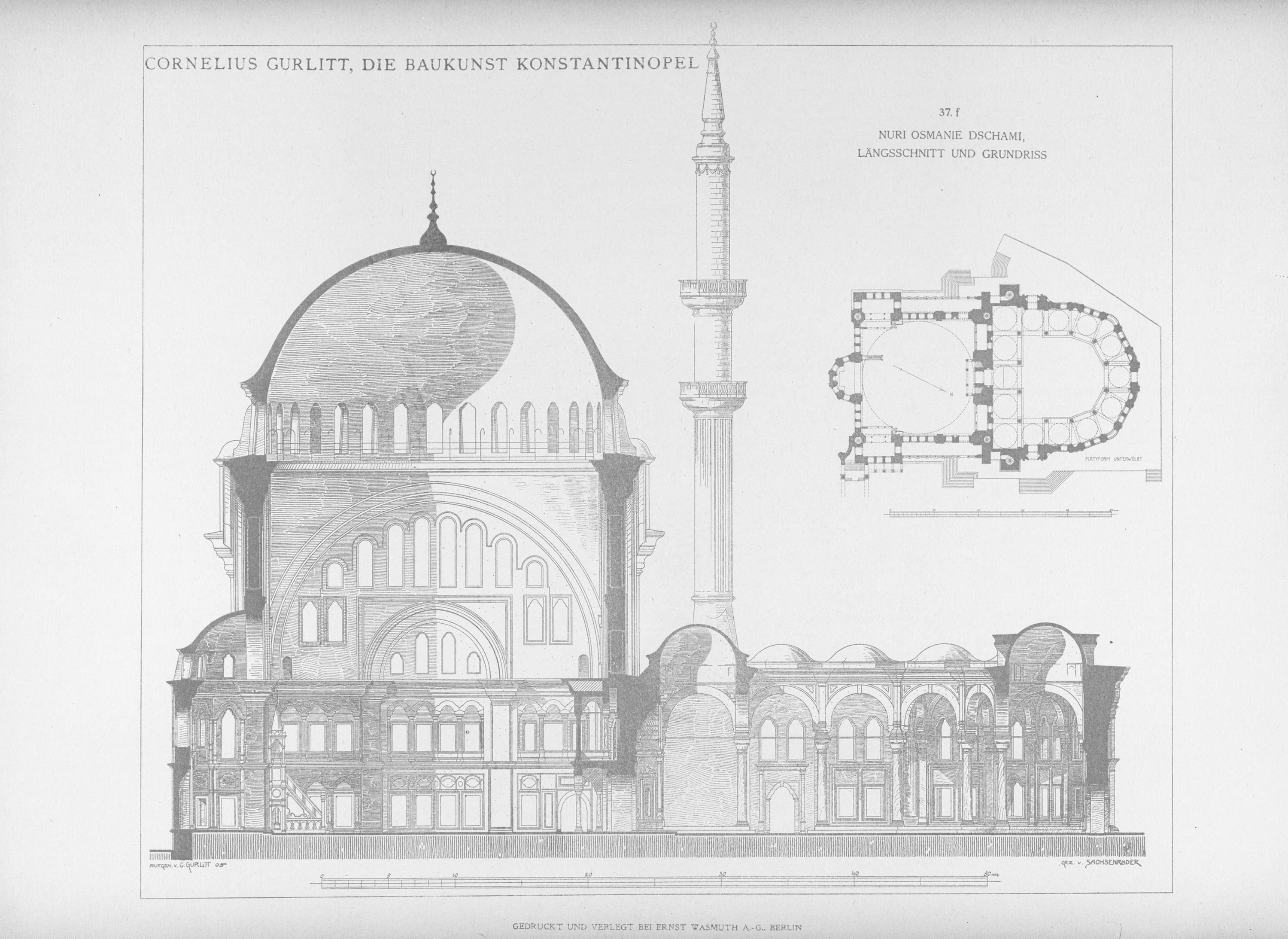
When it opened in 1755, conservatives in Istanbul did not know what to make of it. The Nuruosmaniye Mosque was unmistakably an imperial mosque, the first one a sultan had built in the city in over a hundred years, but its arches curved where they should have pointed, its courtyard formed a horseshoe instead of a rectangle, and the carving above its central doorway looked like a stylized sun rather than the geometric muqarnas everyone expected. The architect was Greek and Christian, drawing on European Baroque he had studied. Pious traditionalists thought it strange. Some thought it scandalous. Two and a half centuries later, the strangeness is exactly what makes it remarkable.
A Sultan Returns to an Old Tradition
Every Ottoman sultan was supposed to build his own great mosque in Istanbul. It was tradition, and a way of marking a reign in stone. But after Ahmed I finished the Blue Mosque in 1617, the practice lapsed for a hundred and thirty years. The empire had its troubles, sultans rose and fell quickly, and money was always short. Mahmud I revived the tradition in 1748 when he commissioned this mosque just inside the walls of the Grand Bazaar. He died in 1754 before it was finished. His brother and successor Osman III completed it in 1755 and named it Nuruosmaniye, the Light of Osman, in his own honor. The mosque sat on the second of Istanbul's seven hills, in a commercially central location chosen partly to remind merchants in the bustling bazaar that the sultan was still watching.
The Greek Architect
The architect was a non-Muslim Greek named Simeon Kalfa in some sources, though his name appears differently in others and his exact identity remains debated. What is clear is that he had studied or absorbed the Baroque architecture then sweeping European Catholic capitals, and he brought its vocabulary into a fundamentally Islamic religious form. The mosque sits beneath a single great dome, the third largest historic dome in Istanbul after the Hagia Sophia and the Suleymaniye, supported by four huge arches pierced with windows that flood the interior with light. The courtyard, instead of forming the traditional rectangle of a Sinan mosque, curves into an unprecedented horseshoe. One contemporary observer described the building as straining everywhere to melt straight lines into curves.
The Vocabulary of the Baroque
Walking the perimeter today, the details give the game away. Pediments above the exterior arches have concave flourishes at their corners. Window and doorway profiles are mixtilinear, mixing different curves rather than following the traditional pointed arch. Above the central doorway of the courtyard rises that radiating sun motif carved in stone, an iconography that fits no Ottoman precedent and no European one either. Inside, the prayer hall is flanked by two-story galleries that move the muezzins' platform out of the central floor space, leaving the dome's interior open and expansive. The minbar drips with Baroque flutes and scrollwork. New capitals on the columns take a vase or inverse-bell shape with small volutes at the corners, an Ionic flavor reinterpreted in Ottoman stone. None of this had been seen in an imperial mosque before.
What Lies Beneath
Between 2010 and 2012, restorers conducting a 20-million-lira renovation made discoveries that changed how scholars understand the building. They found older hand-drawn ornaments under deteriorated plaster. They found that the mosque sits on a bored-pile foundation, the oldest such engineering yet identified in Turkish architecture, an Ottoman application of a technique many believed was much later. And they found an active cistern beneath the complex, 2,242 square meters of underground vaulting that had to be cleared of, in the words of one official, 420 trucks worth of slime. The cistern's gallery and water gauge survive, and authorities have proposed turning it into a museum. In 2018, an art biennial used the cistern as exhibition space.
At the Edge of the Bazaar
The complex contains all the pieces of a traditional kulliye: the mosque itself, a madrasa for Islamic education, an imaret that once distributed soup to the poor, a sebil that dispensed water to passersby, a library, and a turbe holding the remains of Shehsuvar Sultan, mother of Osman III, who died in 1756. The library is one of the great Ottoman manuscript collections. The sebil now operates as a carpet store, the kind of small commercial repurposing that Istanbul does without sentimentality. Just outside the mosque's eastern gate stands one of the entrances to the Grand Bazaar, and the streets around it boil with traffic in shoes, leather goods, and gold. The mosque was never separate from this commerce. It was built to stand inside it.
From the Air
Nuruosmaniye sits at 41.0103 N, 28.9703 E on the second hill of Istanbul, immediately east of the Grand Bazaar in the Cemberlitas neighborhood of Fatih district. From above, look for the single broad dome and twin minarets in the dense old-city street grid, with the green expanse of the Beyazit Mosque complex 400 m to the west and the historic Column of Constantine just south. Istanbul Airport (LTFM) is 33 km northwest; Sabiha Gokcen (LTFJ) is 33 km southeast across the Bosphorus. Recommended viewing altitude 1,500 to 3,000 ft AGL; controlled airspace over historic peninsula is restricted.