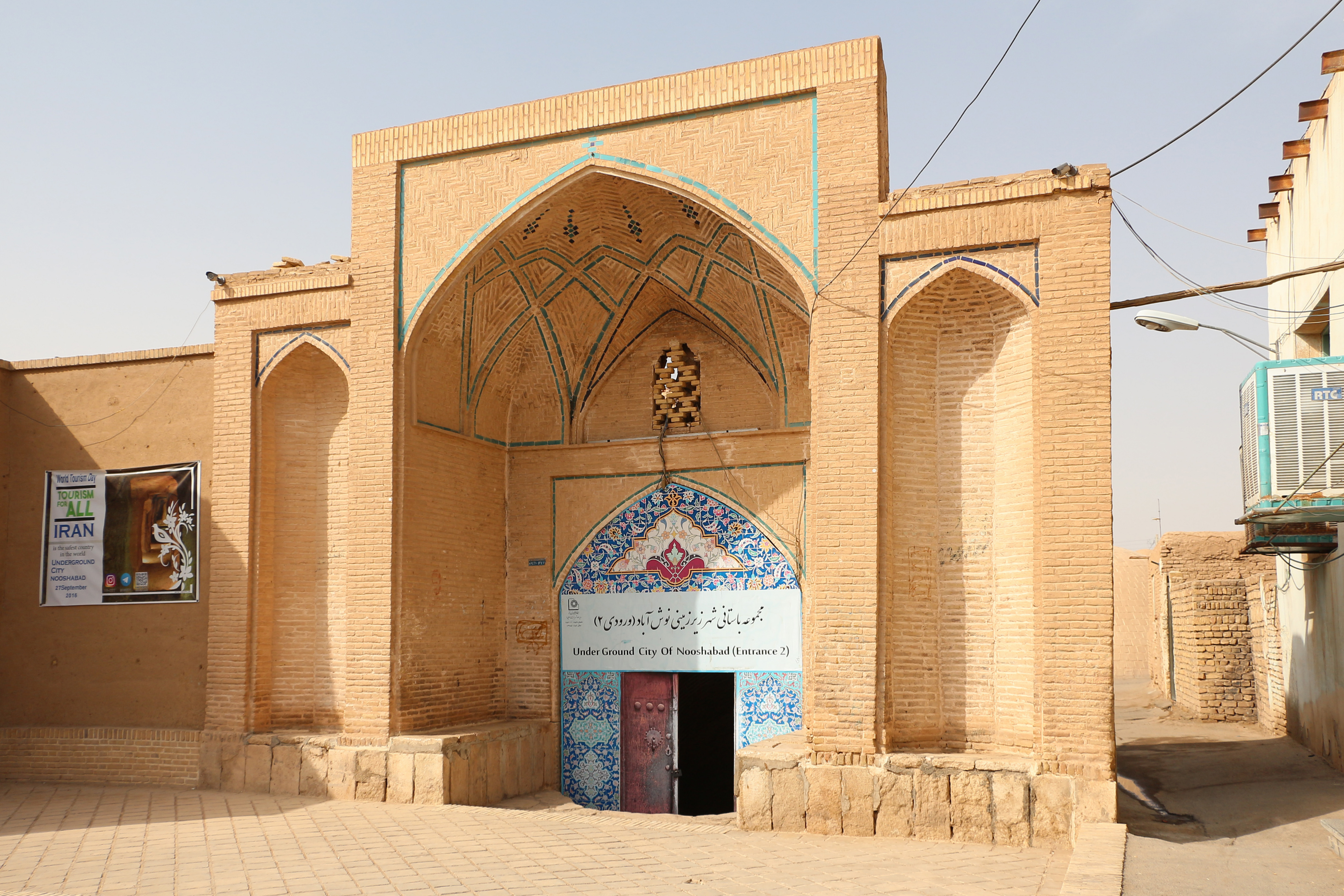
Nushabad
Beneath the streets of Nushabad lies a second city. Three levels deep, connected by curving passages designed to confuse intruders, fitted with trapdoors that swallow the unwary, and accessible through secret entrances hidden inside ordinary houses -- this is Ouyi, one of the most elaborate underground refuges in the ancient world. Above ground, Nushabad is a modest Iranian city of roughly 12,000 people in the desert heartland of Isfahan Province. Below ground, it is a masterwork of defensive architecture born from centuries of insecurity.
The City of Cold, Tasty Water
The name tells an origin story. In ancient times, a Sassanian king passing through the region stopped to drink from a local well and found the water extraordinarily clear and cold. He was so impressed that he ordered a city built around it, naming the settlement Anoushabad -- which evolved over centuries into Noushabad, meaning roughly "city of cold, tasty water." That well became the seed of a community in one of Iran's harshest environments: the central desert, where daytime temperatures soar and nighttime temperatures plunge. The underground city may have initially offered escape from the brutal surface heat, but its true purpose was far more urgent.
Architecture of Survival
This region of central Iran endured centuries of raids and invasions. The inhabitants of Nushabad responded by carving a network of tunnels beneath the entire city, connecting homes, public buildings, and the main fort through underground passages. Multiple entrances were built into private houses and important gathering places, allowing the population to vanish below ground at the first sign of attack. People could shelter in the tunnels for days without needing to surface. The passages linked every part of the city, enabling residents to move unseen from one neighborhood to another while invaders searched empty streets above.
Traps for the Unwelcome
The underground city's designers were not merely builders -- they were military engineers. The three-level structure was laid out so that movement between levels required going from lower to higher ground, giving defenders the advantage of elevation against anyone who managed to enter. Passages curved deliberately, eliminating sight lines and creating natural ambush points where a few defenders could hold off many attackers. Deep holes were dug into the floors of rooms and covered with rotating stones that appeared solid but collapsed under weight, dropping intruders into pits. Every feature of the underground labyrinth served a single purpose: make the cost of invasion unbearable.
Hidden in Plain Sight
What makes Nushabad's underground city remarkable is its integration with the surface world. This was not a fortress or a bunker built apart from daily life. The entrances were woven into the fabric of ordinary existence -- a trapdoor beneath a kitchen floor, a passage behind a market stall, an opening inside the city fort. The underground and above-ground cities functioned as a single organism, one visible and one concealed, each essential to survival. Today, with a population of roughly 11,000 to 12,000 people, Nushabad has long outgrown its need for underground refuge. But the tunnels remain beneath the streets, a testament to the ingenuity of people who built a city they could make disappear.
From the Air
Nushabad is located at 34.08°N, 51.44°E in the central desert region of Isfahan Province, Iran, just north of the city of Aran o Bidgol. The city appears as a compact urban area in an arid landscape. Nearest major airport is Isfahan International Airport (OIFM), approximately 100 km to the south. The underground city is not visible from the air, but the surface city and its surrounding desert terrain provide orientation. Best viewed at 4,000-8,000 ft.