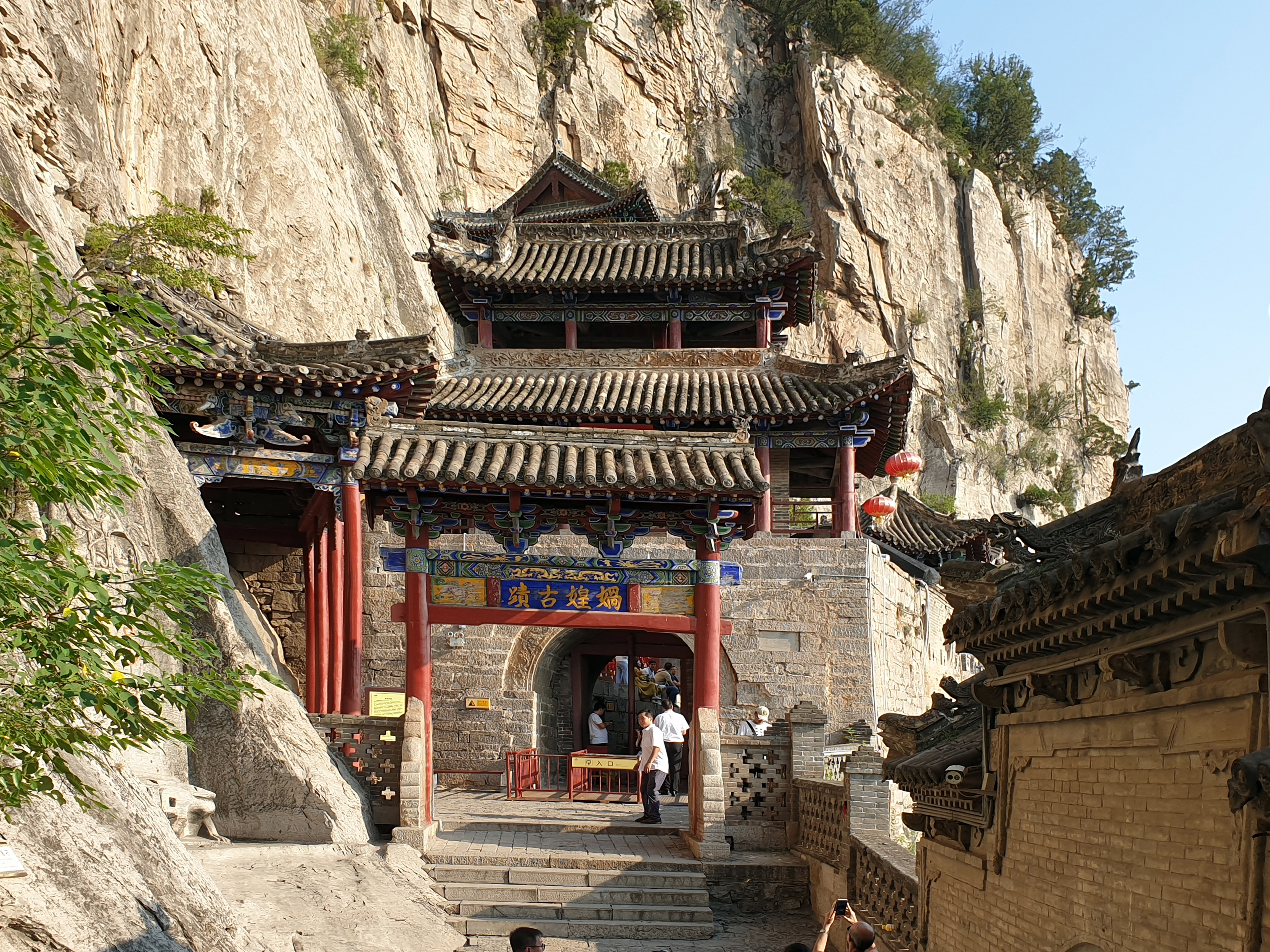
Nuwa Palace
According to Chinese mythology, the sky once broke. A water god named Gonggong, defeated in a struggle for leadership of the gods, slammed into Mount Buzhou in rage and knocked the pillar of heaven askew. The sky cracked, the earth tilted, rivers poured southeast, and celestial bodies drifted northwest. It fell to the goddess Nuwa to repair the damage. She melted gems of five colors to patch the holes in the heavens and cut the four legs from the great sea tortoise Ao to prop up the sky at its corners. This creation myth -- which ancient Chinese scholars used to explain both the Earth's axial tilt and the southeastern flow of China's great rivers -- has been celebrated at Nuwa Palace on Phoenix Mountain in Hebei Province since at least the 2nd century AD.
A Temple for Humanity's Ancestor
Nuwa is not merely a sky-mender in Chinese tradition. She is regarded as the creator of humanity itself, having fashioned the first humans from yellow earth. Nuwa Palace -- also known as Wahuang Palace -- sits in She County, under the jurisdiction of Handan Prefecture, and is treated as a kind of ancestral shrine for the entire human race. The site draws particular attention during the first through eighteenth days of the third month of the Chinese lunar calendar and on Tomb Sweeping Day, when visitors come to pay respects at a place that connects them, mythologically, to the very beginning of their species. The temple complex covers 1.67 square kilometers of Phoenix Mountain, combining religious architecture with natural landscape in the way that Chinese sacred sites have done for millennia.
Scripture Carved in Stone
The mountain's rock face bears one of the most extensive collections of carved Buddhist scripture in China. Beginning during the Northern Qi dynasty in the 6th century, monks began incising text into the cliff, and the practice continued across subsequent dynasties until the total reached an astonishing 130,000 characters. The juxtaposition is striking: a site dedicated to a pre-Buddhist goddess from China's oldest myths, covered in the sacred texts of a religion that arrived in China centuries later. Rather than contradiction, the coexistence reflects the syncretic character of Chinese religious practice, where Daoist myths, Buddhist philosophy, and Confucian ethics have long occupied the same physical and spiritual spaces.
Five Colors of the Sky
The myth of Nuwa repairing the heavens with five-colored stones connects to Wuxing, the Chinese philosophical system of five elements or phases: wood, fire, earth, metal, and water. Each element corresponds to a color, a season, a direction, and a quality. The five-colored gems Nuwa used were not random; they represented the fundamental forces that sustain the cosmos. The story is among the oldest attempts in any culture to explain the apparent irregularities of the natural world -- why the Earth tilts, why rivers flow in one direction, why the sky seems to rotate around a point that is not directly overhead. By placing the answer in the hands of a goddess rather than in the mechanisms of physics, the myth acknowledges both the strangeness of the world and the human desire to believe that someone, somewhere, has it under control.
Recognition and Renewal
Nuwa Palace was designated a nationally protected historical and cultural site by the State Administration of Cultural Heritage in 1996, recognizing both its antiquity and its continuous importance in Chinese religious life. In 2015, it received the highest tourist designation in China -- AAAAA status -- from the National Tourism Administration. The classification reflects the scale and ambition of the site, which has been expanded and renovated repeatedly over its nearly two-thousand-year history while retaining its core identity as a place of worship dedicated to the goddess who fixed the broken sky. For visitors arriving at Phoenix Mountain, the carved scriptures and temple halls are impressive. But the deeper power of the place lies in its connection to a story so old that it predates recorded history -- a story about a world that fell apart and a goddess who put it back together.
From the Air
Nuwa Palace is located at 36.64°N, 113.62°E on Phoenix Mountain in She County, Handan Prefecture, Hebei Province. The temple complex covers approximately 1.67 square kilometers of mountainous terrain. Nearest major airport: Handan Airport (ZBHD), approximately 50 km to the east. The site is in the hilly terrain of the Taihang Mountains' eastern foothills. The carved rock face and temple structures on Phoenix Mountain may be visible in clear conditions at lower altitudes.