Nyungwe National Park
Somewhere in southwestern Rwanda, a raindrop lands on a leaf and begins a journey that will take it either to the Atlantic or the Mediterranean. This is Nyungwe -- a 970-square-kilometer rainforest that sits precisely on the continental divide between the Congo River basin to the west and the Nile basin to the east. One of the source streams of the Nile itself begins on the forest's eastern slopes. The forest is hundreds of thousands of years old, ancient enough that its western reaches served as a refugium for rare species during the last Ice Age, when the eastern half reverted to grassland. What survived in that western core -- and what recolonized the east as the climate warmed -- makes Nyungwe one of the most biologically important protected areas in all of Africa.
Thirteen Primates and a Canopy Walk
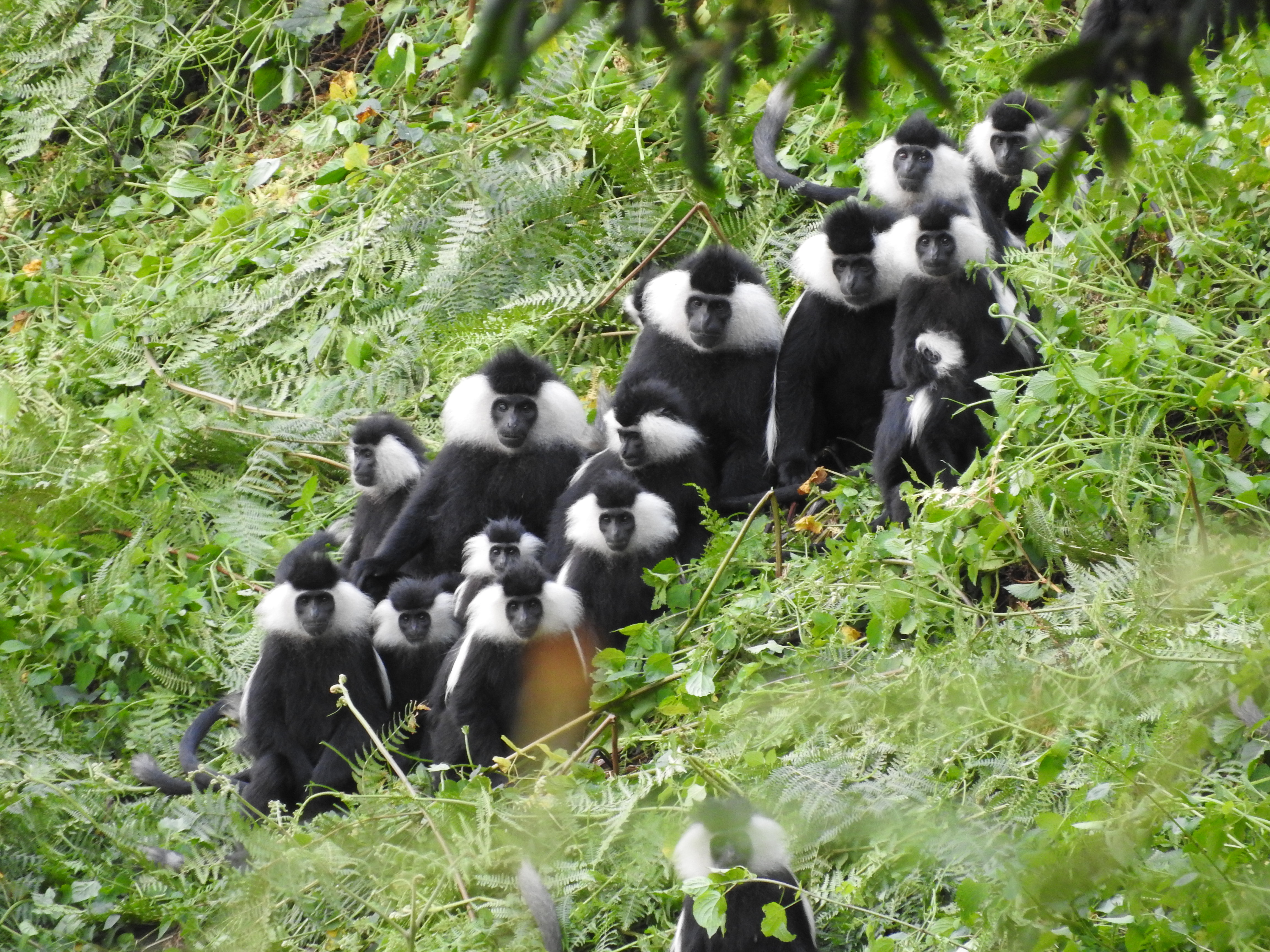
Nyungwe is home to 13 primate species, representing roughly a quarter of Africa's total primate diversity. Around 500 chimpanzees live in the forest, the only great ape species present, and two groups have been habituated to human contact for tracking excursions. But the park's most astonishing primate spectacle belongs to Adolf Friedrich's Angolan colobus monkey. Nyungwe is the only forest in Africa where these black-and-white monkeys form supergroups of more than 500 individuals -- the largest arboreal troops of colobus ever recorded anywhere. Since 2010, visitors can observe the upper canopy from a suspended walkway: 160 meters long and 70 meters above the ground at its highest point, strung above a steep valley, the only attraction of its kind in East Africa. From that swaying platform, the forest reveals what it hides from the ground: butterflies, blue monkeys, and birds moving through a world most people never see.
Where Two Oceans Begin
The forest's position on the Albertine Rift -- the western branch of the East African Rift System -- gives it a unique ecological character. Altitude ranges from 1,600 meters to over 3,000 meters at the summit of Mount Bigugu, and the vegetation shifts dramatically with elevation. At the lowest levels, towering African mahogany trees, locally called umuyove, form the canopy. Higher up, tree ferns and middle-elevation species dominate. Near the summit, bamboo and subalpine shrubs take over, with Erica and Podocarpus replacing the broad-leaved trees of the lowlands. Epiphytes -- mosses, ferns, and over 140 species of orchids -- cling to branches throughout, drawing moisture directly from the cloud-drenched air. More than 1,000 plant species have been cataloged in the park, many of them found only in the Albertine Rift. Among the rarest is Impatiens nyungwensis, which grows on Mount Bigugu and nowhere else in the world.
A Forest That Nearly Vanished
Nyungwe's survival is not guaranteed by its beauty. The German colonial government declared it a forest reserve in 1903, and Belgian administrators maintained that status after World War I, but enforcement was inconsistent. Between 1958 and 1973, fires, woodcutting, and small-scale agriculture reduced the forest by more than 150 square kilometers. Elephants, once numbering in the hundreds, dwindled steadily. The last buffalo was killed by hunters in 1974. Then came 1994. The Rwandan genocide devastated the country and destroyed the research and tourist facilities at Uwinka, the park's main base. Most senior staff fled, though junior rangers stayed to protect what they could. Recovery began in 1995, but the forest lost its last elephant to poachers in 1999, killed in a swamp. The Rwandan government officially elevated Nyungwe to National Park status in 2005, and in 2023 it received further international recognition. The loss of its megafauna is irreversible, but the forest endures.
Birdsong on the Rift
BirdLife International classifies Nyungwe as an Important Bird Area, and with 278 documented species, the designation is well earned. Twenty-six of those species are found only in the handful of forests strung along the Albertine Rift. The Ruwenzori Turaco, rare elsewhere, is abundant here -- its loud, repetitive call resonating through the canopy like an alarm that never quite resolves. Endemic sunbirds, including the Purple-breasted and Blue-headed, feed in flowering trees along the trail system. Grauer's Rush Warbler haunts the isolated mountain swamps such as Kamiranzovou, one of the largest high-altitude bogs in Africa. The Black-and-white-casqued Hornbill announces itself with a honking call that carries across valleys. For birders, Nyungwe is less a destination than a pilgrimage -- a place where concentrated endemism makes every morning walk a census of species that exist almost nowhere else.
From the Air
Located at 2.49S, 29.29E in southwestern Rwanda, bordering Burundi to the south and the DRC to the west. The forest appears from the air as a vast, dark-green block of montane canopy, sharply distinct from surrounding tea plantations and cultivated land. Best viewed from 8,000-12,000 feet AGL. Lake Kivu is visible to the northwest. The main entrance at Uwinka lies along the Cyangugu-Huye road. Nearest airport: Kamembe Airport (HRZA) near Cyangugu, approximately 55 km to the west. Kigali International Airport (HRYR) is approximately 150 nm to the northeast.