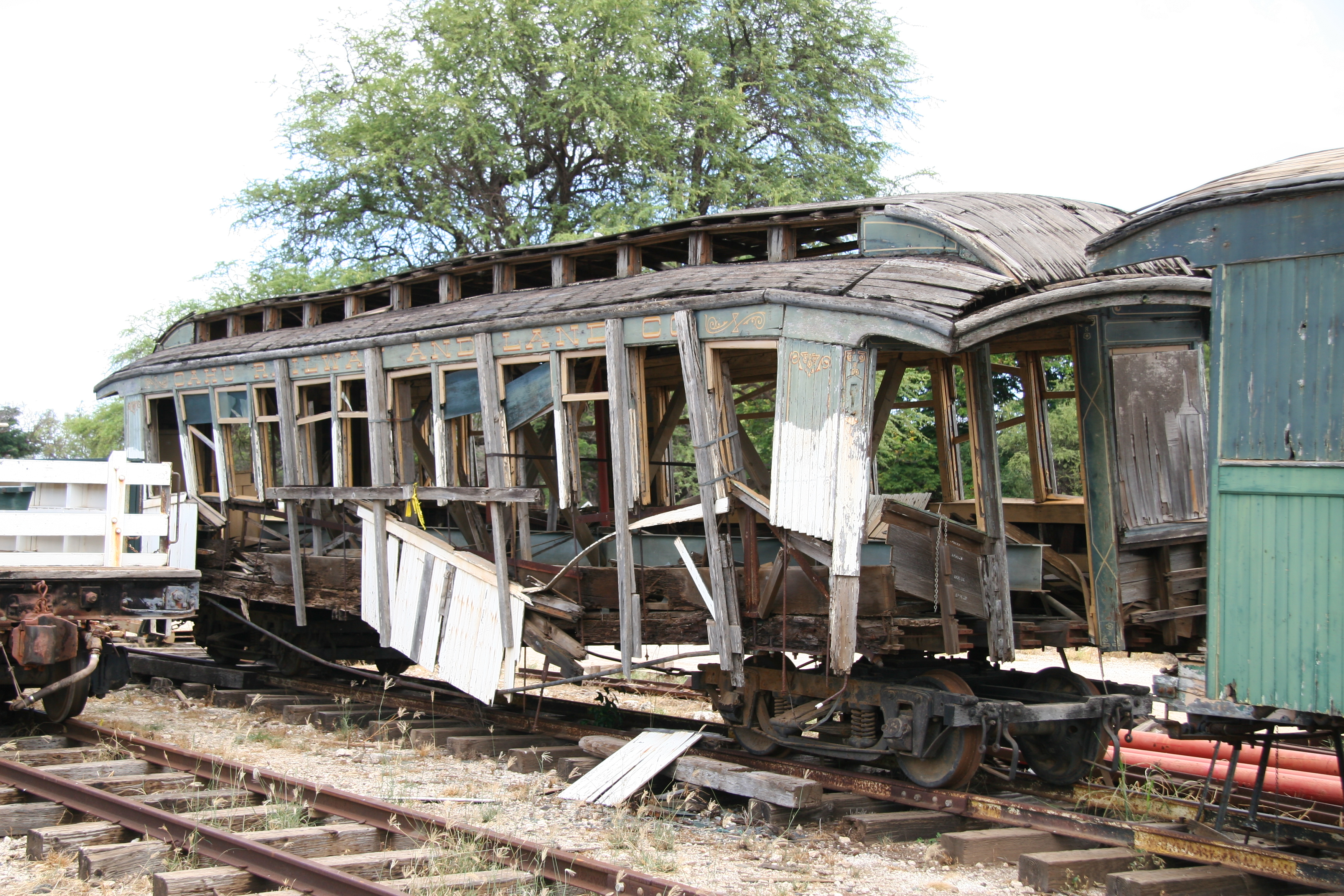
Oahu Railway and Land Company
Benjamin Franklin Dillingham never planned to stay in Hawaii. He arrived in Honolulu as a sailor in 1865 and might have shipped out again had he not fallen from a horse and broken his leg. The injury forced him to recuperate on the islands, and recuperation turned into a life's project. On September 11, 1888, King David Kalakaua granted Dillingham a railroad charter, and on November 16, 1889 -- the king's birthday -- the Oahu Railway and Land Company opened for business, giving free rides to more than 4,000 passengers. It would become the largest narrow-gauge common carrier railroad in the United States, a three-foot-gauge lifeline that shaped the economic and military geography of Oahu for nearly six decades.
Sugar, Pineapple, and Steel
The charter demanded that Dillingham connect Honolulu to Aiea, 12 miles away, within months. He broke ground in March 1889 and met the deadline. By 1892, the line had extended 18.5 miles to the Ewa sugar mill, the heart of Dillingham's own Ewa Plantation Company. Expansion continued aggressively. By the early 1900s, the railway stretched over 70 miles along Oahu's western and northern coastlines, serving sugar plantations, pineapple farms, and the popular Haleiwa Hotel on the North Shore. The narrow-gauge tracks threaded through cane fields and along coastal cliffs, carrying freight that fueled Hawaii's plantation economy and passengers who discovered the island's beaches and small towns along the way. The railroad did not just transport goods; it opened land for development, which is why Dillingham named his venture a railway and land company.
The War's Workhorse
When Japanese planes attacked Pearl Harbor on December 7, 1941, the OR&L became an indispensable military asset virtually overnight. Trains rolled 24 hours a day, moving munitions, troops, and defense workers between Honolulu and the military installations that dotted Oahu's western coast -- Pearl Harbor, Hickam Field, Barbers Point Naval Air Station, Schofield Barracks, and Wheeler Army Airfield. The railroad carried civilians to their base jobs and servicemen back to Honolulu for rest and recreation. In 1944 and 1945, the OR&L carried nearly two million riders. Even garbage trains kept running after Pearl Harbor, hauling waste to prevent incinerator flames from guiding enemy bombers to targets. World War II was arguably the most important chapter in the railroad's history, but the relentless wartime pace ground down equipment that was already aging.
A Tsunami and a Strike
By the end of the war, the rolling stock, right-of-way, and facilities were worn out. Road networks across Oahu had been upgraded significantly during the military buildup, creating serious highway competition for the first time. Passenger traffic and gross revenues dropped by more than fifty percent. Then, on April 1, 1946, the Aleutian Islands earthquake sent a 55-foot tsunami crashing into Oahu's coast, destroying sections of track. The railroad rebuilt, but the blow was compounded by a massive sugar workers' strike that began on September 1, 1946. Some 22,000 workers at 33 of Hawaii's 34 sugarcane plantations walked off the job, and OR&L freight dropped to record lows. The combination was fatal. The decision was made to shut down.
The Last Train Home
On December 31, 1947, a final excursion departed from Kahuku behind American Locomotive Company steam engine number 70. Company president Walter F. Dillingham -- Benjamin's son -- rode with guests through 71.4 miles of countryside back to the Honolulu station. The narrow-gauge tracks that had shaped Oahu's development for nearly sixty years fell silent. Most of the infrastructure was scrapped, and the right-of-way gradually disappeared under highways and suburban development. But traces survive. Two diesel locomotives, GE 44-ton switchers numbered 15 and 19, remain in regular service on the Cumbres and Toltec Scenic Railroad in Colorado and New Mexico. A heritage railway operates on a restored section of the original line near Ewa, offering visitors a glimpse of the railroad that a sailor with a broken leg built into an island institution.
From the Air
The OR&L's former route traced Oahu's western and northern coastlines from downtown Honolulu through Ewa, Waianae, and around Kaena Point to Kahuku on the North Shore. The former Honolulu terminal was located near the intersection of King Street and Iwilei Road at approximately 21.314N, 157.865W. Portions of the old right-of-way are visible from the air as linear clearings along the western coast. A heritage railway operates near Ewa at approximately 21.354N, 158.028W. Nearest airport is Daniel K. Inouye International (PHNL). Best viewed from 2,000-3,000 ft AGL following the western coastline.