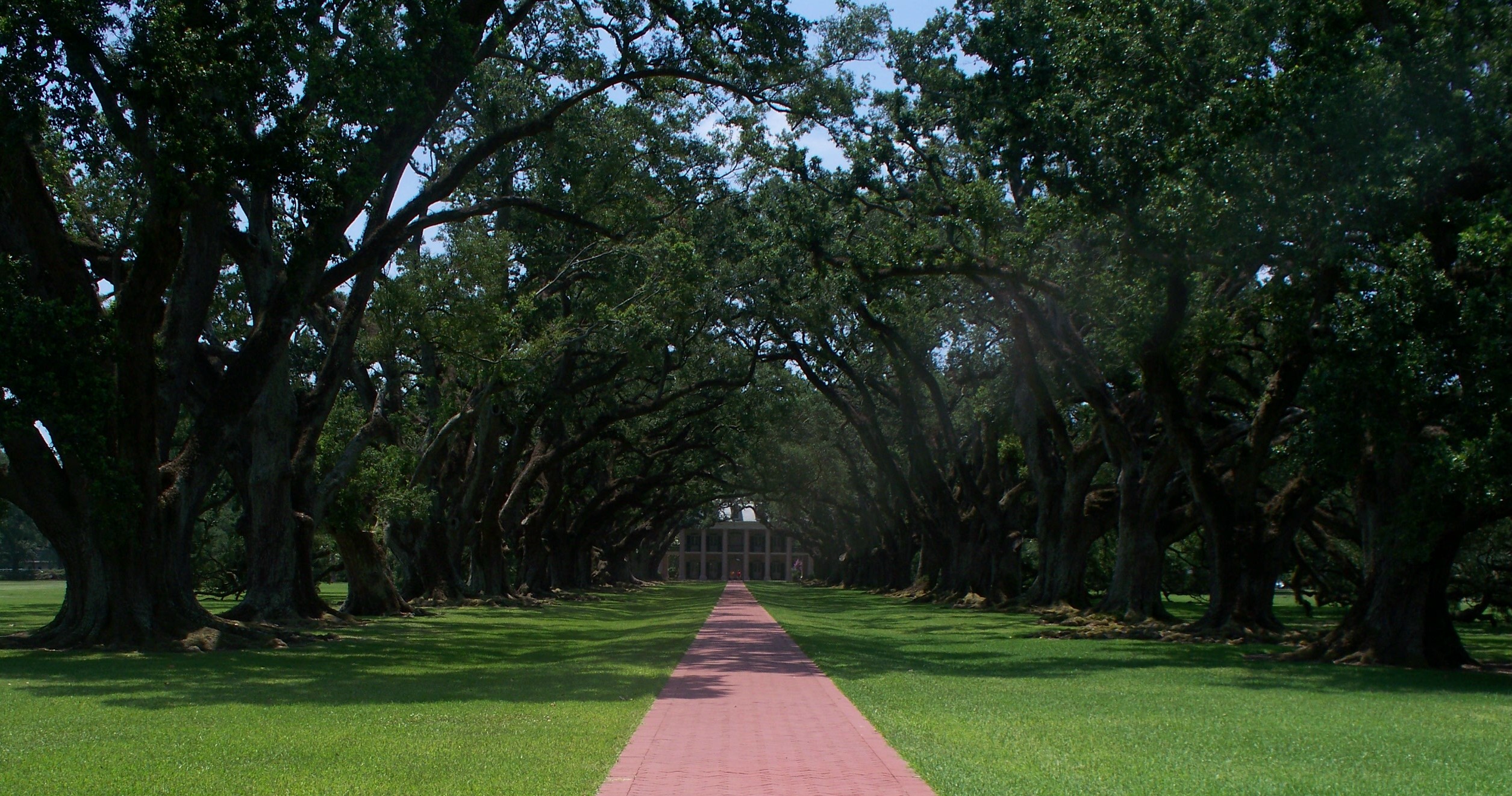
Oak Alley Plantation
An enslaved man named Antoine changed American agriculture, and almost no one knows his last name. In the winter of 1846, working as a gardener at a sugar plantation on the Mississippi River, Antoine mastered the technique of grafting pecan trees and produced a variety with shells so thin you could crack them with your bare hands. The "paper shell" pecan won a prize at the 1876 Centennial Exposition in Philadelphia, was renamed the Centennial Variety, and launched a commercial industry across southern Louisiana. Antoine's original trees were cleared for more sugarcane after the Civil War. But the plantation where he performed this quiet revolution still stands, guarded by 28 live oaks that someone planted a century before the house was even built.
A Cathedral of Oaks
The trees came first. Sometime in the early eighteenth century, long before Jacques Roman commissioned his mansion, someone planted a double row of southern live oaks stretching from the riverbank toward the interior. Twenty-eight trees, fourteen on each side, forming a canopied allee that filters the Louisiana sun into a green, cathedral-like tunnel. The property was originally known as Bon Sejour, but the oaks were so striking that river travelers gave it the name that stuck: Oak Alley. When Roman built his Greek Revival mansion in the late 1830s, he made the architecture rhyme with the landscape -- 28 Doric columns encircling the house on all four sides, one column for every oak in the alley. Constructed of bricks made on site, the thick walls are finished with white stucco meant to resemble marble. The effect from the river is unforgettable: a white temple floating at the end of a living green corridor.
The Paper Shell Revolution
Antoine's horticultural genius deserves to stand alongside the architectural spectacle. Grafting -- the technique of joining tissue from one plant to another -- requires patience, precision, and deep botanical knowledge. Antoine experimented with multiple trees before succeeding in producing his thin-shelled pecan, a nut that transformed the pecan from a wild forage crop into a commercially viable product. The Centennial Variety spread across Louisiana, where pecans became a considerable cash crop. Antoine's original grove was sacrificed for more sugarcane, but a commercial planting had been established at nearby Nita Plantation. In 1890, the Nita Crevasse -- a catastrophic break in the river levee -- washed away Nita Plantation entirely, destroying the last direct descendants of Antoine's original Centennial trees. His innovation survived in the countless grafted orchards it had spawned across the South.
Fortunes Rise and Crumble
Jacques Roman died of tuberculosis in 1848, leaving the estate to his wife Celina. She struggled with the business, spending heavily and nearly driving the plantation to bankruptcy. Their son Henri took control in 1859 and fought to right the ship, but the Civil War shattered the economic foundation of sugar slavery even though it left the buildings untouched. By 1866, Henri's uncle Valcour Aime and his sisters Octavie and Louise forced an auction. The plantation sold for $32,800. Successive owners could not afford the upkeep, and by the 1920s the grand house and grounds had deteriorated badly. Salvation came from an unlikely source: a Texas cattle rancher's wife named Josephine Stewart, whose husband Andrew bought the property for her in 1925. With a sugarcane virus devastating the industry, the Stewarts converted the plantation to a cattle ranch -- Josephine's expertise from her Texas upbringing.
From Ruin to Silver Screen
Josephine Stewart commissioned architect Richard Koch to oversee a sweeping restoration. The staircase was relocated from the southwest corner to the central hall, marble floors gave way to wood, and dormers multiplied across the roof. She installed formal gardens and maintained the property until her death in 1972, when she bequeathed it to the Oak Alley Foundation, opening the grounds to the public for the first time. The plantation's photogenic quality attracted Hollywood. The oak-lined allee and columned mansion appeared in the 1994 gothic horror film Interview with the Vampire, as well as Hush...Hush, Sweet Charlotte and The Long Hot Summer. The property even served as architectural inspiration for the Braithwaite Manor in the 2018 video game Red Dead Redemption 2, extending its cultural reach to a new generation.
Roots Deeper Than Columns
Oak Alley earned its designation as a National Historic Landmark for three reasons: its Greek Revival architecture, its landscaping, and Antoine's pecan grafting -- a rare acknowledgment that the contributions of enslaved people shaped the significance of a plantation site. The mansion's 28 columns are impressive, but the 28 oaks are older and will outlast them. The trees were ancient before Roman laid his first brick, and they continue to grow, their branches now so heavy they rest on the ground in places. Walking the allee today, visitors move through a space that predates the plantation system, survives it, and frames the complicated legacy it left behind. The property preserves not just a building but a full landscape of American ambition, exploitation, innovation, and endurance, rooted in soil that has been tended by many hands across three centuries.
From the Air
Located at 30.004N, 90.776W on the west bank of the Mississippi River in Vacherie, St. James Parish, Louisiana. The iconic double row of 28 live oaks is visible from the air as a distinctive dark-green corridor running perpendicular to the river, with the white Greek Revival mansion at the inland end. Nearby airports include Louis Armstrong New Orleans International (KMSY, 35 nm southeast) and Baton Rouge Metropolitan (KBTR, 40 nm northwest). Best viewed at 1,000-2,000 feet AGL. The plantation is adjacent to St. Joseph Plantation along the River Road (LA-18).