Oak Ridge National Laboratory
In 1942, the U.S. Army Corps of Engineers quietly purchased isolated farmland in eastern Tennessee, displaced families, and erected fences. Behind those fences, a secret city rose from nothing. The Clinton Engineer Works -- part of the Manhattan Project -- needed a place to produce plutonium, and this ridge-and-valley terrain between the Clinch River and Black Oak Ridge offered something essential: isolation. By 1943, the Clinton Laboratories were operational, housing the X-10 Graphite Reactor where Enrico Fermi and his colleagues built the world's second self-sustaining nuclear reactor and the first designed for continuous operation. That wartime urgency planted the seed for what would become Oak Ridge National Laboratory, today the largest science and energy national laboratory in the Department of Energy system, sprawling across 18 square kilometers of a 150-square-kilometer federal reservation in Roane County.
The Secret City's Reactor
The X-10 Graphite Reactor's mission was blunt: convert natural uranium into plutonium for the atomic bomb. Fermi's team had already achieved the first self-sustaining chain reaction at the Chicago Pile-1 in December 1942, and the X-10 scaled that breakthrough into a machine that could run continuously. After the war ended, the reactor's purpose evaporated almost overnight. The demand for military science collapsed, and the laboratory's 1,000 employees found themselves without a clear mission. Management changed hands rapidly -- from the University of Chicago to Monsanto (which withdrew in 1947) back to Chicago, and then to Union Carbide and Carbon Co. in December 1947. It was Union Carbide that gave the site its lasting name: Oak Ridge National Laboratory. The X-10 reactor is now a National Historic Landmark, a concrete monument to the era when splitting the atom was both a weapon and a promise.
Machines That Think at the Speed of Light
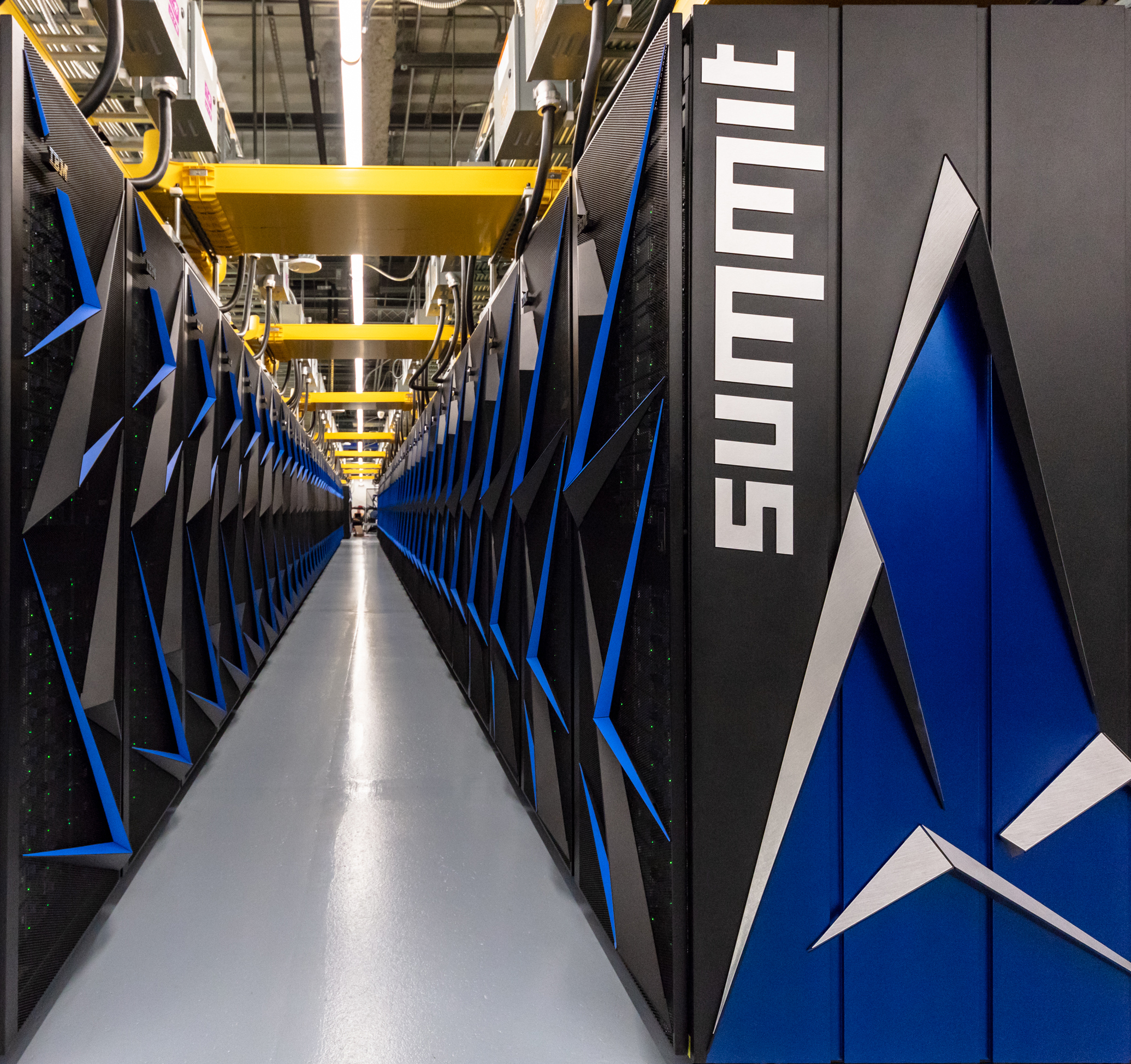
Oak Ridge has chased the frontier of computing since 1953, when it partnered with Argonne National Laboratory to build ORACLE -- the Oak Ridge Automatic Computer and Logical Engine -- with 2,048 words of memory and an addition speed of 590 microseconds. The ambition only accelerated. In 2005, the Cray XT3-based Jaguar arrived at 25 teraFLOPS and was upgraded to 2.3 petaFLOPS by 2009, claiming the title of world's fastest supercomputer. When Jaguar was reborn as Titan in 2012, it pioneered the use of GPUs for the majority of processing, hitting 17.59 petaFLOPS. Then came Summit in 2018, benchmarked at 122.3 petaFLOPS with 27,648 Nvidia Tesla GPUs. But the real milestone arrived in May 2022, when the Frontier system shattered the exascale barrier at 1.102 exaFLOPS using over 8.7 million cores -- the first machine to cross that threshold. ORNL programmers also wrote the first version of Parallel Virtual Machine in 1989, software that became the standard for distributed computing, and Jack Dongarra created the LINPACK benchmarks still used by the TOP500 to rank the world's fastest machines.
Neutrons, Isotopes, and the Invisible World
Two facilities at Oak Ridge peer into matter at scales invisible to the eye. The High Flux Isotope Reactor, which went critical in 1965, provides the world's highest constant neutron flux -- a stream of subatomic particles that scientists use to probe the internal structure of materials, from aircraft alloys to biological proteins. HFIR is also a major source of medical radioisotopes used in cancer treatment and diagnostic imaging, and is expected to operate until approximately 2060. The Spallation Neutron Source, operational since 2006, takes a different approach: it fires the highest-intensity neutron pulses of any human-made source, upgraded to 1 megawatt with plans for 3 megawatts. These intense bursts allow researchers to analyze smaller samples with fewer pulses, producing clearer images of molecular structures. Together, these two instruments make Oak Ridge one of the world's premier destinations for neutron science.
From Diesel Engines to Deep Space
The laboratory's reach extends far beyond nuclear physics. Between 2002 and 2008, ORNL partnered with Caterpillar Inc. to develop CF8C Plus, a new stainless steel alloy with added manganese and nitrogen that withstands extreme temperature fluctuations in diesel engines -- better performance at similar cost. The Center for Nanophase Materials Sciences produced a lithium-sulfide battery in 2012 with a theoretical energy density three to five times greater than existing lithium-ion batteries. And in January 2019, ORNL announced a breakthrough in automating plutonium-238 production, pushing output from 50 grams to 400 grams per year and moving toward NASA's goal of 1.5 kilograms annually to power deep-space exploration missions. With a staff of 5,700 (including roughly 2,000 scientists and engineers) and 3,200 guest researchers each year, the lab operates on an annual budget of $2.4 billion, channeling resources into everything from fusion energy research and ITER contributions to biofuels, national security, and global population mapping through its LandScan database.
From the Air
Oak Ridge National Laboratory sits at 35.93N, 84.31W in the ridge-and-valley terrain of eastern Tennessee. The 150-square-kilometer DOE reservation is visible as a large fenced complex surrounded by forested ridges. Best viewed from 5,000-8,000 feet AGL. The nearest airport is Downtown Island Airport (KDKX) in Knoxville, about 25 nautical miles east. McGhee Tyson Airport (KTYS) is approximately 30 nautical miles southeast. The Clinch River and Melton Hill Lake provide good visual references on approach.