Oaks Explosion
The message sent to mining engineer Thomas Woodhouse was six words long: 'The Oaks Pit is on fire. Come directly.' Woodhouse was in London. His partner, Parkin Jeffcock, responded instead, arriving in Barnsley by train before ten that evening. Jeffcock descended into the shattered pit, took charge of the rescue, and worked through the night to restore ventilation and recover survivors. The next morning, a second explosion killed him along with 27 other rescuers. The Oaks disaster of 12 December 1866 claimed 361 lives in all -- 334 miners from the original blast and 27 who went down to save them. It remains the worst mining disaster in English history.
The Pit They Called Dangerous
Everyone knew the Oaks was dangerous. The colliery near Hoyle Mill in Barnsley sat atop the Barnsley seam, eight feet thick and prone to violent outbursts of firedamp -- the methane gas that accumulates in coal seams and turns a mine into a bomb. Explosions at the Oaks had already killed 73 men in 1847. Gas was so pervasive that it could extinguish every Geordie lamp for 1,500 yards. Workers had struck for ten weeks in the 1850s over management incompetence, but were forced back by starvation. In 1864, strikers were replaced by blackleg labor and their families evicted from company houses. Deputies had written the word 'Fire' in chalk at certain places underground. Two weeks before the disaster, workers formally complained to management about inadequate ventilation. A rock drift was being blasted to improve airflow. It was expected to be finished on the day the mine exploded.
Three Hundred Yards Below
At 1:20 on a Wednesday afternoon, with less than an hour remaining in the shift, 340 men and boys were underground. Among them were hewers cutting coal, hurriers hauling it to the shaft bottom, horse drivers, maintenance workers, and trappers -- boys employed to open and close ventilation doors for passing wagons. The youngest were ten years old. The explosion shook the entire neighborhood like an earthquake and sent two columns of smoke and debris erupting from the downcast shafts. The pit cages were destroyed. Thomas Dymond, the colliery owner, was among the first to descend after a replacement cage was rigged. Rescue volunteers from surrounding collieries went down in relays. By four o'clock they had recovered about 80 workers, but only 19 were barely alive. Of those, just six survived. The rest had succumbed to afterdamp -- the silent, suffocating mix of carbon monoxide and other gases that follows an explosion through the tunnels.
The Second Explosion
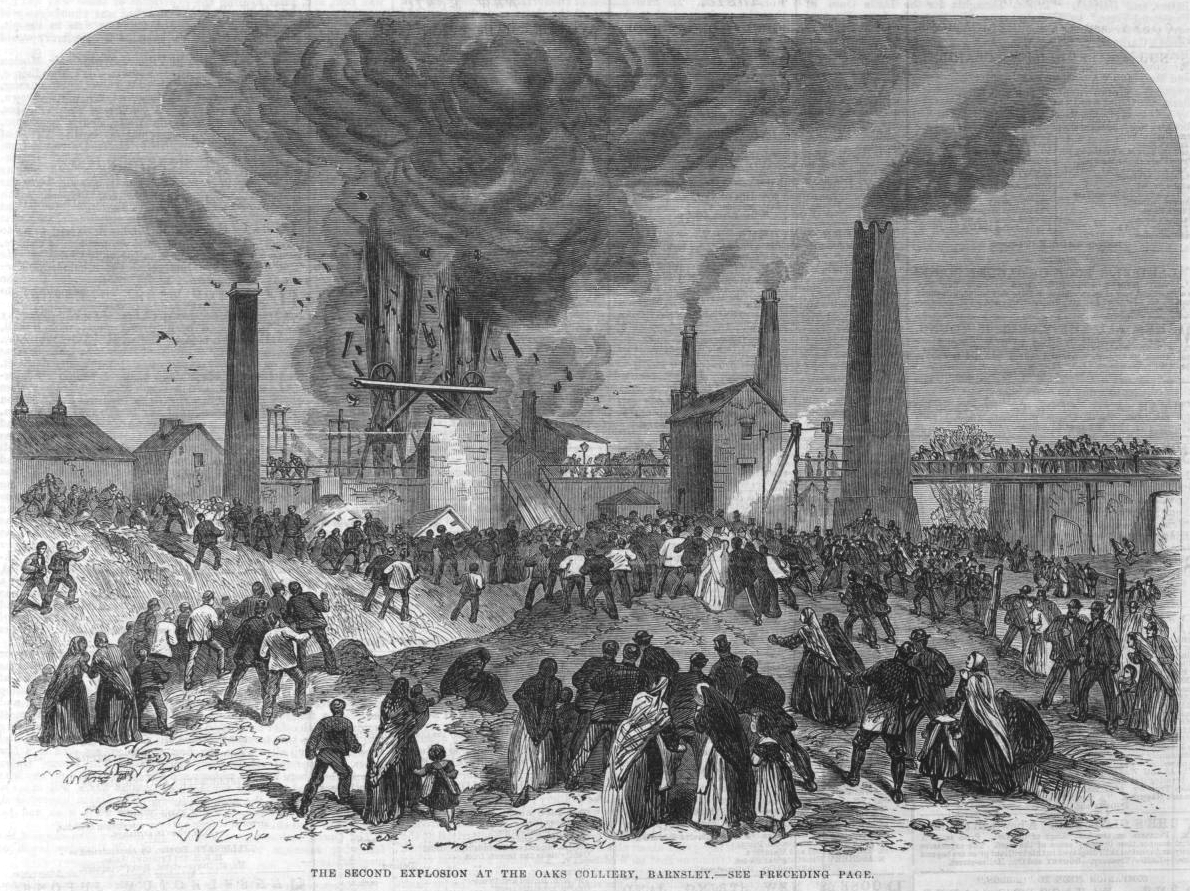
At dawn the next day, about 70 men went underground to recover bodies. At 8:30 in the morning, a smaller explosion sent the air reversing through the tunnels. Men rushed to the pit bottom, sixteen cramming into a cage built for six. They bid each other farewell as they waited for it to return. Then at five minutes to nine, the second, larger explosion hit. The cage was blasted into the headgear. Burning timbers were hurled into the air. Jeffcock, the engineer who had worked through the night, was killed along with Tewart, Siddons, Sugden, and 23 others. A third explosion followed that evening. The mine was sealed. From the surface, a telegram arrived from Queen Victoria at Windsor Castle, inquiring about the loss of life. Underground, the fire burned for months.
The Bell in the Dark
Between four and five in the morning on the third day, the signal bell at the No. 1 shaft rang. A bottle of brandy and water was lowered on a rope. When it came back up, the bottle was gone. Engineer John Mammatt and young Thomas Embleton volunteered to descend in a makeshift bucket, each man standing with one foot in the kibble, holding the rope with one hand and fending off the shaft walls with the other, safety lamps tucked under their clothes against the water streaming down the shaft. At the bottom they found Samuel Brown, who had survived both explosions by sheltering in a lamphole. His companions were dead around him. The three men balanced on the kibble as they were hauled back to daylight.
167 Widows, 366 Children
The disaster left 167 widows and 366 children under twelve. In Hoyle Mill, nearly all the men had perished -- some families lost a father and three or four sons. Special trains brought sightseers from Leeds, Sheffield, and Manchester the following Sunday. Thirty-five bodies were buried in a mass grave at Ardsley churchyard. Queen Victoria contributed 200 pounds to the relief fund; the Lord Mayor of London opened another. In total, 48,747 pounds was raised, but families were inadequately supported. Widows received five shillings a week. If they remarried, they got a twenty-pound bonus, and all payments stopped. The colliery was sealed for months. When it reopened in 1870, 150 bodies still underground were recovered. Jeffcock's body was found on 2 October 1869, nearly three years after the explosion. The disaster eventually contributed to the Coal Mines Act of 1872, but twelve more explosions occurred at British mines before the legislation took effect. A monument at Christ Church, Ardsley, erected in 1879, and a second memorial to Jeffcock and his rescuers in 1913, stand as the community's refusal to let the dead be forgotten.
From the Air
Located at 53.55°N, 1.45°W near Hoyle Mill and Stairfoot in Barnsley, South Yorkshire. The colliery site is now largely developed, but the Grade II listed winding engine house and pithead structures survive. Nearest airport: Robin Hood Doncaster Sheffield (EGCN) approximately 12 nm east. The terrain is gently rolling South Yorkshire coalfield country.