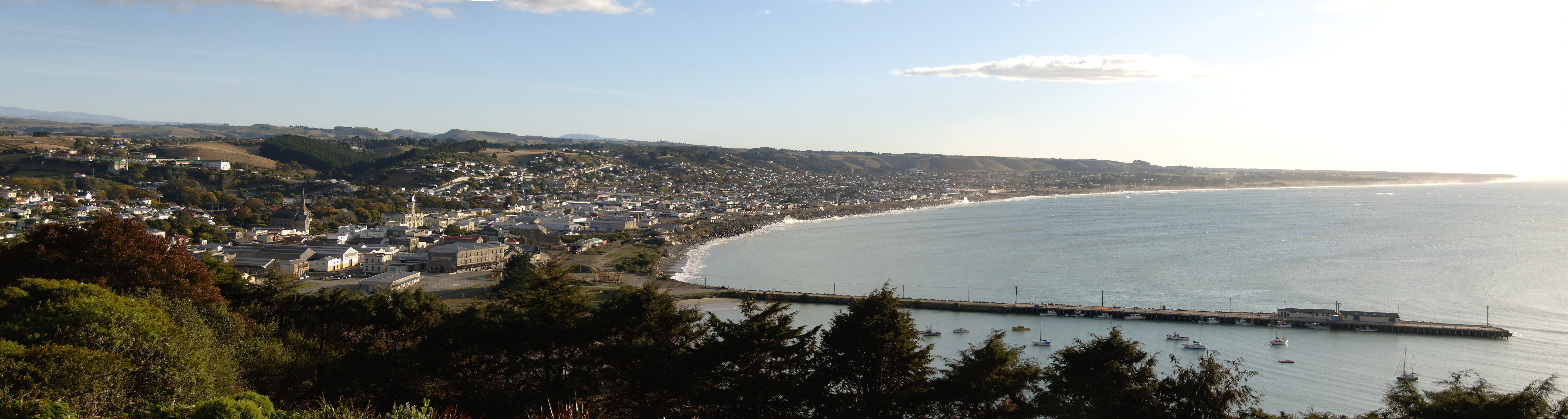
Oamaru
Oamaru went broke, and it was the best thing that ever happened to the town. In the mid-1800s, wool and grain money poured through this North Otago port, and the merchants built accordingly: banks, grain stores, a courthouse, a post office, all carved from the fine white limestone quarried just outside town. When the boom collapsed, Oamaru lacked the resources to demolish the old buildings and replace them with modern ones, the way every other ambitious New Zealand town was doing. The Victorian precinct survived by neglect. Today, that accidental preservation has given Oamaru the most significant collection of Victorian commercial architecture in the country, a streetscape so intact it feels less like a heritage district than a city that simply forgot to change.
Written in Whitestone
The buildings that define Oamaru are made from a material that could only come from here. Oamaru whitestone is a locally quarried limestone, cream-colored and fine-grained, soft enough to carve when freshly cut but hardening with exposure to air. Masons shaped it into Italianate facades and Classical columns, Corinthian capitals and ornate cornices, giving a small colonial port the architectural ambitions of a European city. The stone proved so workable and attractive that it was shipped across New Zealand for use in buildings far from Otago. But the greatest concentration of whitestone architecture remains in Oamaru's harbour precinct, where the buildings were constructed within a roughly thirty-year span during the town's peak prosperity. The region is now recognized as the Waitaki Whitestone UNESCO Global Geopark, New Zealand's first, honoring not just the architecture but the sixty-six-million-year-old geological formation from which the stone was quarried.
The Port That Fed Britain
Oamaru's wealth came from the land and left by sea. The natural harbour was improved with a breakwater to handle the volume of exports flowing out of North Otago's sheep stations and grain farms. But the moment that cemented the town's place in New Zealand economic history happened just south of town, at Totara Estate. There, the New Zealand and Australian Land Company built an export slaughterhouse, and from Totara Estate the carcasses traveled by train to Port Chalmers, where they were loaded as part of the first shipment of frozen meat from New Zealand to Great Britain. That single innovation launched what would become a billion-dollar industry, one that turned New Zealand into what was called the farmyard of Britain for most of the twentieth century. The prosperity funded the whitestone buildings, and when the export economy eventually contracted, the buildings remained as monuments to the era that built them.
Nightly Visitors
Every evening at dusk, the little blue penguins come ashore. Oamaru has several colonies of korora, the smallest penguin species in the world and the only one that is blue. They spend their days fishing at sea and return to their nesting burrows after dark, waddling up the beach in small groups while visitors watch from grandstands. The largest colony is managed as a commercial operation by the town council, with viewing platforms and controlled access that allow close observation without disturbing the birds. It is a genuinely strange spectacle: dozens of penguins, barely thirty centimetres tall, marching past a crowd of humans in near-darkness, utterly indifferent to their audience. Beyond the main colony, a smaller population of yellow-eyed penguins, known as hoiho, nests at Bushy Beach Scenic Reserve just outside town. The hoiho is one of the world's rarest penguin species, and seeing both in a single visit makes Oamaru one of the most accessible penguin-watching destinations anywhere.
Gears and Goggles
Somewhere between the Victorian architecture and the local appetite for the eccentric, Oamaru declared itself New Zealand's capital of steampunk. The movement found a natural home here. The whitestone buildings already looked like the backdrop for a Jules Verne adaptation, and the town's creative community leaned into the aesthetic with conviction. Steampunk HQ, housed in an 1883 Oamaru stone building at the entrance to the Victorian precinct, opened in 2011 as a part-museum, part-gallery, part-junkyard devoted to retro-futurism: ray guns, steam-powered contraptions, and repurposed industrial machinery reimagined as Victorian-era technology. An annual steampunk festival, usually held in June, draws enthusiasts from across the country. A separate Victorian heritage festival in November celebrates the architecture more directly. Together, the two events have given Oamaru a cultural identity that no one could have predicted when the town's economy first collapsed, proof that sometimes the most interesting places are the ones that had no choice but to become interesting.
From the Air
Oamaru sits on the North Otago coast at 45.09S, 170.97E, with its harbour and Victorian precinct visible along the waterfront. The town is served by Oamaru Airport (NZOU), located 20 km to the north alongside State Highway 1 at Hilderthorpe. Dunedin Airport (NZDN) is approximately 115 km to the south. From the air, the whitestone buildings of the harbour precinct are distinguishable by their pale coloring against the surrounding rooflines. The breakwater extending into the harbour is a useful landmark. The Waitaki River mouth is visible to the north, and the coastline south toward Moeraki offers views of the eroding mudstone bluffs that produced the famous Moeraki Boulders.