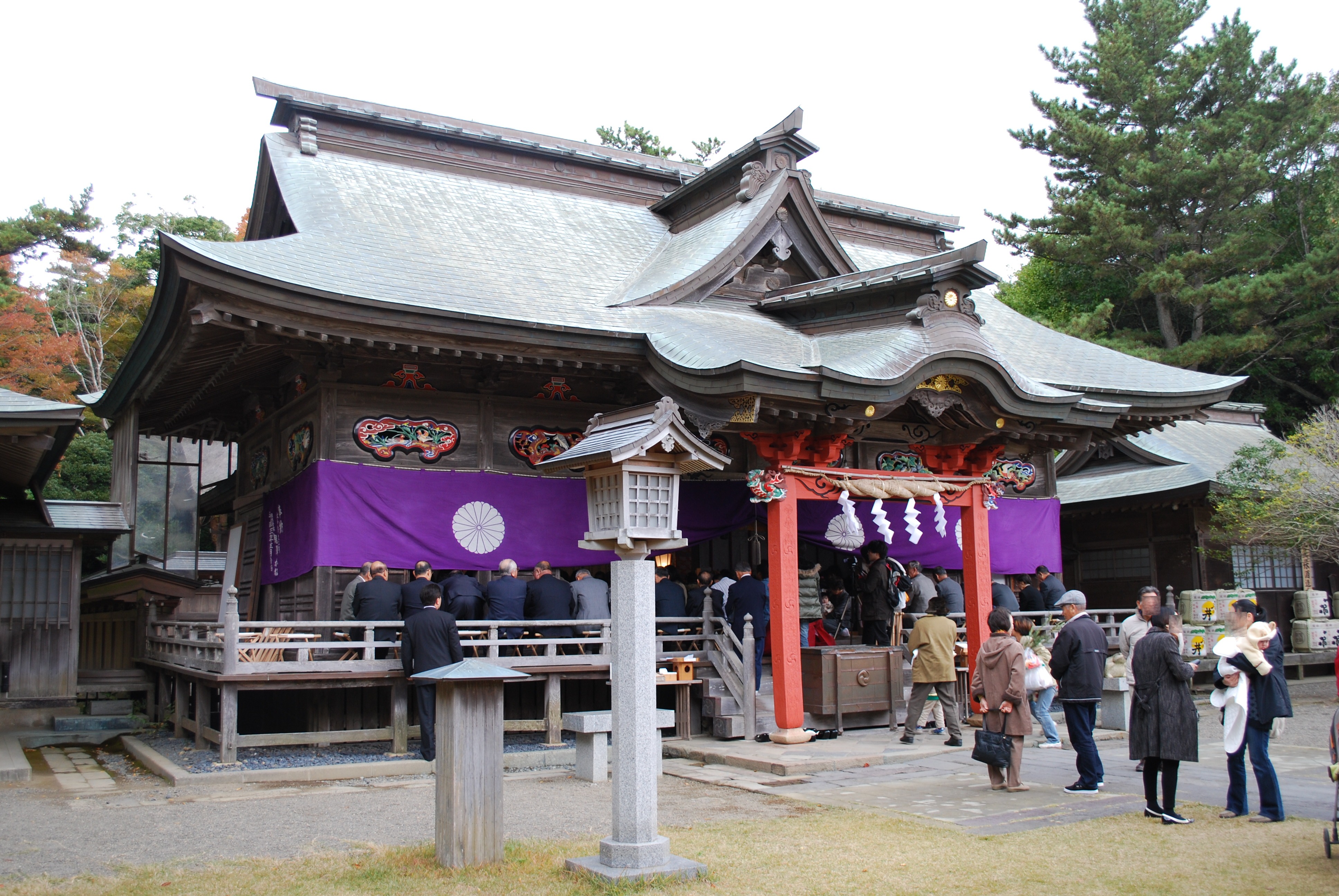
Oarai Isosaki Shrine: Where the Gods Landed on the Rocks
At dawn, photographers line up along the Ibaraki coastline to capture a single moment: the sun rising through the Kamiiso Torii, a stone gate standing on a jagged reef at the edge of the Pacific Ocean. Waves crash against the rocks, spray catching the first orange light, and the torii frames the horizon as if the gate itself is holding the ocean back. This is not decorative. In Shinto belief, this is the spot where the gods Onamuchi-no-Mikoto and Sukunahikona-no-Mikoto descended from the heavens and landed on the rocks. The ocean is the shrine's shintai -- its sacred body -- and the reef is the Kamiiso, the divine shore. The Oarai Isosaki Shrine, founded in 856 on the Kanto Plain northeast of Ibaraki Prefecture, is a place where the boundary between the human world and the divine is drawn not in wood and stone alone, but in salt water and sunrise.
The Divine Shore
The Kamiiso Torii is the image that defines Oarai Isosaki Shrine, but the shrine actually has three torii gates in separate locations, each marking a different threshold. The main torii is a massive reinforced concrete structure standing 15.6 meters high and 22.42 meters wide, positioned on the path leading to the shrine grounds. Behind it, a second torii rises before the shrine buildings come into view. But it is the third -- the Kamiiso Torii on the coast -- that draws visitors from across Japan. Facing east toward the Pacific Ocean and the rising sun, it marks the legendary landing point of the shrine's deities. On New Year's Day, the chief priest descends to the Kamiiso Torii at dawn to perform hatsuhinode prayers, greeting the first sunrise of the year from the sacred reef while waves surge around the gate's stone pillars.
Frogs Instead of Lions
Most Shinto shrines station komainu -- lion-dog guardians -- at their entrance. Oarai Isosaki is different. Statues of frogs guard the worship hall, sitting where visitors expect to see fearsome protectors. The choice is not random whimsy. In Japanese, the word for frog -- kaeru -- sounds identical to the words for 'safe return' and 'return of something lost.' The frogs are a blessing for travelers and those hoping to recover what has gone missing. It is a fitting symbol for a shrine whose deities are said to have journeyed from the heavens to this specific stretch of coast, and whose worshippers have long included fishermen and sailors heading out to sea and praying for a safe return home.
Destruction and a Lord's Devotion
The shrine's history has not been unbroken. Founded in 856, Oarai Isosaki Shrine was destroyed during the wars that swept Japan between 1558 and 1570. For over a century, the sacred site lay in ruins. Reconstruction began in 1690 at the order of Tokugawa Mitsukuni, the second lord of the Mito domain and one of the most influential figures in Japanese cultural history. Mitsukuni was famous for commissioning the Dai Nihonshi, a comprehensive history of Japan, and for his deep engagement with the country's cultural and religious heritage. His patronage of Oarai Isosaki Shrine was part of that broader mission. Construction continued after his death and was completed around 1730. The shrine buildings that stand today -- designated a cultural property by Ibaraki Prefecture -- trace their lineage to Mitsukuni's restoration.
The Ocean as a Shrine
What makes Oarai Isosaki Shrine conceptually striking is that its most sacred element is not a building, a relic, or a statue. The Pacific Ocean itself is the shintai -- the sacred object that embodies the divine presence. The shrine is a kannabi, a place where the natural landscape functions as the dwelling of the gods. The shrine's two deities, Onamuchi-no-Mikoto and Sukunahikona-no-Mikoto, are believed in Shinto tradition to have created Japan itself. Their landing at the Kamiiso reef connects this stretch of Ibaraki coastline to the deepest narratives of Japanese origin. The shrine sits on the Kanto Plain, about two and a half kilometers from Oarai Station, accessible by bus or taxi. But approaching from the sea -- or from the air -- the relationship between shrine and ocean becomes unmistakable: the buildings face the water, the torii stands in it, and the gods came from beyond it.
From the Air
Located at 36.32°N, 140.59°E on the Pacific coast of Ibaraki Prefecture. The Kamiiso Torii gate is visible on the rocky coastline, facing east toward the open ocean. From altitude, look for the shrine complex set back from the coast with the distinctive torii gate on the reef below. The town of Oarai sits along the coast with its fishing port to the south. Ibaraki Airport / Hyakuri Air Base (RJAH) lies approximately 20 nautical miles to the south-southwest. Best viewed at 2,000-3,000 feet AGL approaching from the sea to appreciate the torii-to-ocean relationship. The coastline runs roughly north-south, and the shrine is positioned on a slight promontory.