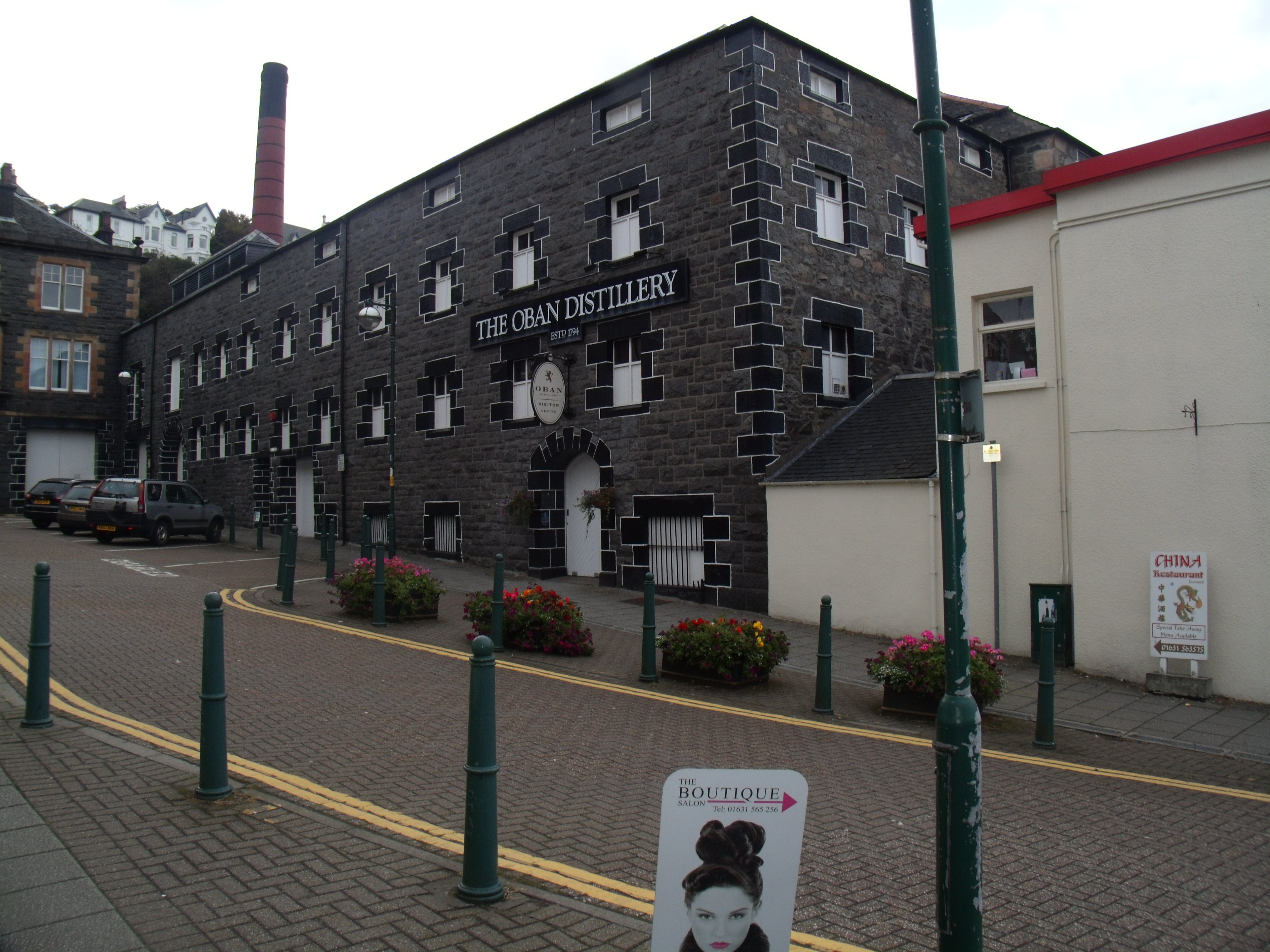
Oban distillery
The distillery was here before the town. When brothers John and Hugh Stevenson built their whisky operation in 1794, the craggy harbour that would become Oban was little more than a scattering of buildings around a natural inlet on Argyll's west coast. The town grew up around the distillery, not the other way round -- a fact that still shapes the geography of Oban, where the distillery sits in the town centre, hemmed in by streets and buildings that arrived later and had to work around it. With only two pot stills, Oban is one of the smallest distilleries in Scotland, producing a whisky that Diageo markets as part of its Classic Malts Selection -- a single malt described as falling between the dry, smoky style of the Scottish islands and the lighter, sweeter character of the Highlands.
Two Centuries in a Harbour
The Stevenson brothers ran the distillery until 1866, when it was sold to Peter Curnstie. Walter Higgin acquired it in 1883 and rebuilt it. In 1898, Alexander Edward -- who also owned Aultmore Distillery -- bought out Higgin, only to suffer major losses in his first year when Pattisons of Leith, a major blending company, collapsed in one of the whisky industry's most spectacular financial scandals. The distillery survived, passing to Dewars in 1923 and joining the Distillers Company in 1925. It fell silent twice -- from 1931 to 1937 and again from 1969 to 1972, when a new still house was built. In 1989, a visitors' centre was installed, opening the operation to the tourists who by then were arriving in Oban by the thousand, bound for ferries to the Hebrides.
Between Two Worlds
Oban's whisky character reflects its geography. The distillery sits at the meeting point of the mainland Highlands and the inner islands -- Mull is visible across the water, Lismore lies to the north, and the ferries to Coll, Tiree, and Barra depart from the pier a few hundred metres away. The resulting malt has been described as having a 'West Highland' flavour: maritime but not as aggressively peated as an Islay whisky, warm but without the honeyed sweetness of a Speyside. The constraint of two pot stills limits production but concentrates character. What comes out of those stills carries something of the harbour -- salt air, rain, and the particular quality of light that occurs when Atlantic weather systems collide with the Scottish coast.
Classic and Continuing
The distillery is primarily known for its 14-year-old malt, part of Diageo's Classic Malts range launched in 1988. A Distiller's Edition, finished in Montilla Fino sherry casks, offers a richer variation. Limited editions have included an 18-year-old and a rare 32-year-old bottling limited to 6,000 bottles. In 2014, Oban introduced a non-age-statement whisky called Little Bay, and in 2023, Diageo released an 11-year-old called The Soul of Calypso, matured in Caribbean rum casks. The distillery continues to operate from its original site, surrounded by a town that grew up around it and a harbour that connects it to the islands whose influence it carries in every bottle. Two hundred and thirty years after the Stevenson brothers chose this craggy inlet, the stills are still running, the visitors are still coming, and the whisky still tastes like the place where the Highlands meet the sea.
From the Air
Located at 56.41N, 5.47W in the centre of Oban on the Argyll coast. The distillery is embedded within the town and not easily distinguished from the air, but Oban harbour and the ferry terminal are prominent landmarks. Nearest airport is Oban Airport (no ICAO code); nearest major airports are Glasgow (EGPF) and Inverness (EGPE). Best viewed at 2,000-3,000 feet with Oban Bay, Kerrera, and Mull visible.