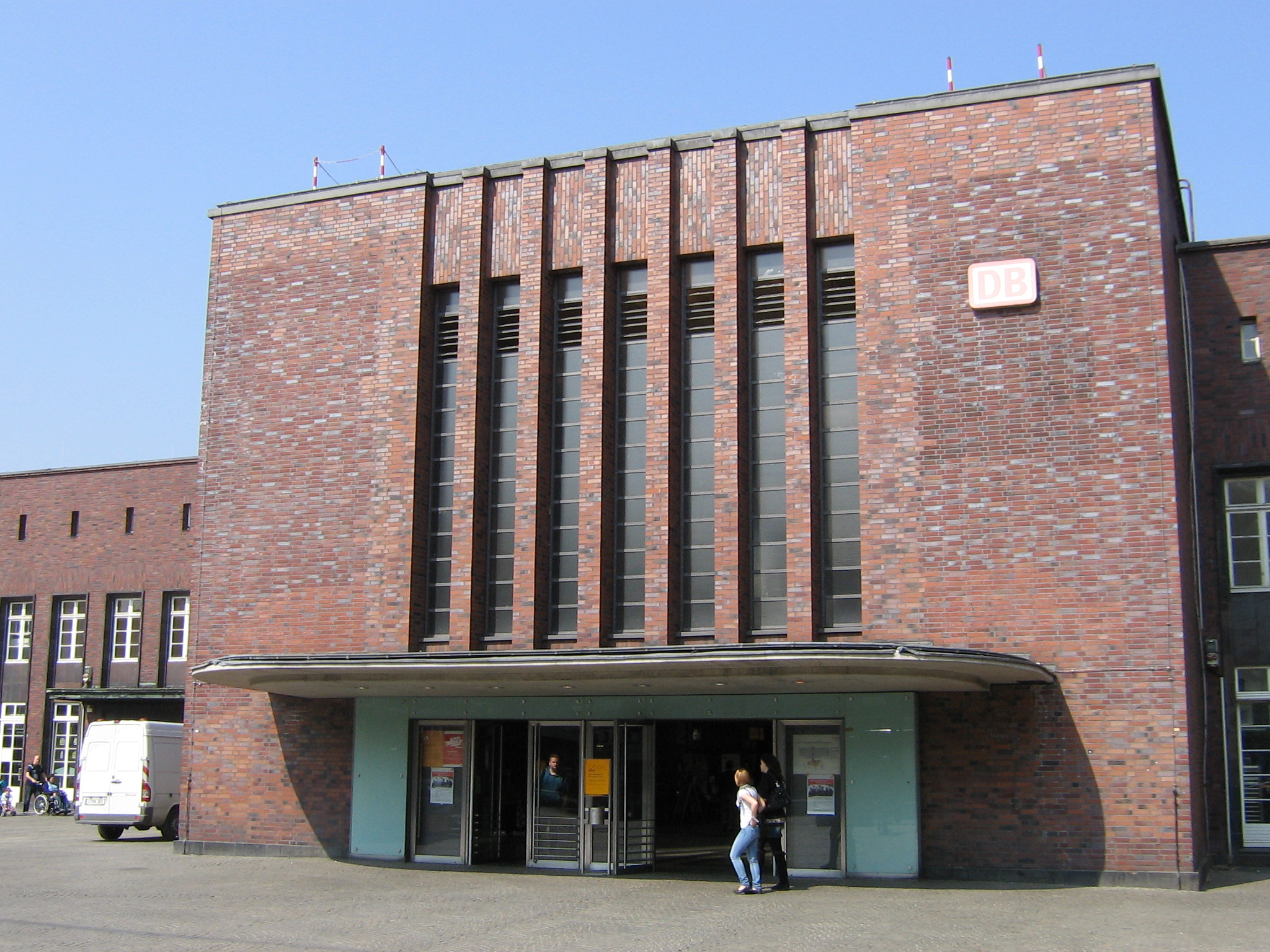
Oberhausen Hauptbahnhof
When the first station opened here on 15 May 1847, the city of Oberhausen did not yet exist. There was a castle nearby called Schloss Oberhausen, and the new half-timbered loading shed took its name. There were coal seams under the heath. There was a steel works at Gutehoffnungshuette and a zinc smelter at Altenberg that would soon be moved closer to the rails. There was Franz Haniel, the industrialist who lobbied the Prussian government to bend the Cologne-Minden Railway's route his way. The station came first; the city assembled itself around the platforms, year by year, like crystal forming on a thread.
The Junction the Ruhr Built
By 1880 Oberhausen had become one of the most important railway junctions in the Ruhr. Multiple companies had laid track here, each with its own station building, each competing for the same coal traffic. The Bergisch-Maerkische company put up its entrance hall in 1866, just meters from the Cologne-Minden building. When Prussia nationalized the railways in the early 1880s, the bureaucrats did what bureaucrats do: they consolidated. In 1888 the two rival stations merged into a single prestigious complex, with tunnels threading between platforms. The new Hauptbahnhof was the Ruhr in microcosm - private capital, eventually folded into state direction, all of it ultimately serving the coal.
Cubic Forms, 1934
The current building went up between 1930 and 1934. The Oberhausen architect Schwingel designed it with Karl Herrmann, the Deutsche Reichsbahn's regional supervisor at Essen, in the simple cubic forms of the international modernist style. It is an austere building - red brick, clean lines, none of the ornament that nineteenth-century stations wore as civic jewelry. The relief above the entrance, Die drei Lebensalter - The Three Ages - by sculptor Ernst Mueller Blensdorf, is just about the only decorative gesture. The building opened in the year that Germany's political experiment with modernism was being violently extinguished. The architecture survived; the political context did not.
Bombs and a Cinema
During the Second World War, the station was hit again and again by bombs and shells. The entrance hall was wrecked. When it finally reopened in 1954 the postwar reconstruction was thrifty and strange: a false ceiling was installed over the original hall, and above that ceiling, in the space that had once been open to the modernist void, a cinema was tucked. The Bali-Kino showed films above commuters' heads for decades. A small shopping arcade filled the rest. Anyone passing through Oberhausen in those years walked under a movie theater they could not see, watching trains they could.
The Emscher Park Restoration
In 1993, as part of the Internationale Bauausstellung Emscher Park - the regional reinvention project that turned old Ruhr industrial sites into museums, parks, and landmarks - the station was completely renovated. The false ceiling came down. The Bali-Kino was removed. The shopping arcade was gone. The 1934 entrance hall reappeared in something close to its original form. Mueller Blensdorf's Three Ages relief came home. The platform tracks were reduced from fourteen to ten. The old railway mail terminal was demolished and the space converted into the platform for the LVR Industrial Museum, headquartered next door from 1997. The pedestrian tunnel was modernized and pushed through to a new entrance on the western side.
A Junction Still
Today Oberhausen Hauptbahnhof remains exactly what it was always meant to be: a node where lines cross. ICE trains glide through on the run between Amsterdam and Frankfurt. EuroCity services connect Muenster all the way to Klagenfurt in Austria. Regional expresses spread out into the Ruhr in every direction - to Dortmund, to Duesseldorf, to Wesel and the Lower Rhine, to Bottrop and Wuppertal. The S-Bahn ties Oberhausen to Muelheim, Essen, and Hattingen. Tram line 112 runs every ten minutes to Muelheim. Eight night buses fan out across the city after the trains stop. A station built before the city it serves still organizes the daily life of a place that owes its name, and arguably its existence, to a rail timetable.
From the Air
Located at 51.4742 degrees north, 6.8533 degrees east, in central Oberhausen, North Rhine-Westphalia, immediately northeast of the city core. Nearest airport is Duesseldorf International (EDDL), about 22 km south. The station is visible from low altitude as a long cluster of platform canopies parallel to the main north-south Ruhr rail spine; the LVR Industrial Museum is the prominent companion structure on the western side. Airspace is congested with EDDL approach traffic.