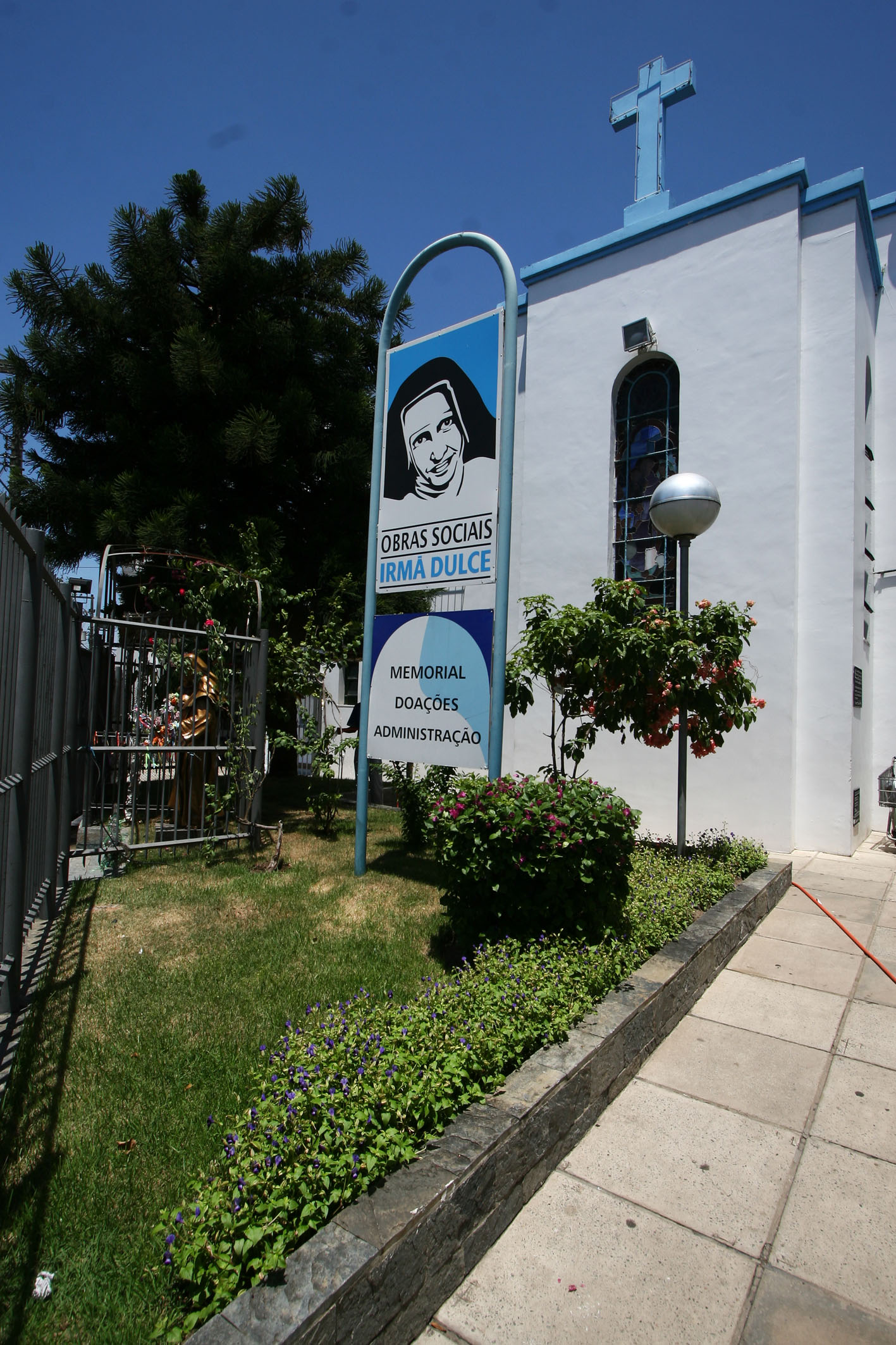
Obras Sociais Irmã Dulce
She started with a chicken yard. In 1949, in the convent where she lived in Salvador, Sister Dulce Lopes Pontes cleared a space behind the hens and began caring for seventy people whose other option was the street. She walked the city at night looking for sick people no one else would take. She walked it during the day collecting food and medicine and whatever else anyone would spare. From that chicken yard grew a thousand-bed teaching hospital, schools for poor children, a children's hospital, a women's clinic, a geriatric center, and a research program partnering with Cornell and Berkeley. Today the Obras Sociais Irmã Dulce - OSID - is one of the ten largest health institutions in Brazil, and every patient it treats pays nothing. She was canonized as Saint Dulce of the Poor on October 13, 2019, the first Brazilian woman ever declared a saint by the Catholic Church.
Maria Rita, Who Became Dulce
She was born Maria Rita de Souza Lopes Pontes in Salvador on May 26, 1914. She entered religious life at nineteen and took the name Dulce - sweet. The city she worked in was a hard one for the poor. Bahia in the mid-twentieth century was a place where rural migrants poured into coastal slums, where the public-health system barely existed, where tuberculosis and malnutrition killed children who had no recorded names. She did what she could with what she had, and what she had was remarkable persistence. Doctors who had paying clinics began volunteering their evenings. Neighbors began donating food. In 1959 she formally established OSID as a charitable foundation. On May 26 of that year - her birthday - she signed the papers. A year later, in 1960, the Santo Antônio Hospital opened its first 150 beds. She had convinced an entire city to build the thing the state refused to.
A Hospital That Grew
The 1960s and 70s turned the foundation into an institution. An advisory council was seated. Medical residencies began. In 1983 the new Santo Antônio Hospital opened with a thousand beds - a scale previously unimaginable for a charity operation. When economic crisis hit Brazil in the late 1980s and patient demand surged faster than funding, OSID nearly went under. Dulce herself was gravely ill by then. She asked that her niece, Maria Rita Pontes, be placed at the head of the foundation, and in 1992 Maria Rita took over. On March 13 of that year, Dulce died. People in Salvador still point out where they were when they heard. The funeral filled the streets. In the decade that followed, OSID did not contract - it expanded. Six new nuclei opened. A pediatric ICU. An adult ICU. A center for alcoholics with nowhere else to go. The institution found its footing again, and its second act turned out to be the bigger one.
The Range of What It Does
OSID today is fourteen nuclei, thirteen of them in the Roma Hospital Complex in Salvador. The Santo Antônio Hospital runs seventeen medical specialties and performs about a thousand surgeries every month. The José Sarney Ambulatory handles roughly three thousand patients a day across thirty-three specialties. The Children's Hospital, one hundred and two beds, is widely cited as a humanistic model of pediatric care and is the only center in Bahia that meets every requirement of the Ministry of Justice for the rights of hospitalized children. The D. Dulcinha Women's Clinic focuses on gynecology and cancer prevention. The Centrinho rehabilitation center for craniofacial anomalies is Brazil's second-largest facility for people with facial clefts. The Augusto Lopes Pontes Social Medical Center takes in people no other hospital would - people without family, people with severe mental illness, people living on the street. The CATA alcoholism center is the only such inpatient service in Bahia. In Simões Filho, one of the poorest cities in the metropolitan region, CESA provides free education, meals, and health care to about 800 children from families where eighty-five percent live on less than a dollar a day.
Santa Dulce
The canonization process began in January 2000. Pope Benedict XVI approved her beatification in 2011. In May 2019, Pope Francis recognized the second miracle attributed to her intercession - a Bahian man blind for fourteen years who prayed to her and regained his sight. On October 13, 2019, Pope Francis canonized Dulce Lopes Pontes as Santa Dulce dos Pobres - Saint Dulce of the Poor. She became the first Brazilian woman ever declared a saint. It was one of the fastest canonization processes in the Church's history. In Salvador, the celebration lasted days. The memorial to her life is the foundation's fourteenth nucleus; it houses roughly three thousand testimonies of people reporting answered prayers. None of that - the sainthood, the miracles, the global attention - changes the daily arithmetic. At the Roma Hospital Complex the doors open in the morning and people who could not afford care anywhere else walk through them, and the treatment is free, because she wanted it to be.
From the Air
Located at 12.93°S, 38.51°W in the Roma neighborhood of northern Salvador, Bahia. The Roma Hospital Complex occupies roughly 39,000 m² of built facilities on 173,000 m² of institutional land - large enough to identify clearly from the air. Recommended viewing altitude 2,000-3,000 ft AGL to place the complex in relation to Salvador's bay and historic center. Nearest airport: Salvador International (SBSV), about 20 km north, full ILS service and scheduled flights. The urban fabric of Salvador is complex - watch for the Lacerda Elevator and Pelourinho to the south and the Itapagipe peninsula jutting into the bay to the northwest. Typical afternoon sea breeze from the southeast; tropical storms are rare, but heavy rain and convective cells are possible December-April.