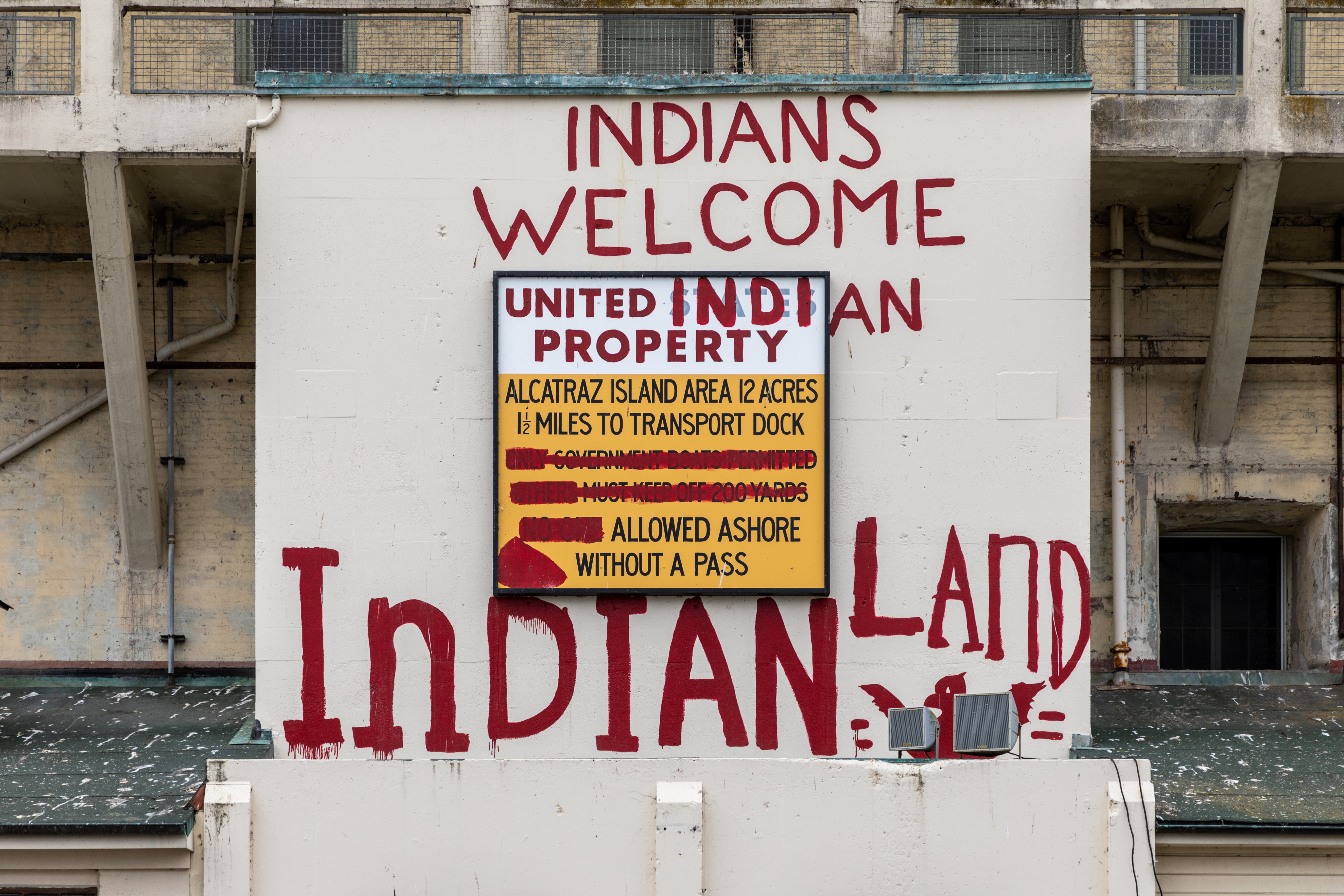
Occupation of Alcatraz
The offer was $9.40 for the entire rocky island. That was 47 cents per acre, the same price the federal government had historically offered Indigenous peoples for their land. On November 20, 1969, when 89 American Indians occupied Alcatraz Island, they were making a point with a price tag. The abandoned federal penitentiary, closed since 1963 and declared surplus property in 1964, sat empty in San Francisco Bay. Under the Treaty of Fort Laramie of 1868 between the United States and the Lakota, retired or abandoned federal land was supposed to return to the Indigenous peoples who once occupied it. For the next 19 months, Alcatraz belonged to Indians of All Tribes.
The First Landing
The 1969 occupation was not the first attempt to reclaim the island. On March 8, 1964, Belva Cottier, a Rosebud Lakota social worker living in the Bay Area, led a small group of about 40 Lakota in a four-hour demonstration. Cottier had read that the penitentiary was closing and remembered the 1868 treaty her people had signed. She and her cousin Richard McKenzie found a copy and proposed that if the property was surplus, the Sioux could claim it. The 1964 protesters even offered to let the federal government maintain use of the Coast Guard lighthouse. They left only under threat of felony charges, but the incident lit a spark that would not go out.
Fire and Urgency
On October 10, 1969, the San Francisco Indian Center burned to the ground. The center had provided jobs, healthcare, legal aid, and a gathering place for the Bay Area's Native American community. Its loss transformed frustration into action. Plans that had focused on writing formal applications and filing proposals gave way to something more immediate. When five boats organized to carry 75 Indigenous people to Alcatraz failed to show up, Adam Fortunate Eagle convinced the owner of the Monte Cristo, a three-masted yacht, to sail past the island. Several activists dove into the water and briefly touched shore before the Coast Guard retrieved them. LaNada Means, dissatisfied with the day's outcome, hired a fishing boat. That night, fourteen people stayed on the island.
We Hold the Rock
At its peak, 400 people lived on Alcatraz. Stella Leach, a Colville-Lakota woman, established a health clinic. Jennie R. Joe, a Navajo, and Dorothy Lonewolf Miller of Blackfeet descent served as nurses, while volunteer doctors provided care. A daycare operated for children. John Trudell became the voice of Radio Free Alcatraz, broadcasting the occupiers' message across the nation. Yet LaNada Means, one of the first to arrive and one of the last to leave, who organized the written statements and speeches, received less recognition from mainstream media. Fellow activist Dean Chavers, a Lumbee, called her the real leader of the occupation. The 14 original occupiers had come from universities, the San Francisco Indian Center, and tribes across the country, united under a flag designed by Lulie V. Nall, a Penobscot activist.
The Treaty That Echoed
The occupiers invoked the 1868 Treaty of Fort Laramie, but they also claimed the island by right of discovery, deliberately echoing the legal doctrine Europeans had used to claim Indigenous lands. Their proclamation to the General Services Administration dripped with irony, offering to create a Bureau of Caucasian Affairs and suggesting the island's isolation and lack of fresh water made it suitable for an Indian reservation. The protest drew inspiration from contemporary civil rights demonstrations, some of which the student activists had themselves organized. Joe Morris, representing the Longshoreman's Union, threatened to close both Bay Area ports if authorities removed the occupiers by force.
From the Air
Alcatraz Island rises from San Francisco Bay approximately 1.25 miles offshore from Fisherman's Wharf, its abandoned cellhouse and water tower visible from any approach to the city. The island covers just 22 acres but dominates the bay visually, its weathered concrete structures a stark contrast to the blue water surrounding it. The graffiti reading 'Indians Welcome' and 'Indian Land' that appeared during the occupation has been preserved as a historic reminder of those 19 months when the former federal prison became a symbol of Indigenous resistance. Flying over the bay, pilots can see Alcatraz as part of the constellation of Bay Area landmarks: the Golden Gate Bridge to the west, Angel Island to the north, the San Francisco skyline to the south.
From the Air
Located at 37.827N, 122.423W in San Francisco Bay, approximately 1.25nm north of Fisherman's Wharf. Alcatraz Island is immediately recognizable from the air by its abandoned prison complex and water tower. The island sits within San Francisco Class B airspace. Best viewed from 1,500-2,500 feet AGL. Nearby airports: KSFO (11nm S), KOAK (6nm E). The island forms a visual triangle with the Golden Gate Bridge and downtown San Francisco.