Occupy Oakland
On October 25, 2011, a police projectile struck Iraq War veteran Scott Olsen in the head as he stood among protesters at Frank Ogawa Plaza in downtown Oakland. The fractured skull and brain swelling that followed would make Olsen a symbol of something larger than any single encampment -- the moment Occupy Wall Street's West Coast sibling became the movement's most volatile chapter. What had started two weeks earlier as a few dozen tents on the plaza's concrete expanse was now drawing thousands into the streets, shutting down the nation's fifth-busiest port, and forcing a city already struggling with poverty and policing to confront questions it had been avoiding for years.
Tents on the Concrete
Occupy Oakland planted its first stakes on October 10, 2011, when a rally of several hundred people gave way to a couple dozen tents at Frank Ogawa Plaza -- the square named for the city's first Japanese-American council member, which protesters would rename Oscar Grant Plaza in honor of a young Black man killed by transit police in 2009. By October 15, the encampment had swelled to roughly 2,500 marchers. A makeshift community took shape: a kitchen, a library, a children's area. Freed American hikers Shane Bauer and Josh Fattal, just released from Iranian custody, came to speak. Rapper Lupe Fiasco donated supplies. The demonstrators acknowledged the area's existing problems -- drug crimes, rats, violence at 14th and Broadway -- but argued these had gone unchecked long before the tents arrived. City officials saw it differently. On October 25, police from Oakland and multiple surrounding departments moved in before dawn, dismantling the camp and arresting dozens.
The Night That Changed Everything
The eviction did not end the occupation. It escalated it. That same evening, hundreds of protesters returned to the plaza, and police responded with tear gas, rubber bullets, and flash-bang grenades. It was during this confrontation that Scott Olsen, a 24-year-old Marine veteran who had served two tours in Iraq, was struck in the head by a projectile. Video showed him lying motionless on the pavement as other protesters rushed to help, only to be driven back by a flash-bang grenade that detonated at their feet. Olsen was hospitalized with a fractured skull. The images ricocheted across the internet. About 2,000 people held a candlelight vigil at the plaza two days later. The Oakland Police Officers' Association took the unusual step of issuing an open letter expressing "confusion" about Mayor Jean Quan's decision-making. Within a week, the tents were back.
Shutting Down the Port
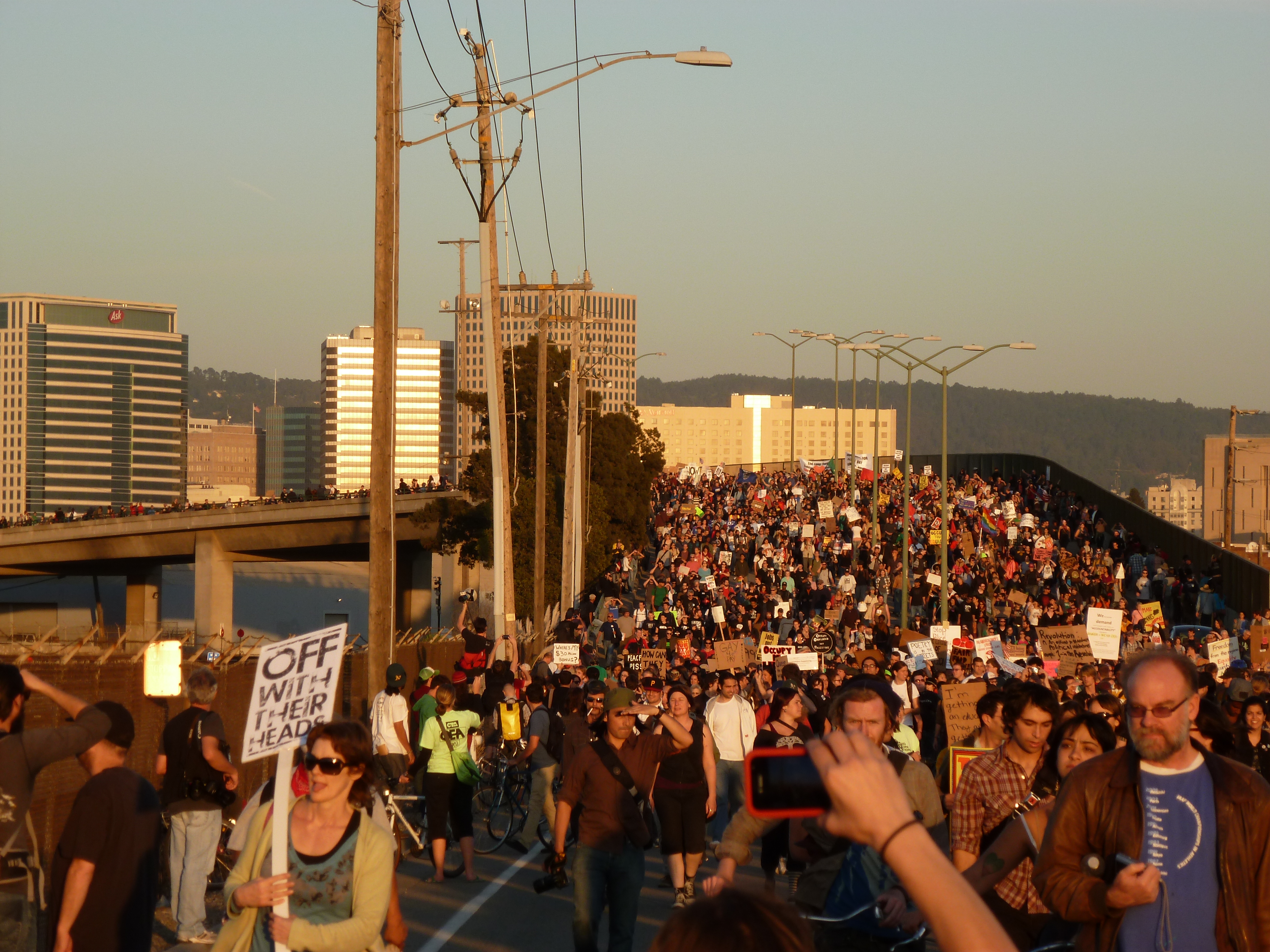
On November 2, 2011, Occupy Oakland called a general strike -- the first in Oakland since 1946. Thousands marched to the Port of Oakland, the fifth-busiest container port in the country, and shut it down. The action drew national attention and debate: supporters saw it as proof that the movement could wield genuine economic power, while critics warned it would hurt the very working-class communities Occupy claimed to represent. The port reopened the next morning, but the precedent had been set. A second port shutdown followed on December 12, this time coordinated with Occupy movements in other West Coast cities. By then, however, the encampment was fraying. A man had been fatally shot about 25 yards from the camp on November 10. The city authorized an emergency $300,000 expenditure to hire private security. Police cleared the camp again on November 21.
January's Reckoning
The most dramatic confrontation came on January 28, 2012. Approximately 500 protesters marched through downtown and attempted to break into the historic Henry J. Kaiser Convention Center. When that failed, they returned to Frank Ogawa Plaza, forced open the doors of City Hall, and surged inside. Surveillance footage showed protesters overturning vending machines, smashing display cases, knocking over a century-old replica of the building, and damaging a children's art exhibit. Someone took an American flag and set it on fire. In all, 409 people were arrested that day -- the largest mass arrest in the movement's history. At least 12 protesters received stay-away orders barring them from City Hall. Mayor Quan said the city would seek monetary compensation for the damage.
What Remained
In 2013, the Oakland City Council approved a $1.17 million settlement for 12 protesters who had been injured by police, including Scott Campbell, who was shot with a less-lethal round while filming officers. The settlement required police to adhere to their own crowd-control policy -- a pointed acknowledgment that they had not. The tent city was gone by then, but its aftershocks persisted. Many former Occupy Oakland members formed Justice 4 Alan Blueford, an organization that coalesced in June 2012 after a young man named Alan Blueford was killed by Oakland police officer Miguel Masso. They pushed for transparency -- a coroner's report, then a police report -- and eventually shut down a City Council meeting to demand accountability. The plaza itself returned to its ordinary life of office workers and lunchtime foot traffic, but the questions Occupy Oakland raised about inequality, policing, and who gets to claim public space never entirely went away.
From the Air
Coordinates: 37.805°N, 122.272°W. Frank Ogawa Plaza sits in downtown Oakland, visible between the distinctive Oakland City Hall tower and the elevated I-880 freeway. Best viewed at 2,000-3,000 feet AGL. Metropolitan Oakland International Airport (KOAK) lies 5 nm to the south. Oakland's downtown grid is easily identifiable from the air, with Broadway cutting diagonally through the regular street pattern. The Port of Oakland's massive container cranes are visible along the waterfront to the west.