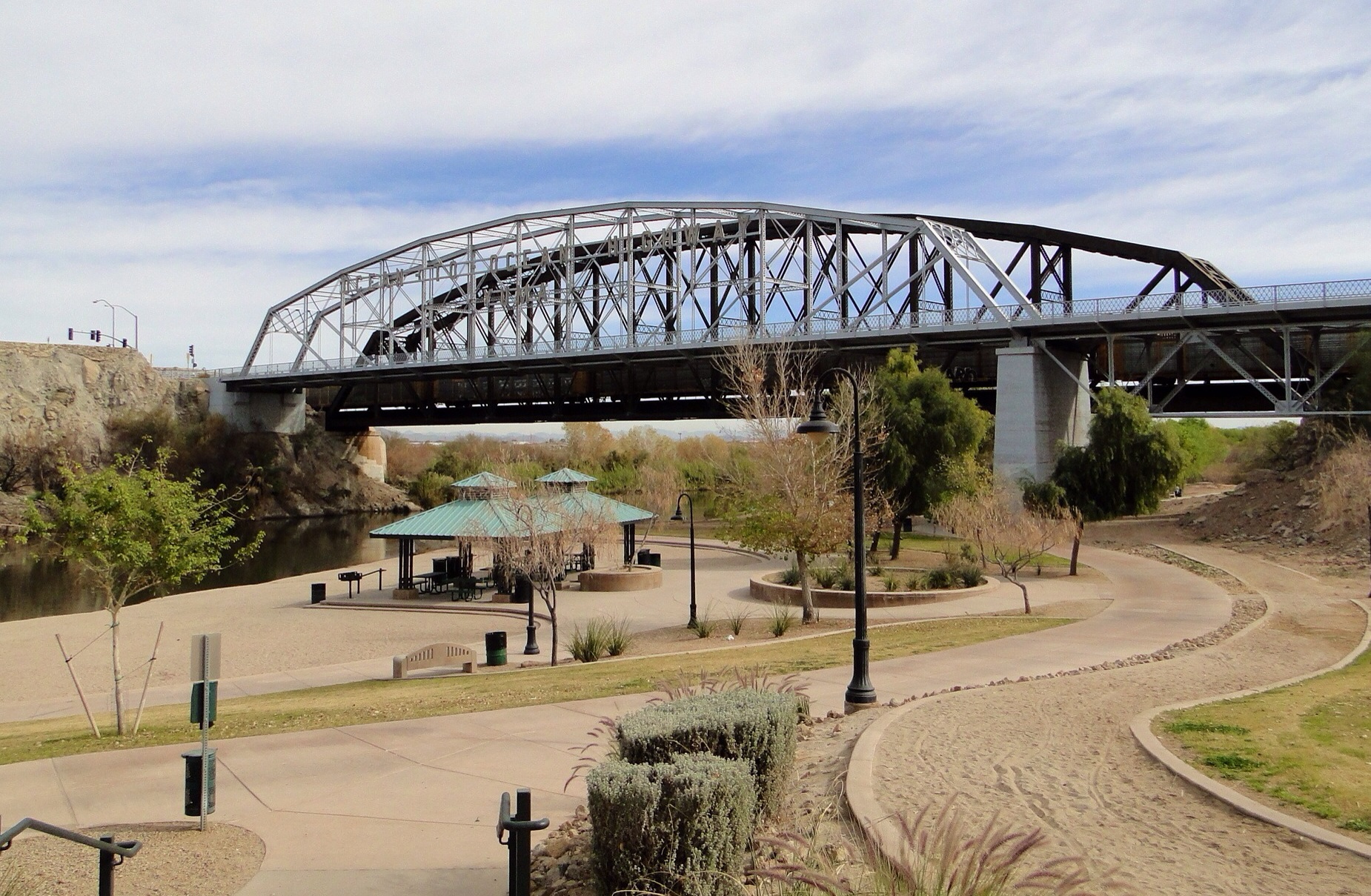
Ocean-to-Ocean Bridge
Before 1915, crossing the Colorado River at Yuma required a ferry or a railroad bridge that did not accommodate automobiles. The Ocean-to-Ocean Bridge changed that — it was the first highway bridge over the lower Colorado, and when it opened, it connected a transcontinental route that ran, at least in aspiration, from the Atlantic to the Pacific. For the next seven decades, it carried the main road west.
The First Highway Bridge
The bridge opened in 1915, a through truss structure spanning the Colorado at Yuma. It was a Pennsylvania truss design — the only one of that type in Arizona — built to carry the Ocean-to-Ocean Highway, an early transcontinental route that would later be designated US Route 80. The crossing it provided was not merely convenient; before its construction, automobile travelers bound for California from the east had to find alternative means to get their vehicles across the river.
The bridge sat at the Yuma Crossing, the same narrow gap in the Colorado that had been the most critical crossing point in the region for centuries. The granite outcroppings that narrowed the river here had guided the Spanish, the gold seekers, the emigrants, and the military. Now they guided the automobile, which was rapidly becoming the dominant technology of American movement.
Seventy-Three Years of Traffic
From 1915 to 1988, the Ocean-to-Ocean Bridge carried the main highway traffic across the Colorado at Yuma. The Ocean-to-Ocean Highway became US 80, which for decades was one of the primary southern routes across the continent — what the Lincoln Highway was to the north, US 80 was to the south, and this bridge was its crossing of the Colorado.
As traffic volumes grew and vehicle weights increased, the bridge was supplemented and eventually replaced by newer infrastructure. Interstate 8 had its own crossing. The historic bridge continued to serve US 80 traffic even as the interstate system rendered its route secondary. Then in 1988, a collision damaged one of the bridge's piers and the structure was closed to traffic. The question became what to do with an aging through truss bridge that no longer served its original purpose.
Closed, Threatened, Restored
After the 1988 closure, the bridge sat unused and deteriorating for thirteen years. Demolition was one option discussed — the bridge was structurally compromised and no longer carrying traffic. The alternative was restoration, which required money and a plan for the bridge's future use.
In 2001, a $3 million restoration project began. The Ocean-to-Ocean Bridge reopened to vehicular traffic in 2002 — carrying local traffic on Penitentiary Avenue, no longer a transcontinental highway but still a working river crossing, and a living artifact of the automobile age that had built it.
In 2018, the bridge was officially designated as part of Historic US 80, a designation that recognizes the route's significance as a predecessor to the interstate system and one of the formative roads of twentieth-century American travel.
A Crossing at the Crossing
What makes the Ocean-to-Ocean Bridge's location significant is its position at the Yuma Crossing — the same geographic point that has been the critical link across the Colorado River for as long as people have needed to cross it. Hernando de Alarcón reached this point in 1540. Juan Bautista de Anza crossed here in 1774 on his way to California. The Butterfield Overland Mail used the crossing. The railroad used it. And then, in 1915, the automobile found its bridge here.
The bridge now serves walkers and cyclists who want to cross the Colorado on foot and look down at the river from its deck. The view from the old through truss includes the water, the riverbanks, the surrounding desert, and the newer infrastructure that replaced it — all the layers of a crossing that has been in continuous use for centuries, each generation finding its own way across.
From the Air
Located at approximately 32.73°N, 114.62°W at the Yuma Crossing, where the Colorado River forms the Arizona-California border. The through truss bridge is visible from low altitude spanning the river just north of the historic downtown Yuma area. The newer Interstate 8 bridge is visible to the north. Nearest airport: Yuma International Airport (KNYL), approximately 4 miles to the south.