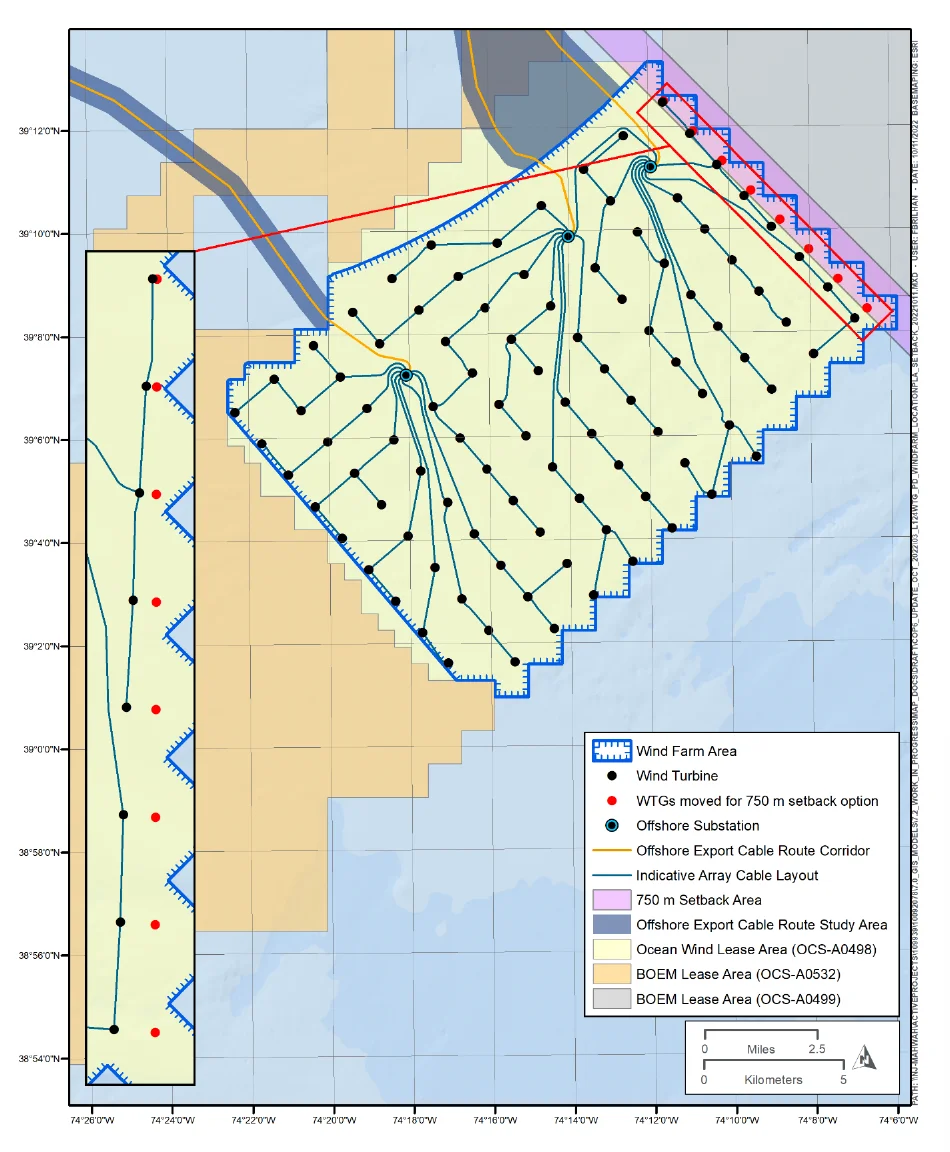

Ocean Wind 1
On a stretch of Atlantic continental shelf about thirteen nautical miles southeast of Atlantic City, the seabed has been leased and unleased over the past decade in one of the longest-running offshore energy stories in American history. The lease area was meant to host Ocean Wind 1 - up to ninety-eight wind turbines with blades 394 feet long and tip heights that would have reached 906 feet above the waves, taller than most office towers. The project was approved, financed, permitted, and partially built. Then, in October 2023, the Danish developer Orsted cancelled it entirely. Eight years of planning collapsed in a single shareholder announcement. The seabed lease was vacated in 2024. The turbines were never installed. The story of Ocean Wind 1 is the story of America's first attempted large-scale offshore wind farm, and what happened to it.
The Lease Auction
On November 9, 2015, the federal Bureau of Ocean Energy Management held a competitive lease sale for 75,525 acres of seabed offshore New Jersey. The total area covered 118 square miles, designated Lease Area OCS-A 0498. After seven rounds of bidding, RES America Developments paid $880,715 for the lease - a remarkably modest sum for what was being sold. The math made sense at the time: no one knew if American offshore wind would ever actually work. The lease changed hands several times over the next decade. By 2018 the Danish company Orsted - the largest offshore wind developer in the world, with decades of European experience - had acquired the rights and proposed Ocean Wind 1. In 2021 the New Jersey utility PSEG bought a 25 percent stake in the project. Together they planned to build something the United States had never seen at scale: an industrial offshore wind farm sized for utility-scale power generation.
The Cables Through Ocean City
The turbines would have been twelve miles offshore, but the power had to come ashore somewhere. After evaluating fourteen potential interconnection points across New Jersey, Orsted selected two: the former Oyster Creek nuclear plant site in Lacey Township, and the BL England Generating Station in Upper Township. The Upper Township cable required running underground through Ocean City. In February 2022, Orsted petitioned the New Jersey Board of Public Utilities to approve the cable route. Ocean City opposed it. The city argued the construction would disrupt summer tourism and damage residential streets. The Board approved the route anyway in September 2022 and February 2023, using a new state law that allowed the BPU to override local objections to offshore wind infrastructure. The fight was bitter. It got worse from there.
The Whales
Starting in late 2022 and continuing through 2023, an unusual number of dead North Atlantic right whales, humpbacks, and other large cetaceans began washing up on New Jersey and New York beaches. The cause was disputed - scientific consensus pointed to vessel strikes and fishing gear entanglement, both ongoing problems unrelated to wind development. But the timing coincided with offshore wind survey activity, and opponents of Ocean Wind 1 argued the surveys themselves were responsible. The North Atlantic right whale is critically endangered, with fewer than 350 individuals remaining. The Final Environmental Impact Statement for Ocean Wind 1, published in May 2023, identified "moderate to major" potential impacts on the species. A coalition called Save LBI mounted lawsuits. Public hearings turned hostile. The political pressure on Orsted mounted just as the project's economics began collapsing.
The Cancellation
On October 31, 2023, Orsted announced that it was canceling Ocean Wind 1 entirely. The company took a $4 billion writedown. The stated reasons were a combination of rising interest rates, supply chain problems, and inflation in offshore wind components - all real and all severe. The company had bid the project under the assumption of much lower borrowing costs and much cheaper steel. By 2023 the math no longer worked. Orsted had committed $300 million in guarantees to ensure the project's completion. The State of New Jersey demanded payment after the cancellation. Orsted argued the guarantees did not apply to a voluntary withdrawal. In May 2024 the two sides reached a settlement: Orsted would pay $125 million to support other offshore wind and clean energy work in the state. In August 2024 the BPU formally vacated the project's approvals. The lease area returned to the federal inventory of un-developed offshore tracts.
What Happens Next
Ocean Wind 1 was supposed to be a milestone - America's first commercial-scale offshore wind farm. Its cancellation became a different milestone: the most dramatic offshore wind failure in American history. In January 2025, President Donald Trump signed an executive order temporarily withdrawing all areas of the Outer Continental Shelf from offshore wind leasing and ordering a review of all existing offshore wind permits. Several other East Coast offshore wind projects have since been suspended, cancelled, or delayed. The Atlantic seabed off Atlantic City remains empty. The cables through Ocean City were never laid. The turbines were never built. New Jersey's goal of 100 percent clean energy by 2035, which Ocean Wind 1 was meant to anchor, now depends on other projects, other technologies, and other politics.
From the Air
The Ocean Wind 1 lease area sits at approximately 39.04 degrees north, 74.35 degrees west, about 13 nautical miles southeast of Atlantic City, New Jersey. From cruising altitude, the lease area would appear as a roughly 118 square-mile rectangle of open continental shelf water - no turbines were ever installed. Atlantic City International (KACY) lies about 15 nautical miles northwest. Cape May County (KWWD) is about 25 nautical miles southwest. The Wind Energy Area is marked on aeronautical charts but currently contains no obstacles. The two planned landfall sites - Oyster Creek (Lacey Township) and BL England (Upper Township) - remain unconnected to any offshore generation.
Nearby Stories
- Battle of Delaware Bay 7.9 km away
- Harbor of Refuge Light 19 km away
- USS Jacob Jones (DD-130) 30 km away
- South Jersey 41 km away
- Fort Delaware: The Island Prison Where 33,000 Confederates Waited Out the War 64 km away
- PS General Slocum 162 km away
- Wardenclyffe Tower 219 km away
- USS Atik 479 km away
Sources
- Ocean Wind 1 - Wikipedia
- BOEM - Ocean Wind 1 Construction and Operations Plan (OCS-A 0498)
- CNBC - Orsted cancels two New Jersey offshore wind projects, takes $4 billion writedown
- Offshore Wind Biz - Orsted and New Jersey Reach USD 125 Million Settlement
- White House - Temporary Withdrawal of All Areas on the Outer Continental Shelf from Offshore Wind Leasing