Ochomogo War
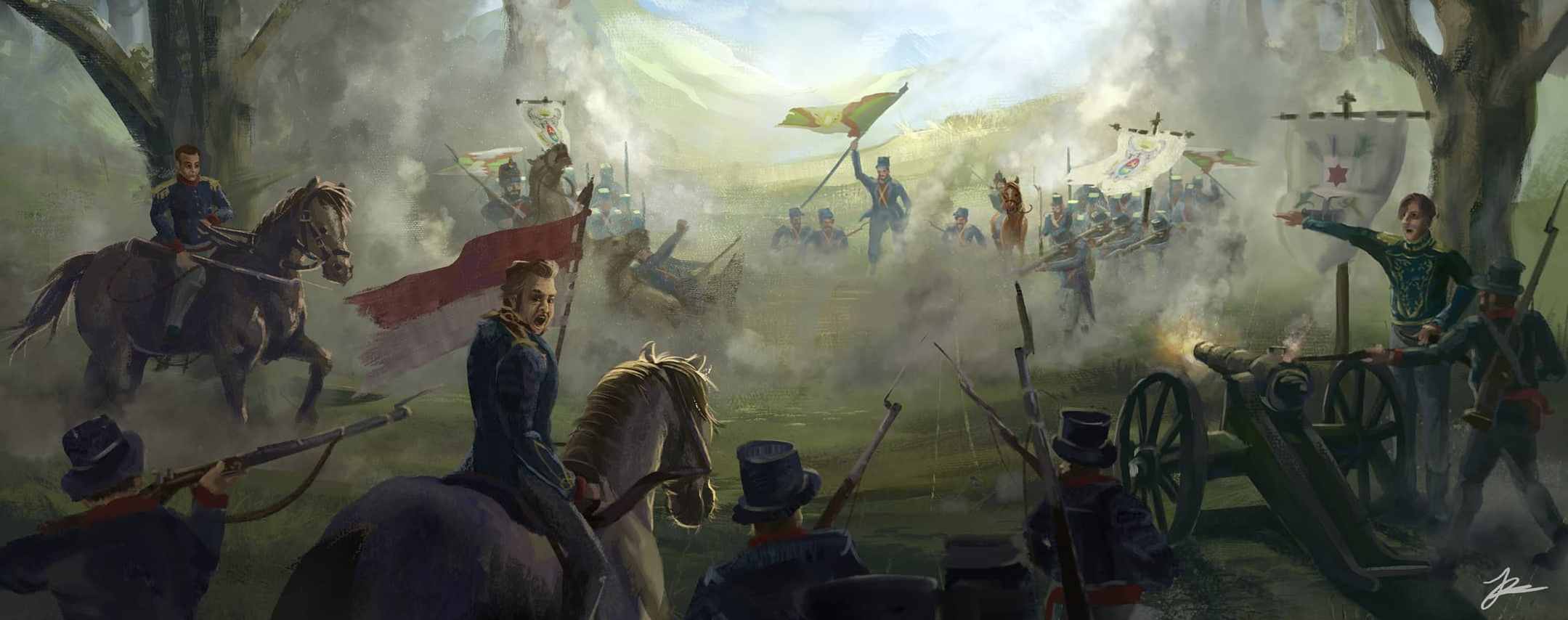
The battle that decided Costa Rica's future lasted less than a day, and by the time news arrived that it had been pointless, the country had already changed forever. On April 5, 1823, republican militia from San Jose and Alajuela met conservative forces from Cartago on a windswept pass littered with volcanic boulders. The question at stake was enormous for such a small place: would Costa Rica join Agustin de Iturbide's new Mexican Empire, or remain independent? Gregorio Jose Ramirez led the republicans. Joaquin de Oreamuno rallied the imperialists. About twenty people died in the fighting. When it was over, San Jose replaced Cartago as the national capital, and Costa Rica's path toward republican self-governance was set - even though, as everyone would learn weeks later, the Mexican Empire had already collapsed before the first musket was fired.
Tobacco, Power, and Four Rival Towns
The roots of the conflict ran deeper than any single political crisis. Cartago, founded in 1563 by Juan Vazquez de Coronado, had been Costa Rica's capital since the colonial era - the seat of political power, home to the aristocratic landowner class. Then, in 1784, the Spanish crown gave San Jose a tobacco factory and monopoly, and the economic balance shifted. San Jose became the commercial center; Cartago kept the political authority. By 1801, Costa Rica's population of roughly 50,000 was concentrated in the Central Valley, divided among four towns - Cartago, San Jose, Alajuela, and Heredia - each with its own identity and interests. When the Act of Independence of Central America was proclaimed in Guatemala on September 15, 1821, it took a full month for the news to reach this isolated corner of the isthmus. The question of what independence actually meant would take longer to answer.
Empire or Republic
In May 1822, Agustin de Iturbide declared himself Emperor of Mexico and announced plans to extend his rule across Central America. The conservative landowners of Cartago and Heredia saw opportunity: the Mexican Empire might protect the privileges they had enjoyed under Spanish rule. The liberal merchants of San Jose and Alajuela saw something different - a chance to build a republic free from imperial control. The four towns agreed to remain neutral while the situation clarified, but neutrality did not survive the tension. Ramirez, representing Alajuela in the governing council, began making military preparations. On March 29, 1823, Joaquin de Oreamuno led a group of Cartago residents who seized the army barracks and proclaimed Costa Rica's allegiance to Mexico, with a formal ceremony set for April 6. San Jose and Alajuela declared war and appointed Ramirez to command their forces. The republic would not wait for a ceremony.
Muskets Among the Boulders
Ramirez sent an ultimatum on April 4. The next morning, the two armies faced each other at the Ochomogo Pass, a valley between San Jose and Cartago where the mountains divide the Pacific and Atlantic watersheds of the Central Valley. Large volcanic rocks scattered across the terrain provided natural cover, and both sides used them. Sergeant Major Salvador de Oreamuno commanded the Cartago militia while Joaquin de Oreamuno initially stayed home - an odd choice for the man who had started the crisis. The republicans held an advantage in artillery, commanded by Antonio Pinto Soares, a future head of state. Negotiations collapsed quickly, and musket fire echoed off the volcanic stone. The Cartago forces charged repeatedly, but Pinto Soares' guns broke each assault. Officers began defecting from the imperialist side, including Salvador de Oreamuno himself. His replacement, Sergeant Felix Oreamuno y Jimenez, asked for a ceasefire. Ramirez demanded unconditional surrender and kept fighting until he got it.
A Victory Already Won Elsewhere
Ramirez entered Cartago, disarmed its inhabitants, and for ten days served as the de facto ruler of Costa Rica. He issued exactly two decrees: one making San Jose the capital, the other calling for a democratically elected governing council. Then came the news that rendered the entire conflict moot. The First Mexican Empire had ceased to exist on March 19, 1823 - seventeen days before the Battle of Ochomogo was fought. The empire Oreamuno had tried to join was already gone. Yet the battle's consequences endured. San Jose kept the capital, and in 1825 Juan Mora Fernandez was elected the first Costa Rican head of state. Rivalry among the four towns simmered for years - an 1834 law even mandated that the capital rotate among them. It took the Guerra de la Liga and a decree by head of state Braulio Carrillo Colina in 1837 to settle the matter permanently in San Jose's favor. The Ochomogo Pass, where twenty people died fighting over an empire that had already fallen, remains a quiet stretch of highway between two cities that long ago stopped arguing.
From the Air
Located at 9.90N, 83.94W in the Central Valley of Costa Rica. The Ochomogo Pass sits between San Jose to the west and Cartago to the east, a mountain valley visible from altitude as a gap in the Cordillera Central connecting the Pacific and Atlantic watersheds. Juan Santamaria International Airport (MROC/SJO) is approximately 20km to the northwest. From the air, the pass is recognizable as the highway corridor (Route 2) threading between the two cities. The terrain is hilly with scattered volcanic rock formations visible on the slopes. Cartago lies below Irazu Volcano to the east; San Jose spreads across the wider valley to the west.