Ocmulgee Mounds National Historical Park
The Muscogee called it "the place where we first sat down." For twelve thousand years—from Ice Age hunters to Mississippian mound builders to Creek confederacies—people have gathered at this spot on the east bank of the Ocmulgee River where the rolling Piedmont hills meet the Atlantic coastal plain. The name itself comes from the Mikasuki words Oki Molki, meaning "Bubbling Water." Today, Ocmulgee Mounds National Historical Park in Macon, Georgia preserves the earthworks, ceremonial lodges, and burial grounds of civilizations that rose, flourished, and fell across a span of time so vast it dwarfs the entire recorded history of the Western world.
Carrying Earth by Hand
Around 950 CE, a sophisticated society arrived on the Macon Plateau and began reshaping the land. The people of the Macon Plateau culture, a local expression of the South Appalachian Mississippian culture, were skilled farmers whose agricultural surpluses supported an elite class of leaders and artisans. Under the direction of those leaders, thousands of workers carried earth by hand in bags to construct the Great Temple Mound on a high bluff overlooking the Ocmulgee River floodplain. Magnetometer scans have revealed something unique among all Mississippian sites: the platform mound contained a spiraling staircase oriented toward the floodplain. The people built rectangular wooden buildings atop the mounds for religious ceremonies and spaced the structures unusually far apart, likely to provide public space and residences between them. The scale of coordinated labor required to build these earthworks speaks to a complex, organized civilization with deep knowledge of soil engineering.
The Eagle Platform
Circular earth lodges served as gathering places for meetings and ceremonies. Remains of one such lodge, carbon-dated to 1050 CE, became the basis for the reconstructed earth lodge that visitors enter today at the park center. Step inside and the modern world vanishes. The interior features a raised-earth platform shaped like an eagle with a forked-eye motif—a symbol of the Southeastern Ceremonial Complex shared across Mississippian cultures. Forty-seven molded seats line the platform where high chiefs or priests once sat. The eagle motif, the deliberate arrangement of seats, the enclosed earthen space—all of it points to a culture that invested meaning in every physical detail. This was not just a meeting hall. It was a seat of power, a place where decisions shaped the lives of thousands.
Displacement and Sacred Memory
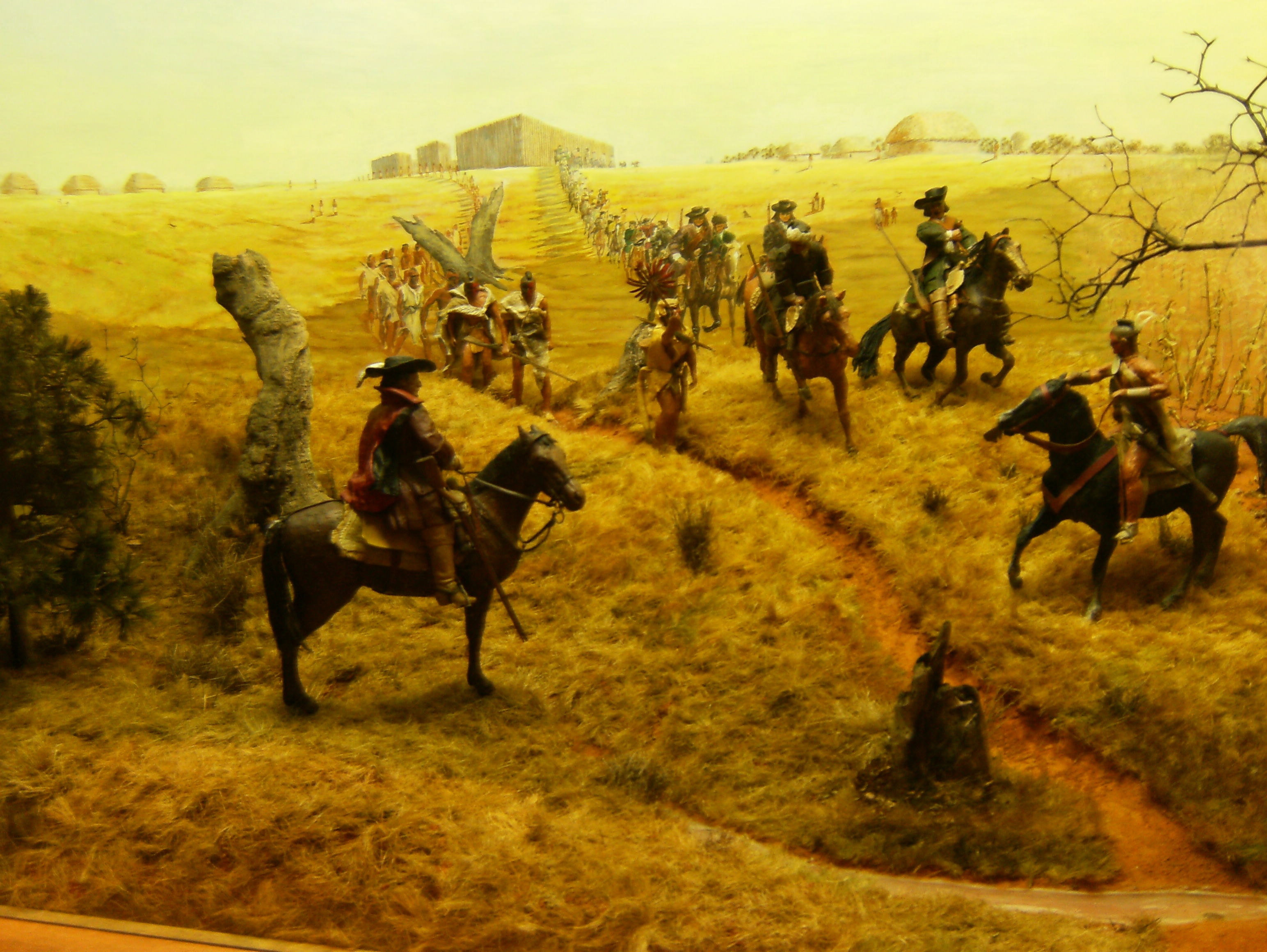
By the late 18th century, the Muscogee (Creek) confederacy—the largest Native American confederacy in present-day Georgia and Alabama—still made pilgrimages to the ancient mounds they considered sacred. Scottish fur traders had built a trading post near the mounds as early as 1690. The word "Creek" itself originated from traders who referred to the Muscogee living along Ochese Creek. Under mounting pressure from American settlers hungry for cotton land after the invention of the cotton gin in 1794, the Lower Creek ceded their lands east of the Ocmulgee River in 1805 but refused to surrender the sacred mounds, retaining a reserve called the Ocmulgee Old Fields. That stand could not hold. By the 1830s, Andrew Jackson's Indian Removal forced the Creek, Cherokee, Choctaw, Chickasaw, and Seminole westward. The Muscogee reorganized in Indian Territory—present-day Oklahoma—and in 1867 named their new capital Okmulgee in honor of the sacred mounds they had been forced to leave behind.
Unearthing the Past
Professional archaeology came to Ocmulgee during the Great Depression, when the Works Progress Administration sponsored large-scale digs between 1933 and 1942. Workers excavated portions of eight mounds, uncovering artifacts that revealed a wide trading network and a complex, sophisticated culture. Congress authorized the site as a national monument in 1934, formally establishing it in 1936 under the National Park Service. In 1997, the NPS designated the Ocmulgee Old Fields as a Traditional Cultural Property—the first such designation east of the Mississippi River. The John D. Dingell Jr. Conservation, Management, and Recreation Act of 2019 redesignated the site as a national historical park and increased its size by about 2,100 acres. In 2022, over 900 additional acres were transferred to the park. Bipartisan bills introduced in Congress in 2024 and 2025 seek to elevate the site further as Ocmulgee Mounds National Park and Preserve, with the Muscogee Nation as a partner in conservation.
Twelve Millennia Underfoot
Today the park encompasses walking trails, the reconstructed earth lodge, the Great Temple Mound reachable by a half-mile walk, burial mounds, platform mounds, and the remains of an English colonial trading post discovered during the 1930s excavations. The Lamar Mounds and Village Site, an isolated unit in the swamps south of Macon, preserves a unique spiral mound from the Late Mississippian period. The visitor center's archaeology museum displays pipes, necklaces, and a pottery vessel topped with a lid shaped like a human head—objects that remind you these mounds were built by people who created art, governed communities, and mourned their dead. Twelve thousand years of human presence is a number almost too large to feel. But stand at the base of the Great Temple Mound, look up at the grass-covered slope that thousands of hands raised from the earth, and you begin to sense the weight of all that time.
From the Air
Located at 32.837°N, 83.608°W on the east bank of the Ocmulgee River in Macon, Georgia. The Great Temple Mound is visible from the air as a large grass-covered hill near the river. Interstate 16 passes through the southwest edge of the park, providing a useful landmark. Nearby airports include Middle Georgia Regional Airport (KMCN) approximately 8 nm south. Robins Air Force Base (KWRB) lies about 15 nm to the south—be aware of its restricted airspace. Best viewed at 2,000–3,000 feet AGL for the full scope of the mound complex along the river.