Odaiba
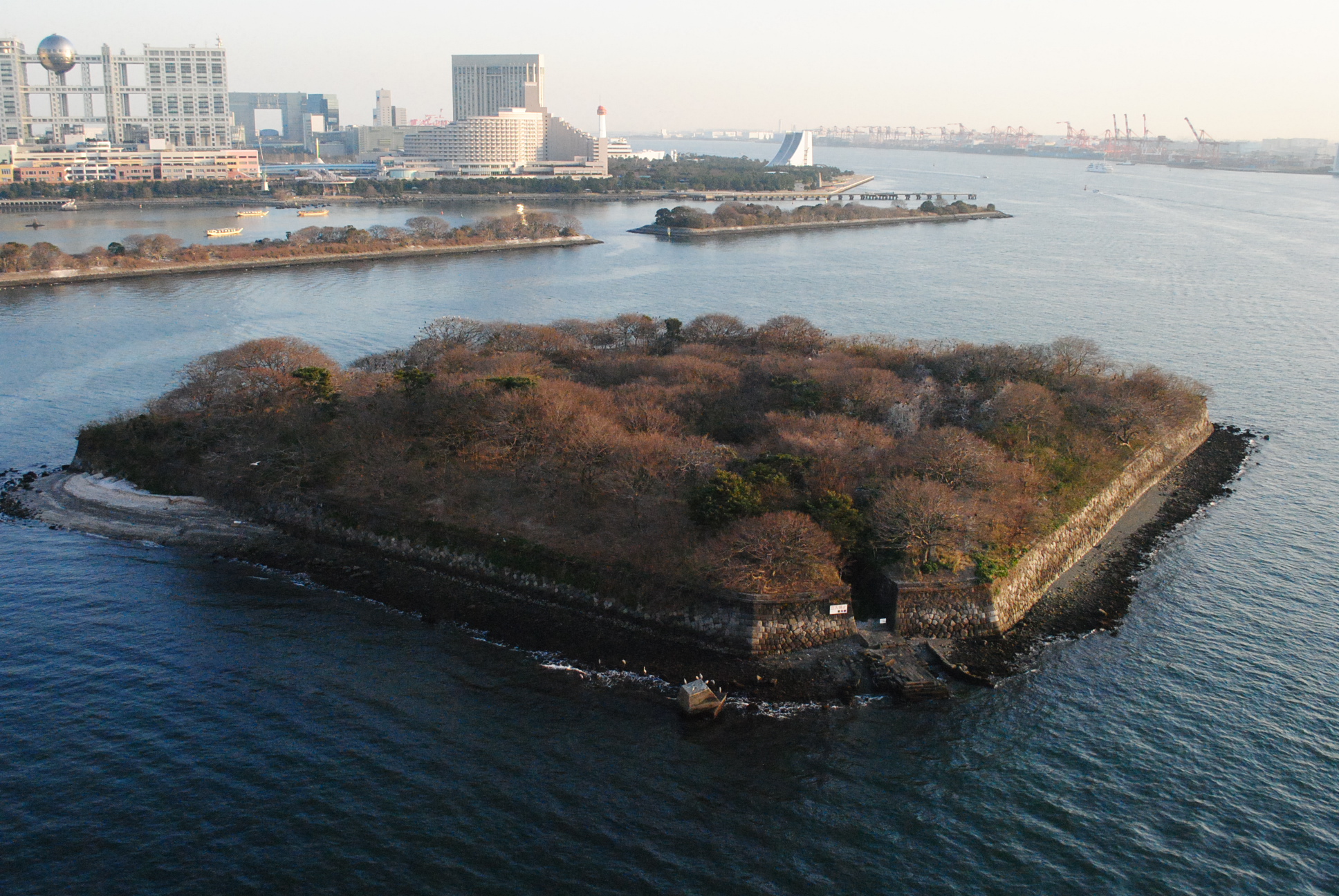
In the summer of 1853, the Tokugawa shogunate had a problem arriving by sea. Commodore Matthew Perry's squadron of black-hulled warships had anchored in Edo Bay, demanding that Japan open its ports to American trade after two centuries of isolation. The shogunate's response was not diplomatic -- it was architectural. Military engineer Egawa Hidetatsu was ordered to construct a chain of island gun batteries across the bay to defend Edo. He completed the first three in just eight months, piling earth and stone into the water, mounting heavy bronze cannon behind earthen walls. The Japanese word for these fortified platforms was daiba -- and the honorific prefix o gave the place its name. Odaiba. The cannons were never fired in anger. But the island they created would transform twice more, each time into something its builders never imagined.
Fortress in the Water
Of the eleven batteries originally planned, seven saw construction begin, but only six were ever completed. Batteries No. 1 through No. 3 were finished by the end of 1853, a feat of desperate engineering driven by the urgency of Perry's presence. Construction on Nos. 4 through 7 began in 1854, though only Nos. 5 and 6 were finished that year. Nos. 4 and 7 were abandoned at 30 and 70 percent completion respectively, with a land-based alternative built near Gotenyama instead. Work on No. 4 eventually resumed in 1862 and was completed the following year. The batteries themselves were small artificial islands -- low, angular, built for function rather than permanence. By the time Japan opened its ports and embarked on modernization, they were military relics. Battery No. 3 was refurbished in 1928 and opened as Metropolitan Daiba Park, a quiet green space where visitors can still walk the old fortification walls and imagine cannon pointed at the horizon.
The Bubble's Playground
For most of the twentieth century, the bay around the old batteries was industrial waterfront -- docks, warehouses, the working infrastructure of one of the world's busiest ports. Then came the 1980s economic bubble and a bold vision: reclaim more land, connect the island to central Tokyo, and build a futuristic district from scratch. The Rainbow Bridge, engineered by Kawasaki Heavy Industries and completed in 1993, gave Odaiba its most iconic visual landmark -- a graceful suspension bridge whose cables light up in shifting colors after dark. The Fuji Television headquarters, designed by Kenzo Tange, followed soon after, its spherical observation deck becoming an instant symbol of the district. The automated Yurikamome transit line, a driverless train that sweeps across the bridge and loops through the island, began service in 1995. Odaiba was Tokyo's bet on the future, a place where architecture could be playful because nothing here carried the weight of history.
A 64-Foot Robot and a Statue of Liberty
Today's Odaiba is a magnet for tourists and Tokyoites alike, a sprawling entertainment district packed with attractions that range from the educational to the surreal. The Miraikan -- Japan's National Museum of Emerging Science and Innovation -- occupies a gleaming building where visitors can interact with humanoid robots and watch a globe-shaped LED display render real-time earth data. DiverCity Tokyo Plaza draws crowds with its 19.7-meter-tall statue of a Gundam mobile suit, towering over the entrance like a sentry from a science-fiction future. A replica of the Statue of Liberty stands on the waterfront, originally installed for a French cultural exchange and kept by popular demand. Tokyo Big Sight, the massive exhibition center with its four inverted pyramids, hosts everything from anime conventions to international trade shows. The Sea Forest Waterway, built for the 2020 Olympic rowing and canoeing events, stretches along the island's eastern edge.
Water's Edge, City's Edge
What makes Odaiba unusual in Tokyo is not its attractions but its openness. The city's waterfront is largely industrial, blocked by port facilities and restricted zones. Odaiba, along with Minato Mirai 21 in Yokohama, is one of the rare places where residents and visitors can actually reach the water. The district has one of only two beaches in urban Tokyo -- swimming is prohibited, but the sand and the view across the bay to the glittering skyline are freely available. Shiokaze Park offers barbecue areas and green space. Ferries run from Asakusa down the Sumida River to Odaiba Seaside Park, offering a water-level perspective on the bridge and the bay. A new 150-meter-high fountain in Odaiba Marine Park, designed with a cherry-blossom-shaped base and synchronized light and music shows, is planned for 2026. Odaiba keeps reinventing itself -- from cannon battery to container port to neon playground -- and the bay water laps at its engineered shores as if none of it were the least bit surprising.
From the Air
Located at 35.63N, 139.775E in Tokyo Bay. From the air, Odaiba is immediately recognizable as a large artificial landmass connected to central Tokyo by the Rainbow Bridge, with the distinctive spherical Fuji TV building, the inverted pyramids of Tokyo Big Sight, and the giant Gundam statue all visible at lower altitudes. Spans parts of Koto, Minato, and Shinagawa wards. Nearest airports: Tokyo Haneda (RJTT) approximately 6 nm south, Narita International (RJAA) approximately 38 nm east-northeast. Best viewed at 1,500-3,000 feet AGL. The Rainbow Bridge and the sharp geometric outline of the reclaimed island against the natural bay shoreline are excellent visual waypoints.