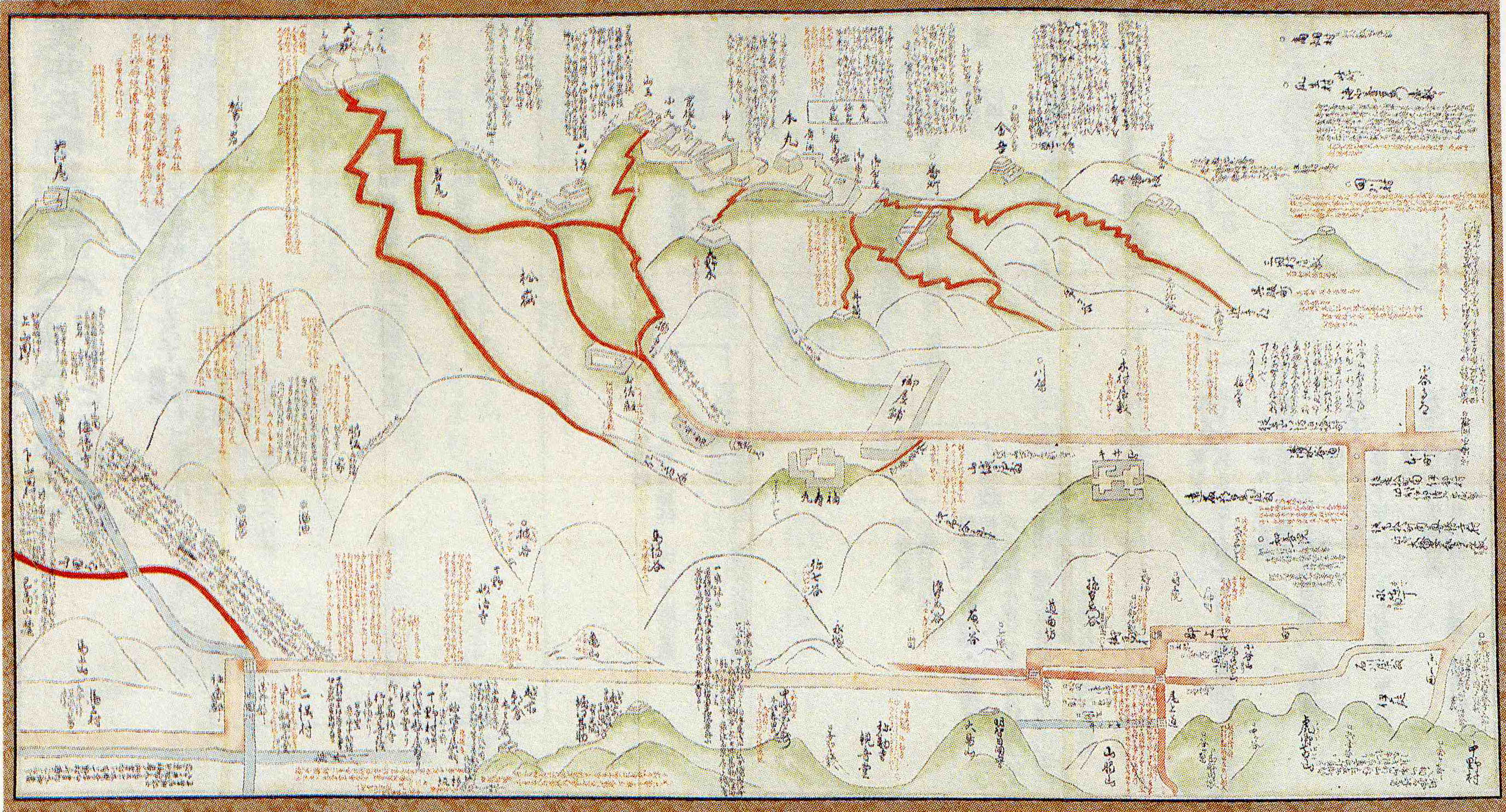
Odani Castle
The mountain looked impregnable. That was the whole point. When the Azai clan began building Odani Castle around 1520, they chose a peak in northern Omi Province whose ridges and valleys could be sculpted into a fortress stretching over a square kilometer, its main fortified area running more than 800 meters along the crest. For half a century, it worked. The Azai rose from minor warlords to the dominant power in the region, fought off armies of 25,000 men, and married into the family of Oda Nobunaga himself. Then Nobunaga came to tear it all down, and the mountain that had protected the Azai became their tomb.
Clawing Up from Nothing
The Azai were nobodies. Northern Omi Province in the early 1500s belonged to the Kyogoku clan, vassals of the Ashikaga shogunate who preferred the comforts of Kyoto to the unglamorous work of governing a rural province. They ruled by proxy, and their proxies were weak. Azai Sukemasa saw the opportunity. From 1516, he assembled a coalition of minor warlords, and by 1520 they had expelled the Kyogoku's deputies entirely. The overlords had no choice but to accept the fait accompli. Sukemasa was named deputy governor, but the title was a polite fiction -- the Azai were now the real power in northern Omi. Construction of Odani Castle began during this period, anchoring their newfound authority to the mountaintop.
A Marriage That Became a Trap
By the 1560s, Azai Nagamasa had transformed his clan from regional upstarts into serious players. He defeated a Rokkaku invasion force of 25,000 with a much smaller army and pushed aggressively into neighboring provinces. But expansion brought him face to face with the most dangerous man in Japan: Oda Nobunaga. Nagamasa chose alliance over war. He married Nobunaga's younger sister Oichi and joined the warlord's coalition, but with one crucial condition -- Nobunaga must never attack the Asakura clan, the Azai's longtime allies and protectors in neighboring Echizen Province. In August 1569, Nobunaga violated that agreement and invaded Asakura territory. Nagamasa was trapped between loyalty to his wife's brother and honor toward the clan that had saved his family a generation earlier. He chose the Asakura.
The Siege That Broke the Mountain
The war that followed was brutal and drawn out. At the Battle of Anegawa in 1570, fought just five kilometers south of Odani Castle, the Azai were defeated and lost half their territory. But the mountain held. With Asakura reinforcements, Odani Castle resisted Nobunaga's siege for years. It was Nobunaga's general Toyotomi Hideyoshi who finally cracked the defense -- not with brute force, but by recruiting defectors from among the Azai generals and systematically destroying their Asakura allies. When the Asakura were annihilated at the Siege of Ichijodani Castle, the Azai stood alone. Hideyoshi's forces penetrated to the third bailey. Azai Hisamasa and his son Nagamasa both took their own lives. The castle fell in 1573, ending the Azai clan forever.
Stripped for Parts
What happened next was both practical and symbolic. Hideyoshi did not abandon Odani Castle immediately. He used it as his headquarters while he supervised the construction of a new castle on the shores of Lake Biwa -- Nagahama Castle. But a mountaintop fortress was the wrong tool for a man who wanted to govern and trade, not merely defend. Hideyoshi systematically dismantled Odani Castle, hauling its timbers and stone walls down the mountain to serve as raw materials for his lakeside stronghold. When Nagahama Castle was complete, Hideyoshi relocated and Odani Castle was formally abolished. The conqueror had cannibalized the conquered.
What the Mountain Still Holds
Today, little remains of the fortress except fragmentary dry moats, crumbling stone walls, and the massive 20-meter-wide central moat that once divided the castle into its old and new sections. The ruins were designated a National Historic Site in 2005. Reaching them requires a 45-minute walk from Kawake Station on the JR West Hokuriku Main Line, followed by an hour-long hike up the mountain. The difficulty of the approach is itself a lesson in why the castle endured as long as it did -- and why Hideyoshi, once he had conquered it, decided he would rather build on flat ground by the lake than rule from the clouds.
From the Air
Located at 35.459N, 136.277E on a mountaintop in northern Shiga Prefecture, roughly 10km north of Nagahama city on the eastern side of Lake Biwa. The castle ruins occupy forested ridgelines and are not easily visible from the air, but the mountain itself is identifiable by its position between Lake Biwa to the west and the Ibuki mountain range to the east. The Battle of Anegawa took place approximately 5km to the south along the river plain. Nearest airport: Chubu Centrair International (RJGG) approximately 120km southeast. Lake Biwa provides the dominant visual landmark for navigation.