Oea
Tripoli has a secret that hides in plain sight. Beneath its streets, under foundations poured in the 20th century, under Ottoman walls and medieval markets, lie the remains of a city called Oea. Founded by Phoenician traders in the 7th century BC, possibly on top of an even older Berber settlement called Oyat, the city spent nearly 1,600 years under that name before the 9th century replaced it with the one the world uses today. Unlike its sister cities Sabratha and Leptis Magna, which were abandoned to the sand and preserved as ruins, Oea was never deserted. Its inhabitants simply kept building on top of it, century after century, burying the ancient city under the living one.
The Harbor That Drew Empires
What brought the Phoenicians to this stretch of North African coast was geography: a natural harbor flanked on its western shore by a small, defensible peninsula. It was the kind of position that traders dream of and soldiers covet. The Phoenicians established their colony and named it in the local Libyco-Berber tongue, a choice suggesting they built alongside an existing indigenous community rather than on empty ground. Greeks from Cyrenaica took it next, then Carthaginians wrested it from the Greeks. By the 2nd century BC, Rome had swallowed them all. The Romans gave the region a new name, Regio Syrtica, and later Regio Tripolitana, meaning the region of three cities: Oea, Sabratha, and Leptis Magna. Septimius Severus, born at Leptis Magna and destined to become Rome's first African-born emperor, may have elevated Tripolitania to a separate province.
Languages of the Living City
Oea was never culturally monolithic. Most of its inhabitants continued speaking Phoenician, mixed with local Berber vocabulary, well into the 3rd century AD, even as Latin served as the official language of the elite. By the 6th century, when Byzantine administrators governed the city, Latin had become a minority language. Nearly everyone spoke Berber, and Phoenician had vanished entirely. This linguistic layering reveals a city where imperial languages sat lightly on a population that maintained its own traditions beneath the surface. Christianity arrived gradually, coexisting with the pagan beliefs of the Berber-Phoenician population until the mid-3rd century. The historian Mommsen concluded that the city did not adopt Christianity as a whole until the 4th century, making Oea one of the later converts in Roman Africa.
Bishops, Vandals, and the Desert Frontier
Three bishops of Oea appear in the historical record. Natalis spoke at the Council of Carthage in 255 AD, representing not only his own diocese but also those of Sabratha and Leptis Magna. Cresconius, a Catholic bishop under the Vandal king Genseric, was eventually summoned to Carthage by King Huneric in 484 and exiled for his faith. Between these markers of institutional Christianity, the city weathered the collapse of the Western Roman Empire, Vandal invasions, and economic decline across the 5th and 6th centuries. Rome's earlier contribution to the city's prosperity had been as much about security as infrastructure. The empire under Trajan and Septimius Severus had built the Limes Tripolitanus, a frontier defense system of forts, towns, and fortified farms along the southern edge of Oea's territory, keeping desert raiders at bay and commerce flowing.
The City That Refused to Disappear
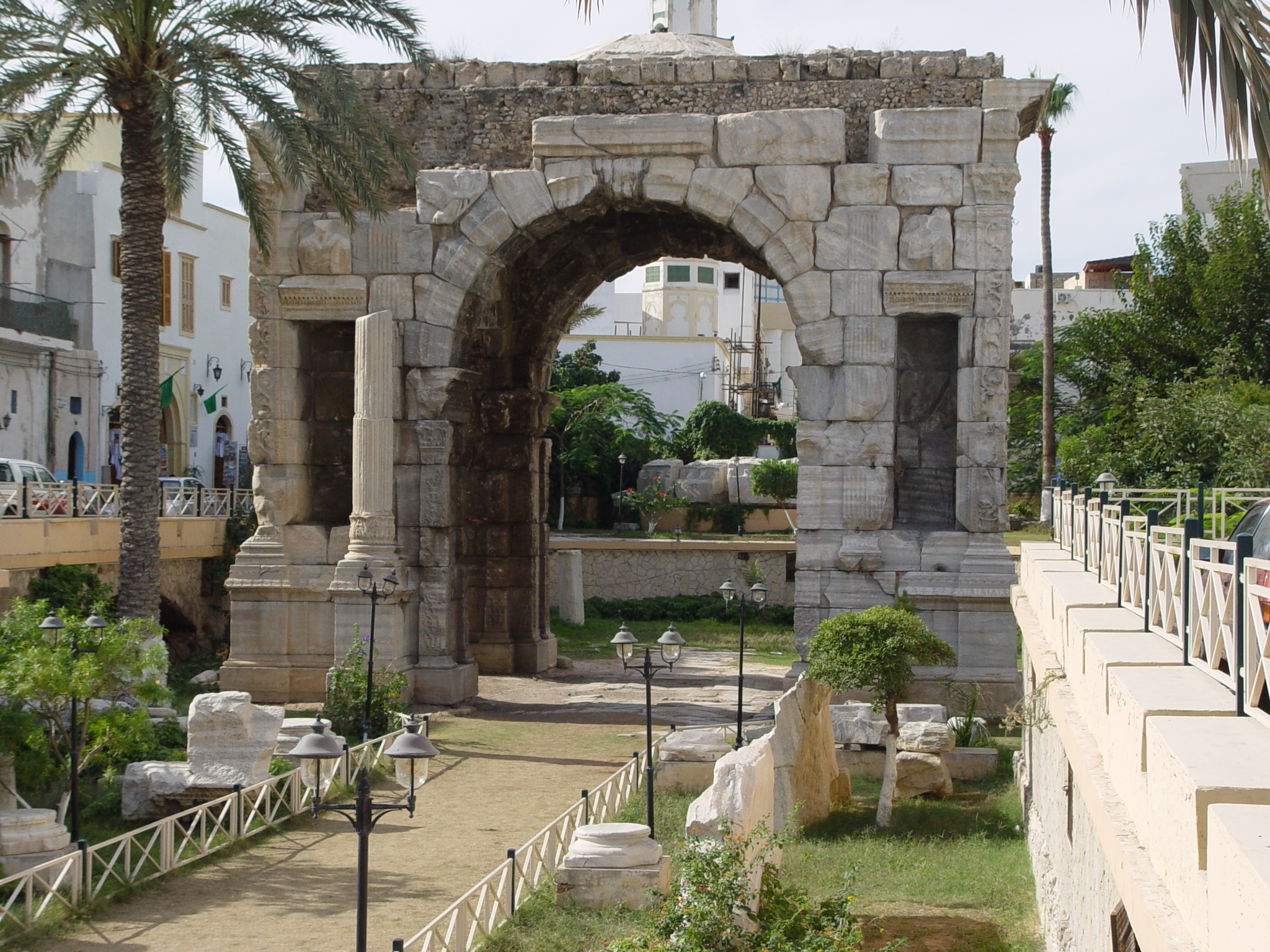
In November 643, Arab armies took Tripoli shortly after conquering Alexandria. The Byzantines briefly recaptured the city before it fell again around 680. What makes Oea's story remarkable is what did not happen next. Sabratha was abandoned. Leptis Magna was swallowed by sand. But Oea endured, growing into the capital of Tripolitania and eventually adopting the name Tripoli in the 9th century. Continuous habitation came at an archaeological cost: inhabitants quarried material from older buildings, destroying them in the process, or built directly on top of Roman and Phoenician structures. The only visible Roman remains today are the Arch of Marcus Aurelius from the 2nd century AD and fragments of a small temple called the Genius Coloniae. Everything else lies unexcavated beneath the modern city, an ancient world sealed under asphalt and concrete, waiting.
Restoration and What Lies Below
After Italy conquered Libya in the Italo-Turkish War, Italian archaeologists and architects turned their attention to what remained visible. Conservation work began around 1919, and in the 1930s, architect Florestano Di Fausto redesigned the area around the Arch of Marcus Aurelius, creating the public space that visitors see today. But these efforts only touched what was already exposed. The real Oea, the Phoenician harbor, the Carthaginian market, the Roman streets, the Byzantine churches, remains largely buried. Archaeological research in the nearby Gefara oasis has uncovered evidence that Christianity persisted in the Tripoli area until the 11th century, centuries longer than most scholars had assumed. Every excavation hints that the city beneath the city holds far more than anyone has yet found.
From the Air
Located at 32.90N, 13.18E, Oea occupies the same ground as modern Tripoli's old city. The Arch of Marcus Aurelius is the only visible Roman-era surface landmark. Nearest major airport is Mitiga International Airport (HLLM), about 8 km east. From 2,000-3,000 ft, the dense medina district is visible along the Mediterranean waterfront. Leptis Magna is approximately 120 km to the east along the coast, and Sabratha about 70 km to the west.