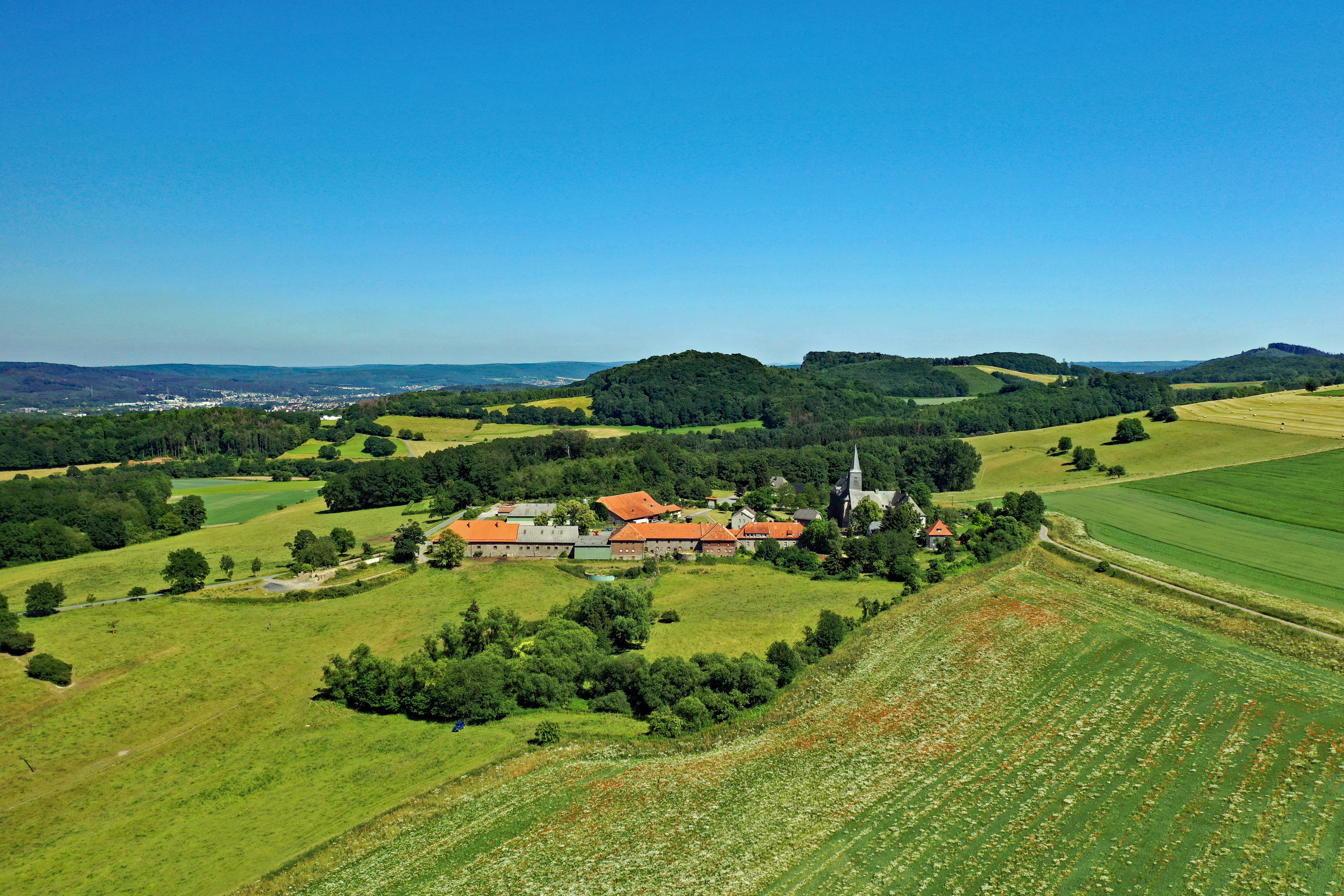
Oelinghausen Monastery
Most of what survives in Kloster Oelinghausen began as someone's quiet defiance of a rule. The organ in the gallery still sounds with pipes a Dutch builder cast in 1599 and a Westphalian master rebuilt in 1717 - some of the oldest playable organ pipes in Germany. The seated Virgin in the crypt, a 57-centimeter lindenwood figure they call the Kölsche Madonna, was carved at the start of the thirteenth century and has been venerated here ever since. The twelve life-sized apostles in the nave were carved by Wilhelm Spliethoven, and you cannot see the complete set of his work anywhere else. Eight hundred and fifty years of women, mostly, kept all of this here: through plague, fire, Reformation troops, the Thirty Years' War, the Catholic Enlightenment, secularization, and a century and a half of being someone else's parish church. Since 1992 it has belonged again to a community of sisters.
A Foundation in the Forest
Tradition has it that in 1174, a low-ranking nobleman named Siegenand von Basthusen and his wife Hathewigis endowed the monastery and entrusted its protection to a count. Modern historians are less sure. The archivist Manfred Wolf has argued that Siegenand's gifts were too small to launch a monastic community and that the real founding probably happened sometime between 1152 and 1174, with Scheda Monastery setting up Oelinghausen as a daughter house. Either way, the early community was strange and revealing: a double monastery, men and women living the Premonstratensian life in separate quarters of the same complex, an arrangement the order's general chapter would finally outlaw in 1188. Records of brothers and sisters together at Oelinghausen still appear as late as 1238, decades after the rule changed.
The Madonna in the Crypt
Beneath the nuns' gallery lies a small Romanesque crypt from around 1200, single-naved, three-bayed, vaulted with cross-ribs. Since the 1960s it has served as a chapel of grace, and at its center sits the statue the Sauerland calls its Queen. The Kölsche Madonna is carved from lindenwood, fifty-seven centimeters tall, and depicts a seated Virgin in a long robe facing forward, with the Christ Child in her lap raising a hand in blessing. The figure dates to the early thirteenth century and was, by tradition, donated by Engelbert von Berg, the archbishop of Cologne who would be murdered by his own cousin in 1225. Engelbert also helped the small monastery in less mythic ways: in 1225 he secured a papal confirmation of its foundation from Pope Honorius III, placing it under the protection of Saints Peter and Paul. The statue's hands, its child, and its crown have all been replaced over the centuries. Its repainted 1976 colors are based on art-historical study of what the original layer must have looked like.
Plague, Fire, and a Sister Named Ottilia
The middle centuries were not gentle. The Soest Feud of the 1440s drained the monastery's finances. The plague swept through repeatedly in the fifteenth century and killed many of the sisters. Strict enclosure was repeatedly ordered and repeatedly ignored; some nuns kept separate households inside the cloister, in a slow drift away from the original rule. In 1583, troops of the Protestant Archbishop Gebhard Truchsess von Waldburg occupied the monastery and tried, without success, to convert the women to Lutheranism. Then came Ottilia von Fürstenberg, prioress from 1585 to 1621 and the most consequential figure in the monastery's history. She cleared twenty thousand thalers of debt, recovered lost property, hosted the archbishop of Cologne and the bishop of Paderborn under the same roof, and shepherded Oelinghausen through a formal transformation in 1618 from a Premonstratensian nunnery into a more aristocratic, less strictly enclosed canoness foundation.
The Organ That Survived Everything
The organ in the gallery is the building's quiet marvel. A first instrument is mentioned in the late Middle Ages. A spring-chest organ with two manuals is recorded by 1585. The next year, on 2 February 1586, Dutch troops under Martin Schenck von Nideggen raided the monastery and destroyed it. In 1599, the Paderborn Prince-Bishop Theodor von Fürstenberg, brother of Ottilia, gave his sister two new organs, and the builder Marten de Mare put together the current instrument from undamaged remnants of the older ones. Johann Berenhard Klausing rebuilt and expanded it between 1713 and 1717, with new casework by the sculptor Wilhelm Spliethoven and the painter Alexander La Ruell. Most of the pipes from de Mare's 1599 work and Klausing's 1717 work are still there. A 2000-2002 restoration by the Swiss firm Orgelbau Kuhn returned the instrument as nearly as possible to its 1717 sound. Hearing it play, you are listening through pipes that have been singing in this building for over four centuries.
Dissolution, Parish, Sisters Again
In 1804, after the Duchy of Westphalia was handed to Hesse-Darmstadt, the secularization commissioners dissolved Oelinghausen. The land was bought in 1828 by the Baron von Fürstenberg of Herdringen, the same family whose names recur throughout the monastery's seven-hundred-year story. The church became a parish church and has stayed one. For decades the monastic buildings housed first missionary priests, then nothing in particular. Then in 1992 the Sisters of Saint Mary Magdalene Postel moved into the restored complex, and Oelinghausen returned, in its quiet modern way, to being a working religious community. A monastery garden museum has been added in recent years. The Baroque apostle figures by Spliethoven were named Monument of the Month for Westphalia-Lippe in March 2014, a small honor for a set of life-sized saints that have watched over this nave for three hundred years.
From the Air
Coordinates 51.4126°N, 7.94417°E, in the wooded Holzen district of Arnsberg in the Hochsauerland. The monastery sits in a largely agricultural and forested clearing, set apart from any settlement and surrounded by the Oelinghausen Landscape Protection Area. The site is small from the air - a single hall church with a slate roof, a ridge turret, and an adjacent monastery building. Best identified at 1,500-3,500 ft AGL using Herdringen Castle 3 km east-northeast as a landmark. Nearest airfields: Arnsberg-Menden (EDKA) about 13 km west, Meschede-Schüren (EDKM) about 25 km east. Dortmund (EDLW) is roughly 45 km west.