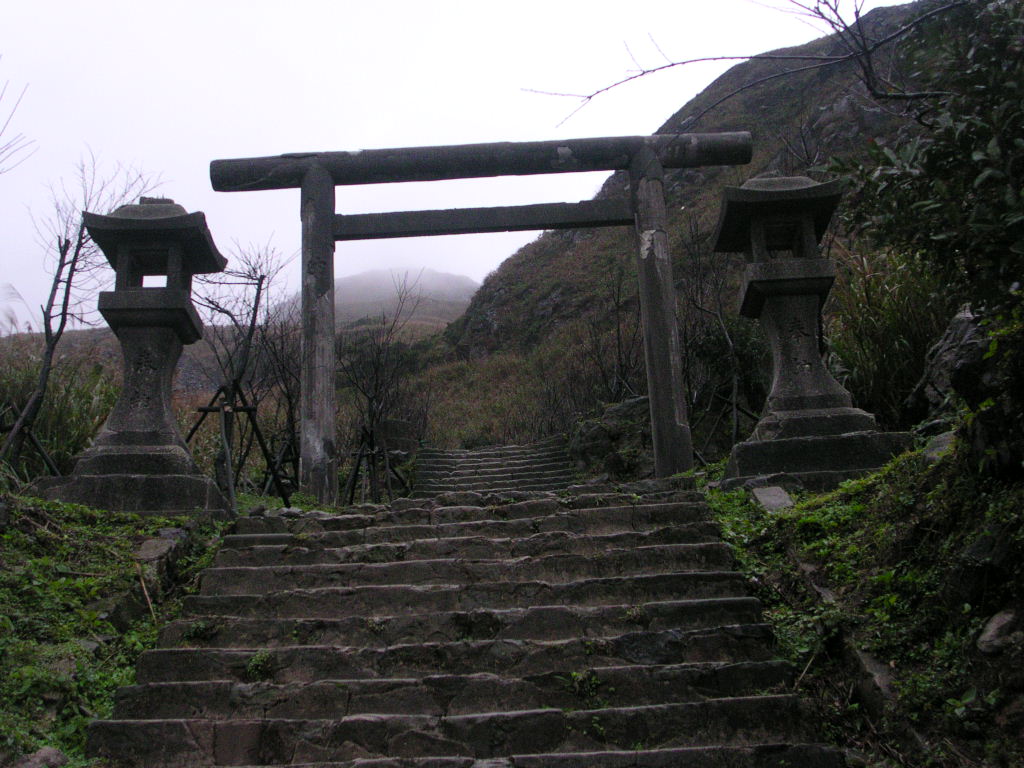
Ogon Shrine
Two torii gates still stand. They frame nothing - no temple behind them, no priests between them, no procession passing through. The wooden structures they once announced were torn apart by vandals after 1945, when the Japanese left Taiwan and everything they had built became either patrimony or target. But stone is harder to destroy than wood, and the gates remain on the mountainside above Jinguashi, marking a path to a shrine that exists now only in fragments.
The Ogon Shrine - the Gold Shrine, the Spirits of the Mountain Shrine, sometimes called the Jinguashi Shinto Shrine - was built halfway up a steep slope in what is now the Gold Ecological Park in Ruifang District, New Taipei City. It was consecrated on March 2, 1898, during the Meiji era, and for nearly half a century it anchored the spiritual life of a mining town that was, by some accounts, the richest gold-producing settlement in Asia.
A Miner's Gods
The shrine was built and managed by Tanaka Chobei, an industrialist who held the mining rights to the Kinkaseki Mine - the Japanese name for the Jinguashi gold deposit. Tanaka had pioneered ironworks in Japan before turning to colonial mining, and when he established the shrine he chose three kami as its guardian spirits: Okuninushi, the deity of nation-building and earthly affairs; Kanayamahiko no Mikoto, the god of metals and mining; and Sarutahiko, the kami of guidance and crossroads. The selection was deliberate. A mine needs earth gods, metal gods, and a spirit to guide workers safely through the dark. Every year during Japanese rule, a grand matsuri festival drew miners and residents from across the district. The celebration was part reverence, part release - a chance for men who spent their days underground to stand in open air and acknowledge the forces they depended on.
What the Path Once Held
At its peak, the shrine complex was substantial. A sando path climbed the mountainside to the main structures: the Honden, where the kami resided; the Haiden, where worshippers offered prayers; and the Temizuya, the purification pavilion where visitors washed their hands before entering sacred ground. Along the ascending path stood three torii gates, five flag banner platforms, a copper bull, and ten pairs of stone toro lanterns - the traditional stone lanterns that lined Shinto approaches throughout the Japanese empire. The shrine was not merely decorative. It was a working institution in a working town, maintained by the mining company and visited by laborers who understood that gold extraction was dangerous, uncertain, and subject to forces beyond engineering. The kami received prayers for safety, for productivity, and for the mountain's continued generosity.
After the Flag Came Down
Japan's surrender in 1945 ended colonial rule in Taiwan and left behind a landscape dotted with Shinto infrastructure that the new administration had no interest in preserving. The Ogon Shrine was vandalized - its wooden buildings dismantled or destroyed, its sacred objects removed or scattered. What survived was what vandals could not easily carry or break: the stone foundations of the Honden, two of the three torii gates, and four pairs of the original ten stone toro lanterns. These remnants stand today in a state that hovers between ruin and monument. The jungle has been partially cleared around them, enough to allow visitors to climb the old sando path and stand where the Honden once rose. The stone pillars mark its footprint. The mountain view is unchanged - the Pacific visible through gaps in the vegetation, the mining terraces below, the steep ridgeline above. It is a place where the absence of a building tells a story as clearly as its presence once did.
Gold Shrine in the Mist
Japanese visitors have a particular affection for the Ogon Shrine. Travel accounts describe climbing through fog to reach the ruins - the mist common to Jinguashi's altitude lending the stone gates an atmosphere that photographs struggle to capture. One Japanese travel blog titled its account 'Visiting the Gold Shrine of the Mist,' and the phrase has stuck. The shrine sits within the Gold Ecological Park, now the New Taipei City Gold Museum, and is accessible from the museum grounds by a moderate uphill walk. The path passes through subtropical vegetation that has reclaimed much of the surrounding hillside. At the top, where the torii gates frame the sea and sky, the shrine's original purpose - to sanctify the relationship between humans and the mineral wealth beneath their feet - still resonates. The gold is gone. The miners are gone. The kami, if they remain, keep their own counsel. But the stone endures, and the mountain continues to offer whatever the visitor is willing to climb for.
From the Air
Located at 25.10°N, 121.86°E on a mountainside above the Jinguashi mining district in Ruifang District, New Taipei City, Taiwan. The shrine ruins sit within the Gold Ecological Park, partway up the slope between the coast road and the ridgeline leading to Teapot Mountain (580m). From altitude, the shrine is not individually visible, but the broader Jinguashi mining complex - including the Remains of the 13 Levels smelter and the Yin-yang Sea - provides clear reference points along the coast. Taiwan Taoyuan International Airport (RCTP/TPE) is approximately 80km southwest. Songshan Airport (RCSS/TSA) is about 40km west. The terrain is steep with dense vegetation. Fog and low cloud are common.