Ohr-O'Keefe Museum of Art
For decades, thousands of ceramic pieces sat in a garage behind a gas station in Biloxi, Mississippi, gathering dust while the art world slowly caught up to the man who made them. George Edgar Ohr, the self-proclaimed "Mad Potter of Biloxi," created over 20,000 works between 1880 and 1910, twisting, pinching, and folding impossibly thin clay walls into shapes that wouldn't look out of place in a modern art gallery. He died in 1918 convinced of his own genius, telling anyone who would listen that his pottery would one day be recognized. It took another fifty years, but he was right. Today, those works anchor the Ohr-O'Keefe Museum of Art, a five-building campus designed by Frank Gehry that stands as one of the most striking architectural landmarks on the Gulf Coast.
The Mad Potter's Gamble
George Ohr was born on July 12, 1857, to German immigrant parents in Biloxi. His father had established the town's first blacksmith shop; his mother ran an early grocery store. In 1879, Ohr apprenticed under potter Joseph Fortune Meyer and discovered a calling. He built his own studio, which he called his "Pot-Ohr-E," and turned it into a regional attraction with colorful signs and a flamboyant personality. His ceramics were radical for the time: paper-thin walls, vivid glazes, and forms that twisted and ruffled in ways that defied convention. At the 1904 St. Louis World's Fair, he displayed hundreds of pieces. Crowds stopped to stare, but nobody bought a single one. Undeterred, Ohr packed the unsold work away, confident that future generations would understand what his contemporaries could not.
Lost and Found
After Ohr's death in 1918, his vast collection passed to his sons, who stored the pieces in a garage behind their gas station. There they sat for decades, a forgotten treasure trove in coastal Mississippi. In 1970, Jim Carpenter, a New Jersey antiques dealer and barber, visited Biloxi and discovered the collection. He purchased most of the family's holdings, and word began to spread. Art critics and collectors gradually recognized what Ohr had known all along: his experimental forms prefigured the Abstract Expressionist movement by half a century. Today, his pieces are highly coveted, appearing in major museum collections nationwide. The Smithsonian has called him one of America's most important art potters.
Gehry Among the Live Oaks
When architect Frank Gehry accepted the commission to design the museum campus, he took his cues from the site itself. The four-acre property along the Biloxi waterfront was shaded by ancient live oak trees, and Gehry designed five buildings meant to "dance" among them. The structures feature curving stainless-steel exteriors fabricated by Zahner of Kansas City, described as pods that weave between the old oaks rather than displacing them. Construction began in 2004. Then, in August 2005, Hurricane Katrina slammed into the Gulf Coast. A casino barge washed directly onto the semi-constructed facility, devastating the site. The museum's opening was delayed by years. Three buildings finally opened on November 8, 2010, followed by the City of Biloxi Center for Ceramics in September 2012.
Survival and Renaissance
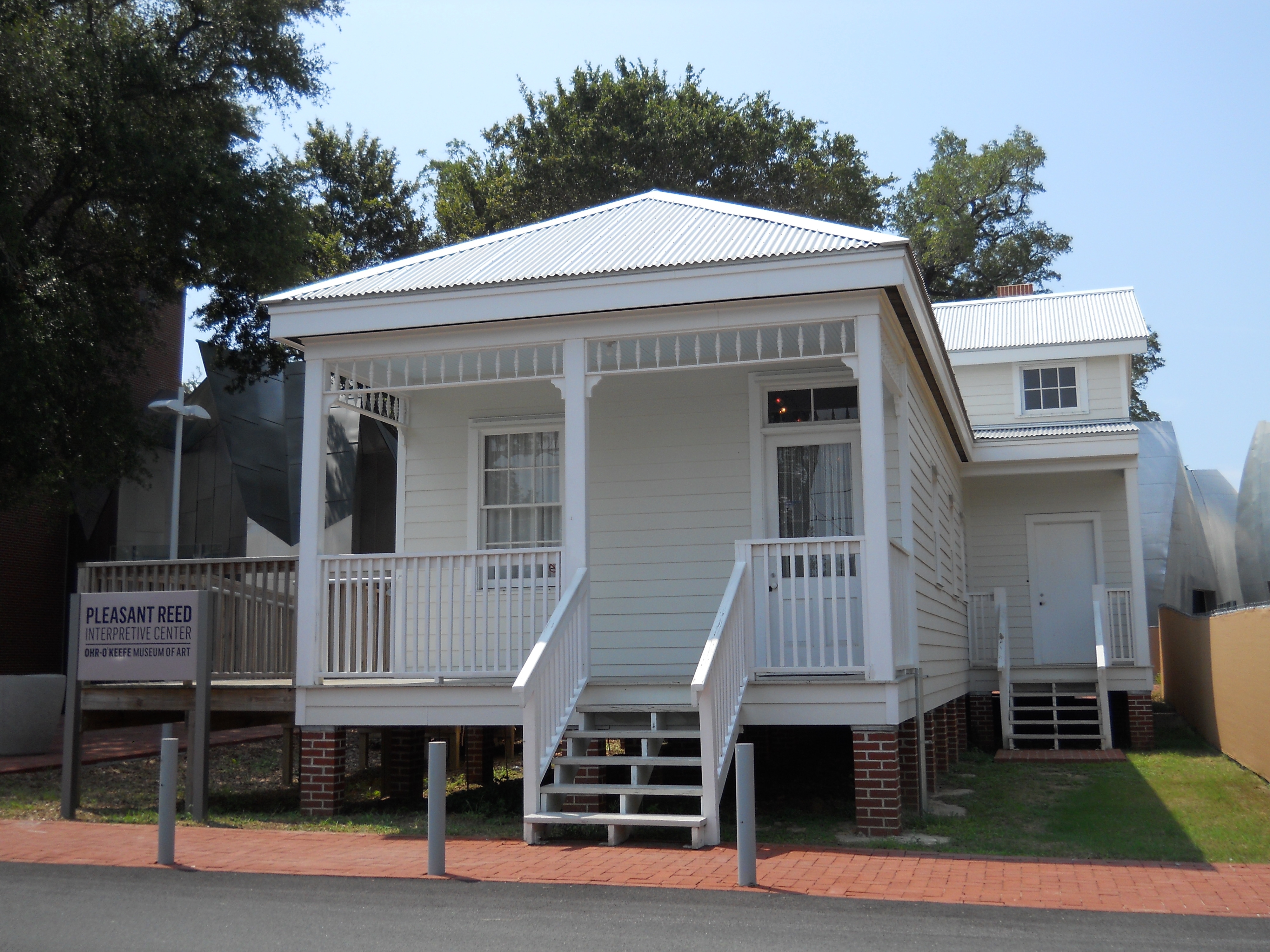
The museum's troubles did not end with Katrina. Less than a year after opening in 2010, the Ohr-O'Keefe faced financial difficulties as revenues fell short of operating costs. In October 2011, the Biloxi City Council stepped in with financial support, banking on the museum's potential as a center for cultural tourism. The gamble reflected the same spirit as Ohr's own: bet on the future. The campus today includes the Mississippi Sound Welcome Center, exhibition galleries, the Gallery of African American Art, and the Pleasant Reed Interpretive Center, a preserved freedman's cottage that tells the story of the African American community in post-Civil War Biloxi. Named jointly for Ohr and for Annette O'Keefe, the late wife of former Biloxi mayor Jeremiah Joseph O'Keefe III who was instrumental in fundraising, the museum stands as proof that persistence eventually finds its audience.
From the Air
Located at 30.394N, 88.872W along the Biloxi waterfront on the Mississippi Gulf Coast. The Gehry-designed stainless-steel pod buildings are distinctive from lower altitudes, set among mature live oaks near the shoreline. Best viewed below 2,500 feet AGL. Nearest airports: Keesler AFB (KBIX) approximately 3 miles southwest, Gulfport-Biloxi International (KGPT) approximately 14 miles west. The campus sits along US-90 (Beach Boulevard) east of downtown Biloxi.