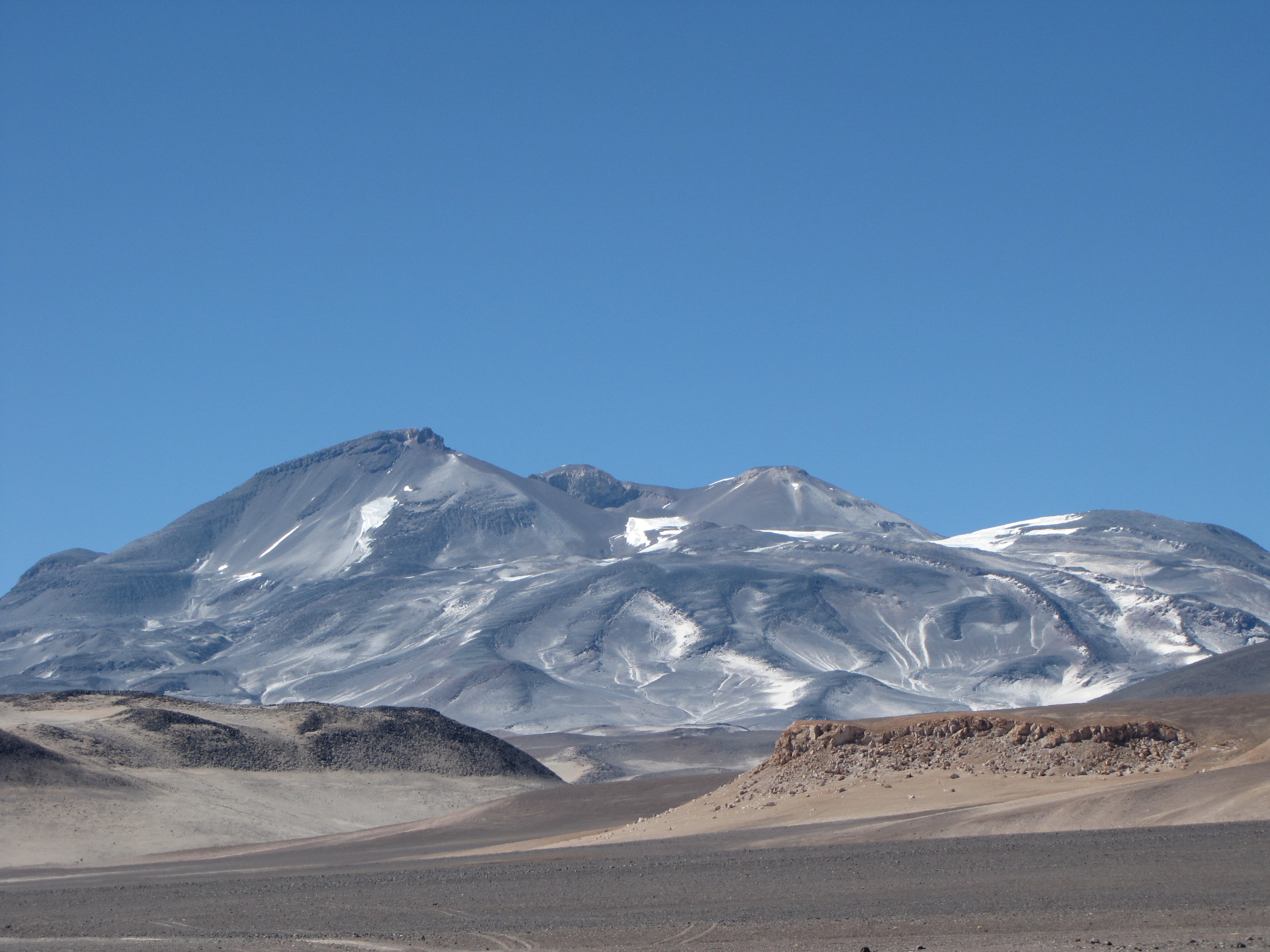
Ojos del Salado
There is a lake near the top of Ojos del Salado. That fact alone is worth pausing over. At 6,480 meters above sea level, tucked inside the summit crater of Earth's highest volcano, a permanent body of water roughly 100 meters across somehow persists in one of the driest environments on the planet. The Atacama Desert, which surrounds the volcano's base, receives almost no precipitation. The mountain itself sits along the Arid Diagonal of South America, where conditions are so desiccated that substantial glaciers cannot form and snow rarely accumulates. Yet the lake endures -- the highest lake of any kind in the world, a small defiance of the logic that governs everything else on this mountain.
A Volcano That Hides
Ojos del Salado rises to 6,893 meters on the border between Chile and Argentina, making it not only the highest volcano on Earth but also the highest peak in Chile. Despite these superlatives, the mountain spent centuries in relative obscurity. Nested among a cluster of peaks of similar elevation in the high Andes, Ojos del Salado does not dominate its skyline the way Aconcagua dominates the view from Mendoza. The Inca used the nearby Paso San Francisco as a major Andean crossing but left no structures on the mountain itself, even though they built ceremonial platforms on surrounding peaks. The Spanish conquistador Diego de Almagro crossed the Andes at Ojos del Salado without mentioning it. Explorer Walter Penck traversed the area in 1912 and 1913 without identifying the peak. For a mountain of its stature, Ojos del Salado was remarkably good at going unnoticed.
The Elevation Wars
Confusion about the mountain's exact height triggered one of the more entertaining disputes in mountaineering history. In 1956, a Chilean expedition measured Ojos del Salado at 7,084 meters using a barometer -- a number the press eagerly reported as fact, despite the well-known unreliability of barometric measurement at extreme altitude. If correct, this would have made Ojos del Salado taller than Aconcagua, claiming the title of highest peak in the Western Hemisphere. Argentine and Austrian teams raced to the mountain to verify. The American Alpine Club sent its own expedition, which was nearly thwarted when a gust of wind stretched their measurement line during a geodetic survey. They ultimately established the elevation at approximately 6,885 meters -- definitively below Aconcagua's 6,960 meters. The question was revisited in 1989 when GPS-based measurements returned a figure of 6,900 meters, plus or minus a small margin. The mountain kept its second-place standing, but not without a fight.
Life at the Edge of Nothing
The aridity that defines Ojos del Salado creates a landscape stripped to its essentials. No vegetation grows above 4,900 meters. Below that line, the terrain supports a sparse desert scrub that gives way to richer communities farther downslope, where guanacos and vicunas graze and flamingos wade in salt-crusted lagoons. The mountain itself belongs to a different world. Lichens and mosses cling to rocks at higher elevations, and green growths have been reported near the summit, but these are exceptions measured in centimeters. Salt-tolerant and acid-tolerant bacteria have been recovered from lake sediments near the top, leading researchers to study Ojos del Salado as a potential analogue for conditions on Mars. Earwigs have been observed at 5,960 meters -- the kind of detail that sounds like a footnote but speaks to the tenacity of life in places that seem designed to exclude it.
The Climb and the Quiet
Only several hundred climbers attempt Ojos del Salado each year, a fraction of the traffic on Aconcagua. The mountain does not require technical ice or rock climbing, but the combination of extreme altitude, bitter cold, relentless wind, and waterless terrain defeats roughly two-thirds of all attempts. Most climbers approach from the Chilean side, where the first refuge can be reached by car. From there, the route passes through Refugio Tejos at 5,825 meters before a final push through scree and a steep couloir to the summit. The first confirmed ascent came in 1937, when Polish climbers Jan Alfred Szczepanski and Justyn Wojsznis reached the top -- though most of their expedition records were lost during World War II. A modified car was driven to 6,688 meters on the mountain's slopes in 2015, a record that captures something essential about Ojos del Salado: it is a place where humans keep finding new ways to test their limits against an environment that does not care whether they succeed.
From the Air
Located at 27.11S, 68.54W on the Chile-Argentina border in the high Andes. At 6,893 meters, Ojos del Salado is a dominant terrain feature visible from great distance in clear air. The summit is permanently snow-dusted but lacks substantial glaciers. Maintain safe separation -- terrain rises rapidly and mountain wave turbulence is common. Nearest airports: Copiapo Desierto de Atacama (SCAT/DAT) on the Chilean side, approximately 200 km west. Catamarca (SANC) on the Argentine side. The international highway through Paso San Francisco passes north of the mountain and provides a visual navigation reference.