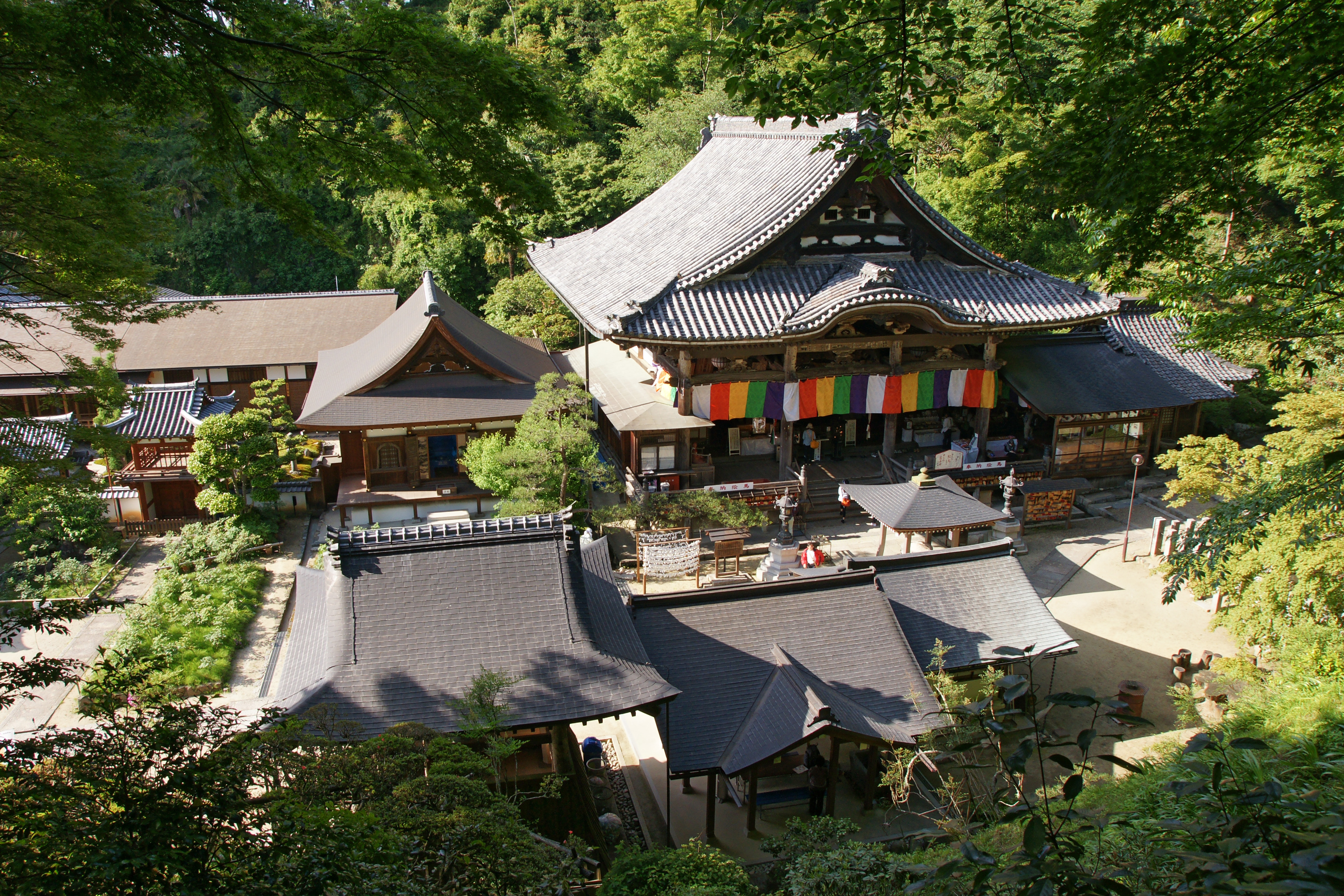
Oka-dera: The Dragon Lid Temple
The formal name tells the whole story. Ryugai-ji -- Dragon Lid Temple. According to legend, the monk Gien arrived in the Asuka hills sometime in the late 7th century and found the local residents terrorized by a malevolent dragon. Gien sealed the creature in a pond and covered it with heavy stones, placing a lid on evil itself. The story made the temple famous as a place of protection, drawing pilgrims from across Japan for more than a thousand years. Today Oka-dera is the 7th stop on the Saigoku Kannon Pilgrimage, one of the oldest pilgrimage circuits in Japan, and inside its main hall sits a figure that commands attention through sheer physical presence: a clay Nyoirin Kannon Bosatsu standing 4.85 meters tall -- the largest clay Buddhist statue in all of Japan.
A Palace Becomes a Prayer Hall
Before Gien built his temple, this hillside east of Asuka village held the Okamiya Palace, residence of Prince Kusakabe, son of Emperor Tenmu. The prince died in 689, and according to records in the Todaiji Yoroku and the Fuso Ryakuki, Gien (643-728) transformed the palace grounds into a Buddhist sanctuary. The first verifiable mention of the temple in historical documents, however, comes from the Shosoin Documents in July 740 -- placing a gap of decades between legend and evidence. Archaeological work by the Kashihara Archaeological Institute in 1982 revealed cut tuff stones at nearby Haruta Shrine that appear to mark the north wall of an original main hall measuring seven bays by four bays -- roughly 12.7 meters by 7.3 meters. Roof tiles from the early Nara period found at the same site suggest the temple originally stood at a different location, slightly west of where it sits today. The former temple site was designated a National Historic Site in 2005.
The Teacher of Giants
Gien was more than a dragon-slaying monk of legend. He founded the Hosso sect in Japan, one of the most influential schools of Buddhist philosophy. His disciples shaped the religious landscape of the entire country. Roben went on to help establish Todai-ji, home of the Great Buddha in Nara -- one of the most recognizable Buddhist monuments on earth. Gyoki, another of Gien's students, became a celebrated itinerant monk who built bridges, irrigation systems, and temples across Japan, eventually playing a key role in the construction of Todai-ji as well. That two of the most important figures in Japanese Buddhist history studied under the same teacher, at a temple perched on an Asuka hillside, speaks to Oka-dera's outsized influence during the Nara period. The temple was a branch of the powerful Kofuku-ji, but over time it declined. During the Edo period, nearby Hase-dera restored the temple and converted it from the Hosso sect to Shingon Buddhism, the tradition it follows today.
The Largest Clay Buddha
The honzon -- the principal image of worship -- at Oka-dera is a seated Nyoirin Kannon Bosatsu sculpted from clay during the Nara period. At 4.85 meters tall, it holds the distinction of being the largest clay statue in Japan. The figure is unusual in its iconography: most Nyoirin Kannon statues across Japan depict the bodhisattva as a six-armed seated figure, but the Oka-dera statue has only two arms, similar to the principal image at Ishiyama-dera near Lake Biwa. The head is original Nara-period work, but the body has undergone extensive repair over the centuries. The legs were originally posed in a half-seated position, again like the Ishiyama-dera figure, but were altered at some point to the fully seated form seen today. Despite these modifications, the statue retains a powerful solemnity -- the scale of clay shaped by human hands more than 1,200 years ago conveys a weight that carved wood or cast bronze cannot quite replicate.
Pilgrims and Preservation
Oka-dera's position as the 7th temple on the Saigoku Kannon Pilgrimage ensures a steady flow of visitors walking a route that has been followed since at least the Heian period. The pilgrimage connects 33 temples across western Japan, each dedicated to Kannon, the bodhisattva of compassion. The temple's other cultural properties tell stories of their own. The Niomon gate dates to 1612, built from materials salvaged from a former three-story pagoda. The main hall was constructed in 1644 during the Edo period. A seated wooden statue of the founder Gien, crafted in the dry-lacquer technique over a wood core, survives from the Nara period and is designated an Important Cultural Property. The Asuka region surrounding the temple is itself a landscape of deep antiquity -- stone-covered tombs, abandoned palace foundations, and terraced rice paddies that trace patterns unchanged since the 7th century. Oka-dera sits among them, the Dragon Lid Temple still keeping watch over whatever lies sealed beneath its stones.
From the Air
Located at 34.47N, 135.83E on a hillside in Asuka village, Nara Prefecture, Japan. The temple sits in the historically rich Asuka region, a landscape of ancient burial mounds, palace ruins, and terraced agriculture visible from moderate altitude. Best viewed at 2,000-4,000 feet AGL to see the hillside temple complex and surrounding Asuka Plain. Nearest major airports are Osaka Itami (RJOO) approximately 30 nautical miles northwest and Kansai International (RJBB) approximately 30 nautical miles southwest. The Asuka region is a compact cluster of archaeological and temple sites visible as a distinctive cultural landscape from the air.