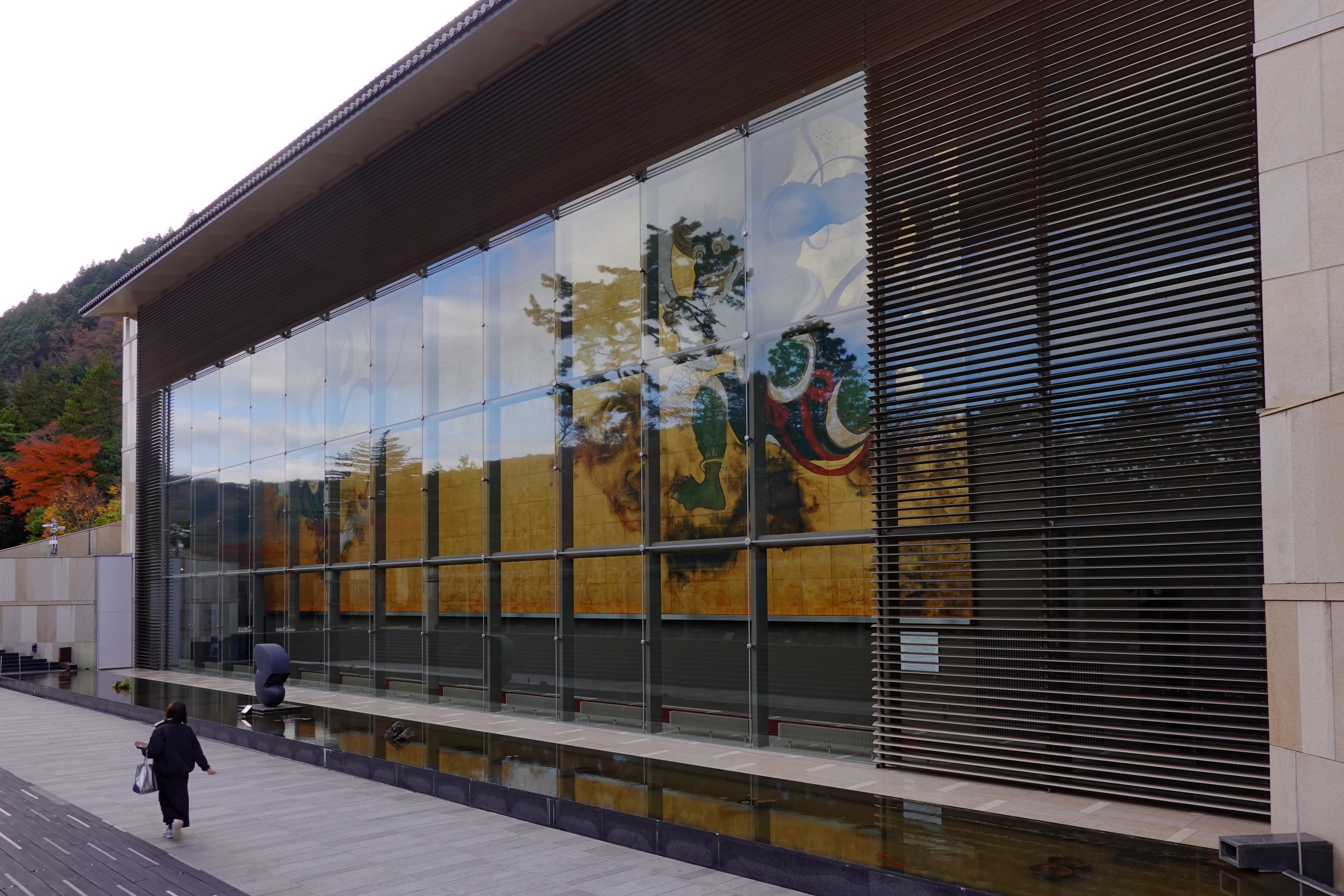
Okada Museum of Art
A twelve-meter-high mural of two guardian deities soaring through clouds greets visitors before they even step inside. Painted by Fukui Kotaro in the Rimpa tradition, the facade artwork called "Wind/Time" announces the ambitions of the Okada Museum of Art, which opened in Hakone in 2013 as a monument to one man's passion for Japanese and East Asian art. That man was Kazuo Okada, the pachinko and casino billionaire whose fortune built both the collection and the five-story building that houses it. With the largest indoor exhibition space in Hakone, stretching across approximately 5,000 square meters of gallery space, the museum held some 450 works spanning centuries of artistic achievement. Then, in November 2025, a court-ordered auction at Sotheby's Hong Kong sent 125 of those works to new owners, including Hokusai's iconic Great Wave off Kanagawa, to satisfy a legal judgment. The museum's story is as dramatic as any painting on its walls.
A Collector's Empire
Kazuo Okada made his fortune in pachinko machines before expanding into the global casino industry. He became an early major investor in Wynn Resorts in 2002, serving as its vice chairman, and his company, Universal Entertainment Corporation, operated gaming properties across Asia. With the wealth came a consuming interest in Japanese and East Asian art. Okada assembled a collection of some 450 pieces centered on early modern and modern Japanese painting, including works by masters of the Rimpa school and Edo-period screen painters. The collection also embraced Chinese bronzes, lacquerware, ceramics, and Buddhist sculpture. When he chose to build a museum, Okada selected Hakone, the hot spring resort town in the mountains southwest of Tokyo already famous for its concentration of art institutions. The museum rose on the former site of the Kaikatei Hotel, a Meiji-era establishment that once served Western visitors, and its five floors of galleries totaling roughly 7,700 square meters of floor space made it the largest exhibition venue in the area.
Treasure House on a Hillside
The building takes advantage of Kowakudani's sloping terrain, with galleries cascading down the hillside and framing views of the surrounding forest. Inside, the collection unfolds chronologically and thematically. Japanese ceramics hold a place of honor, with works by Nonomura Ninsei and Ogata Kenzan, masters of Kyoto pottery whose glazed tea bowls and incense burners represent the pinnacle of Japanese ceramic art. Screens painted by artists of the Kano school line the walls of upper galleries. Chinese bronzes and Buddhist sculpture occupy quieter rooms where the lighting shifts to match the patina of ancient metal. Beyond the galleries, the museum's 6,300-square-meter grounds include a hillside garden and woodland trails designed to blur the boundary between art and nature. An outdoor footbath offers visitors a chance to soak their feet while gazing at the forested slopes, and a cafe-restaurant occupies a traditional wooden villa on the property.
The Great Wave Departs
The legal drama that would reshape the museum's collection began decades earlier, rooted in Okada's partnership with Steve Wynn. After Okada was ousted as Wynn Resorts' vice-chairman in 2012, a protracted legal battle ensued over the forced redemption of Universal Entertainment's twenty-percent stake in the company. Okada eventually prevailed, reaching a $2.6 billion settlement. But when his law firm, Bartlit Beck, submitted a $50 million fee, Okada contested it. The firm won a binding arbitration, and to satisfy the judgment, court-appointed receivers consigned 125 works from the museum to Sotheby's Hong Kong. On November 22, 2025, every single lot sold in what auctioneers call a "white glove" sale, totaling $88 million. Hokusai's Great Wave off Kanagawa and a monumental triptych by Kitagawa Utamaro each set new auction records for their respective artists. The sale sent shockwaves through the Asian art market and left the Okada Museum's galleries with conspicuous gaps.
What Remains
Despite the loss of 125 works, the Okada Museum of Art continues to operate. The remaining collection still spans the breadth of Japanese and East Asian artistic traditions, and the building itself remains a destination. Hakone's constellation of museums, including the nearby Pola Museum of Art and the Hakone Open-Air Museum, ensures that visitors rarely come for just one institution. The Okada Museum's footbath still steams, the Rimpa-inspired guardians still soar across the facade, and the hillside gardens still frame views of the volcanic ridges beyond. Whether the museum can rebuild what the auction took remains an open question, but the building stands as a reminder that great collections are never permanent. They are assembled by human ambition and dispersed by human circumstance, and the story of who gathers beauty and who lets it go is as old as art itself.
From the Air
The Okada Museum of Art is located at 35.2381N, 139.0461E in the Kowakudani area of Hakone, Kanagawa Prefecture. The building sits on a forested hillside and is not easily distinguishable from the air among Hakone's dense tree cover, but the cleared grounds and parking areas provide orientation. The museum lies within the volcanic caldera of the Hakone mountain range, with Lake Ashi visible to the southwest. The nearest airports are RJTO (Oshima Airport) roughly 70 km southeast, and RJTT (Tokyo Haneda) approximately 85 km northeast. Approach from the east over the Kowakudani valley for the best perspective of the hillside setting. On clear days, Mount Fuji is visible to the northwest.