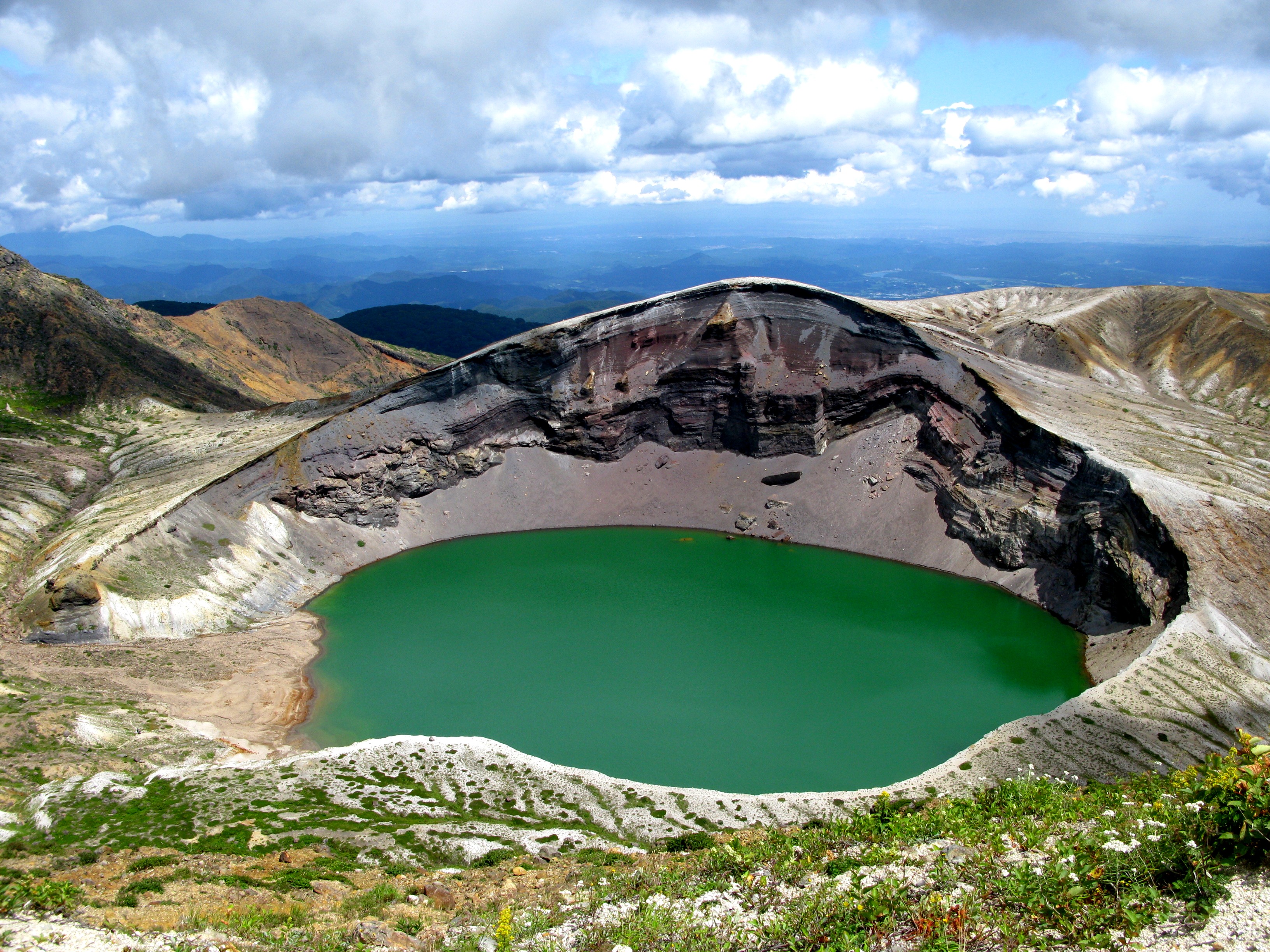
Okama Crater Lake
The water is never the same color twice. Locals call it Okama -- the Honourable Cauldron -- for the way it sits inside the volcanic rim of Mount Zao like a great cooking pot filled with impossible hues. But visitors have given it another name: Goshiki-numa, the Five Color Pond. Depending on the hour, the weather, and the season, the lake's surface shifts from emerald green to deep turquoise to a pale, almost ghostly blue. The effect comes from the water's extreme acidity and the minerals dissolved within it, interacting with sunlight at different angles. Sitting at 1,600 meters above sea level on the border between Yamagata and Miyagi prefectures, this crater is one of the most photographed natural features in the Tohoku region -- and one of the most unpredictable.
Born from an Eruption
The crater that holds Okama was formed by a volcanic eruption in the 1720s, blasting a nearly perfect bowl into the summit ridge of Mount Zao. The Zao range is part of the Ou Mountains, the volcanic backbone that runs through the center of the Tohoku region, and Mount Zao itself is one of over 100 active volcanoes in Japan. A 1968 survey measured the lake's dimensions precisely: 325 meters across from east to west and the same from north to south, with a maximum depth of 27.6 meters. The lake has no outlet stream. Its acidic waters, hostile to nearly all aquatic life, accumulate from rainfall, snowmelt, and volcanic gases that seep through the crater floor. The result is a body of water that is beautiful to behold but inhospitable to life -- a cauldron in more ways than one.
The Alchemy of Five Colors
The lake's color-shifting property is not myth or exaggeration. The combination of dissolved volcanic minerals, the water's pH level, and the angle of sunlight create genuine, dramatic color changes visible to the naked eye over the course of a single day. Morning light might produce a deep cobalt. By midday, the surface can glow an almost neon emerald. Overcast skies drain the color to a muted gray-green, while late afternoon sun can push the palette toward turquoise or even a milky jade. Seasonal changes add another dimension: spring snowmelt dilutes the mineral concentration, shifting the base color, while summer heat concentrates it again. Photographers return repeatedly, knowing that no two visits will yield the same image. The five colors of the name are more suggestion than limit -- the true count is uncountable.
Snow Monsters and Hot Springs
Mount Zao is famous beyond its crater lake. In winter, the mountain's upper slopes transform into a landscape of juhyo -- towering formations of ice and snow that coat the fir trees until they resemble ghostly, hulking figures. These 'snow monsters' draw visitors from across Japan and beyond, particularly from January through February when the formations reach their peak. The Zao Ropeway carries visitors up through the frozen forest for views of the ice-clad peaks. Below the summit, Zao Onsen offers some of the oldest hot spring baths in the Tohoku region, where volcanic-heated water rich in sulfur surfaces naturally. The same geothermal forces that created Okama's crater also warm the baths in the valley below -- a reminder that the mountain, while quiet for now, is very much alive.
The Echo Line to the Rim
Reaching Okama requires driving the Zao Echo Line, a scenic mountain road that climbs through dense forest and alpine meadows along Yamagata-Miyagi Prefectural Route 12. The road is typically open from late April through early November, closed the rest of the year by heavy snowfall. Near the summit, a parking area allows visitors to walk the final stretch to the crater rim overlook. The view from the edge is sudden and dramatic: the ground drops away into the bowl, and the lake fills the void with whatever color it has chosen for the moment. On clear days, the panorama extends across the Zao range and into the plains of both Yamagata and Miyagi prefectures. Clouds often settle into the crater, obscuring the lake entirely and then lifting to reveal it anew -- one more color change in an endless sequence.
From the Air
Located at 38.14N, 140.45E at approximately 1,600 meters elevation on the summit ridge of Mount Zao, straddling the border of Yamagata and Miyagi prefectures. The crater lake is a highly visible circular water feature from the air, distinctly colored against the volcanic terrain. Mount Zao itself rises to 1,841 meters and is part of the Ou Mountain chain running north-south through Tohoku. Nearest airports: Yamagata Airport (RJSC) approximately 30 km to the northwest, Sendai Airport (RJSS) approximately 50 km to the southeast. The Zao Echo Line road is visible winding up the mountainside. In winter, the upper slopes are covered in snow and the juhyo ice formations on the tree line are visible from moderate altitude.