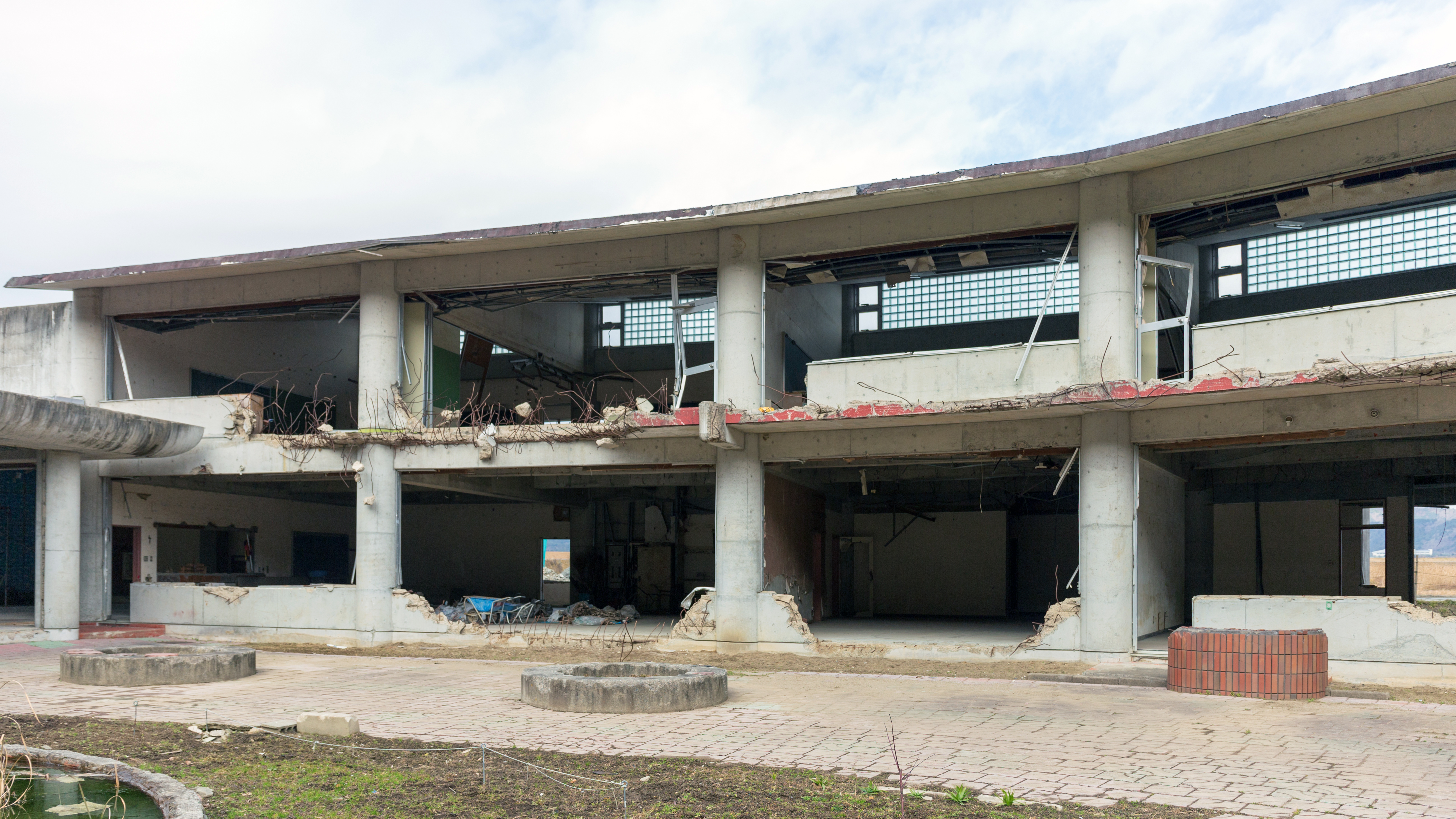
Okawa Elementary School: The Fifty-One Minutes
At 15:29 on March 11, 2011, a mother at Okawa Elementary School sent her husband an e-mail: "I am at the school with our child." Teachers had convinced her to stay. The school was a designated evacuation site, they said. It was safer here. She and her child were dead within minutes.
Okawa Elementary sat on a bend of the Kitakami River in Ishinomaki, Miyagi Prefecture, nearly four kilometers from the coast. It had survived every earthquake in its 138-year history. A forested hill rose directly behind the schoolyard. A 45-passenger bus sat parked out front with its engine running. Of 108 students present that afternoon, 74 would never go home. Ten of eleven teachers would die beside them. What happened in those fifty-one minutes between the earthquake and the wave remains one of the most agonizing stories of the 2011 Tohoku disaster.
Fifty-One Minutes of Indecision
The magnitude 9.0 earthquake struck at 14:46. Windows shattered across the school building, and the structure began threatening collapse from aftershocks. Teachers gathered the children in the schoolyard and began debating. A hill rose behind the school -- students had practiced evacuating to it during drills. But faculty worried about landslides, falling trees, loose rocks. Elderly residents from the neighborhood had already arrived at the school, seeking shelter at the designated evacuation point. Some teachers argued these elderly evacuees could not climb the hill. An alternative was proposed: walk 200 meters west to the base of the Shin-Kitakami Ohashi Bridge on National Route 398, where the road sat slightly higher than the local river weirs. The elevation there was six to seven meters. The debate consumed precious minutes while children waited in the cold schoolyard.
Children Who Knew
Parents began arriving to collect their children, signing them out one by one. Twenty students left this way. Some of these parents warned the teachers that a tsunami was expected soon. But the teachers urged parents to stay, insisting the school was safe. Meanwhile, some children tried to flee toward the hill on their own. Parents who had come to pick up their children watched as other students were physically returned to the schoolyard after attempting to escape to higher ground. Several children were crying, begging their teachers to let them go up the hill. They had seen cracks opening in the earth from the aftershocks. They believed they would die if they stayed. The teachers held them in place. At 15:14, the national tsunami warning was raised from six meters to ten meters. No one at the school received the update.
The Wave on the River
Around 15:37, the group finally moved. Teachers led the children in a line out the school gate and onto the prefectural road, heading toward the bridge. They had chosen the six-meter elevation point over the hill directly behind them. They never reached it. The tsunami, funneling up the broad Kitakami River from the coast, broke over the weirs and engulfed the children from the front. A teacher and several students at the rear of the line turned and sprinted back toward the hill. Some of those who ran survived. Others were so terrified by the sight of the wall of water that they dropped to the ground, unable to move. The bridge they had been walking toward -- their chosen refuge -- was several meters lower than the wave. It was completely submerged. Only four of the students present at the school when the tsunami arrived survived that day.
Accountability and Grief
In 2014, families of 23 of the dead children sued Ishinomaki City and Miyagi Prefecture, arguing that the school's disaster preparedness was fatally inadequate. In October 2016, a court awarded the families 1.4 billion yen -- approximately 12.8 million US dollars -- in compensation. The school was formally closed in 2018 and merged with nearby Futamata Elementary. The question that haunts the case is not whether the teachers cared about the children -- by all accounts, they were devoted educators. The question is systemic: why did a school four kilometers from the coast have no tsunami evacuation plan? Why was a bus with its engine running never used? Why did adults override the instincts of children who were begging to climb the hill?
What Remains
The concrete shell of Okawa Elementary still stands on the Kitakami riverbank. Ishinomaki City chose to preserve the ruins, though budget constraints led to cutting 20 meters from each end of the originally 107-meter-long building. The shattered classrooms are visible from outside, behind barriers. A memorial monument and flower-offering stand mark the site. In July 2021, the Okawa Tsunami Memorial Hall opened nearby, dedicated to disaster education. Former students have worked to transform the grounds into a community gathering space. The school's story is now taught in disaster preparedness curricula across Japan -- a lesson purchased at a cost that no classroom exercise could ever simulate. The hill behind the schoolyard is still there, quiet and green, barely a minute's climb away.
From the Air
Located at 38.546°N, 141.429°E on the banks of the Kitakami River in Ishinomaki, Miyagi Prefecture. The school ruins are visible near a bend in the river, approximately 3.7 kilometers inland from the Pacific coast. The river mouth and coastal floodplain are clearly visible from altitude. Best viewed at 2,000-4,000 feet AGL to see the relationship between the school site, the river, the hill behind it, and the coast. Sendai Airport (RJSS) lies approximately 40 nautical miles to the south-southwest. The Kitakami River is a major landmark flowing southeast to the sea, and the Shin-Kitakami Ohashi Bridge on Route 398 is visible nearby.
Sources
- Okawa Elementary School - Wikipedia
- Ishinomaki City Okawa Elementary School Ruins - TRAVEL TO TOHOKU
- Former students work to turn tsunami-hit elementary school into social hub - The Japan Times
- Miyagi Prefecture - Ishinomaki area recovery information
- The school beneath the wave: the unimaginable tragedy of Japan's tsunami