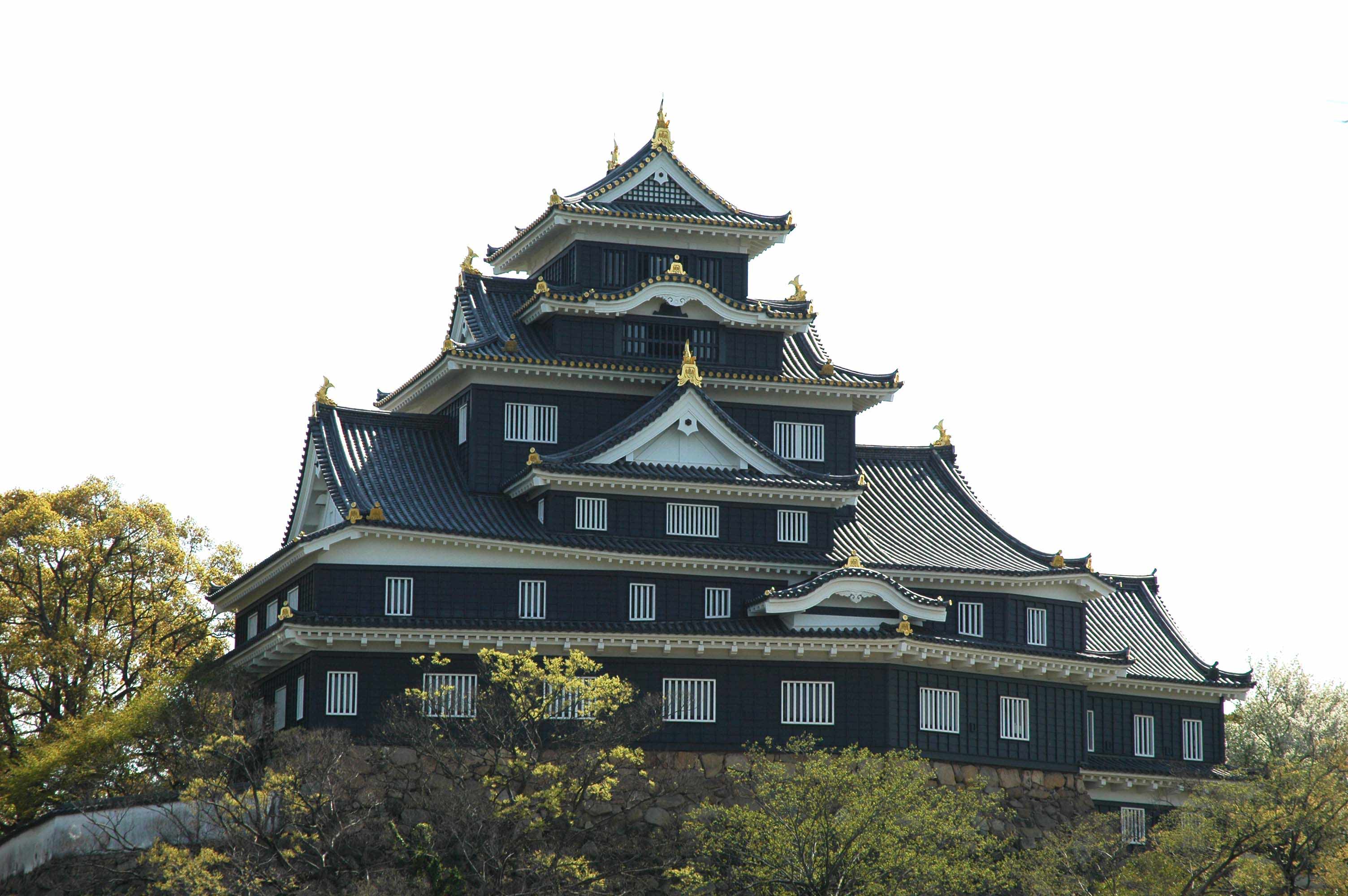
Okayama Castle
Where neighboring Himeji gleams white -- the "Egret Castle," pale as a wading bird -- Okayama Castle absorbs light. Its black exterior earned the fortress its most enduring nickname: Crow Castle. Before the Battle of Sekigahara in 1600, the main keep also featured gilded roof tiles that caught the sun, and the castle was known as the Golden Crow Castle. The gold is mostly gone now, surviving only on a few fish-shaped gargoyles called shachihoko that crown the roofline. The main tower itself is a 1966 concrete reconstruction, built after allied bombers burned the original to the ground on June 29, 1945. But the story the castle tells -- of ambition, betrayal, and the resilience of stone -- reaches back to 1570.
Blood and Black Lacquer
The castle's modern history begins with violence. In 1570, Ukita Naoie killed the castle lord Kanemitsu Munetaka and seized the fortress, beginning a thorough remodeling. His son Ukita Hideie completed the work in 1597, creating the six-story black tower that gave the castle its distinctive silhouette. But Hideie chose the wrong side in the decisive conflict of his era. At the Battle of Sekigahara in 1600, he supported the Toyotomi clan against the Tokugawa forces. When the Toyotomi lost, Hideie was captured and exiled to the island prison of Hachijojima. The castle and its surrounding fiefdoms were handed to Kobayakawa Hideaki as spoils of war. Kobayakawa died just two years later without an heir, and the Tokugawa government transferred everything to the Ikeda clan, who would hold Okayama for the remainder of the feudal era.
The Ikeda Legacy
Under the Ikeda clan, Okayama Castle became the administrative center of a prosperous domain. The Ikeda lords added Koraku-en as a private strolling garden just across the Asahi River from the castle grounds -- a pairing of fortress and garden that persists today as one of Okayama's defining features. The castle complex grew to include multiple watch towers, gates, and defensive walls that stretched along the riverbank. Two of those watch towers would prove to be the only structures to survive the twentieth century intact, and both are now listed as Important Cultural Properties by Japan's Agency for Cultural Affairs.
The Meiji Dismantling
When the Meiji government took power in 1868, it inherited hundreds of feudal castles across Japan and regarded most of them as archaic relics of the samurai era. In 1869, Okayama Castle became the property of the Hyobu-sho -- the Ministry of War. What followed was systematic erasure: outer moats were filled in, most castle buildings were dismantled, and the old stone walls gradually vanished under the expanding city. This was not unique to Okayama -- across Japan, the new government demolished or abandoned castles that had defined the landscape for centuries. By the early twentieth century, the main keep and a handful of gates and towers were all that remained of the once-sprawling complex.
Destroyed and Rebuilt
On June 29, 1945, allied incendiary bombs struck the castle. The main keep and an adjacent gate burned to the ground, leaving only two turrets and sections of the stone foundations standing. For nearly two decades, the castle grounds sat empty. Reconstruction began in 1964, and the new main keep was completed in 1966 -- a concrete structure equipped with air conditioning, elevators, and museum exhibits documenting the castle's history. In 1996, as part of 400th-anniversary celebrations, the rooftop shachihoko gargoyles were re-gilded, restoring a faint echo of the Golden Crow Castle that had dazzled visitors before Sekigahara. The reconstructed keep is candid about what it is: not a faithful restoration but a modern building wearing an old silhouette, its displays focused heavily on the Ikeda era that defined the castle's most stable centuries.
From the Air
Located at 34.67N, 133.94E on the banks of the Asahi River in central Okayama city. The black castle tower is adjacent to Koraku-en garden, forming a distinctive landmark pair visible from altitude. Nearest airport is Okayama Airport (RJOB), approximately 18 km to the northwest. The San'yo Shinkansen line passes through the city. From altitude, look for the dark tower and adjacent green space of Koraku-en along the river. Recommended viewing altitude: 2,000-4,000 feet for castle and garden context.