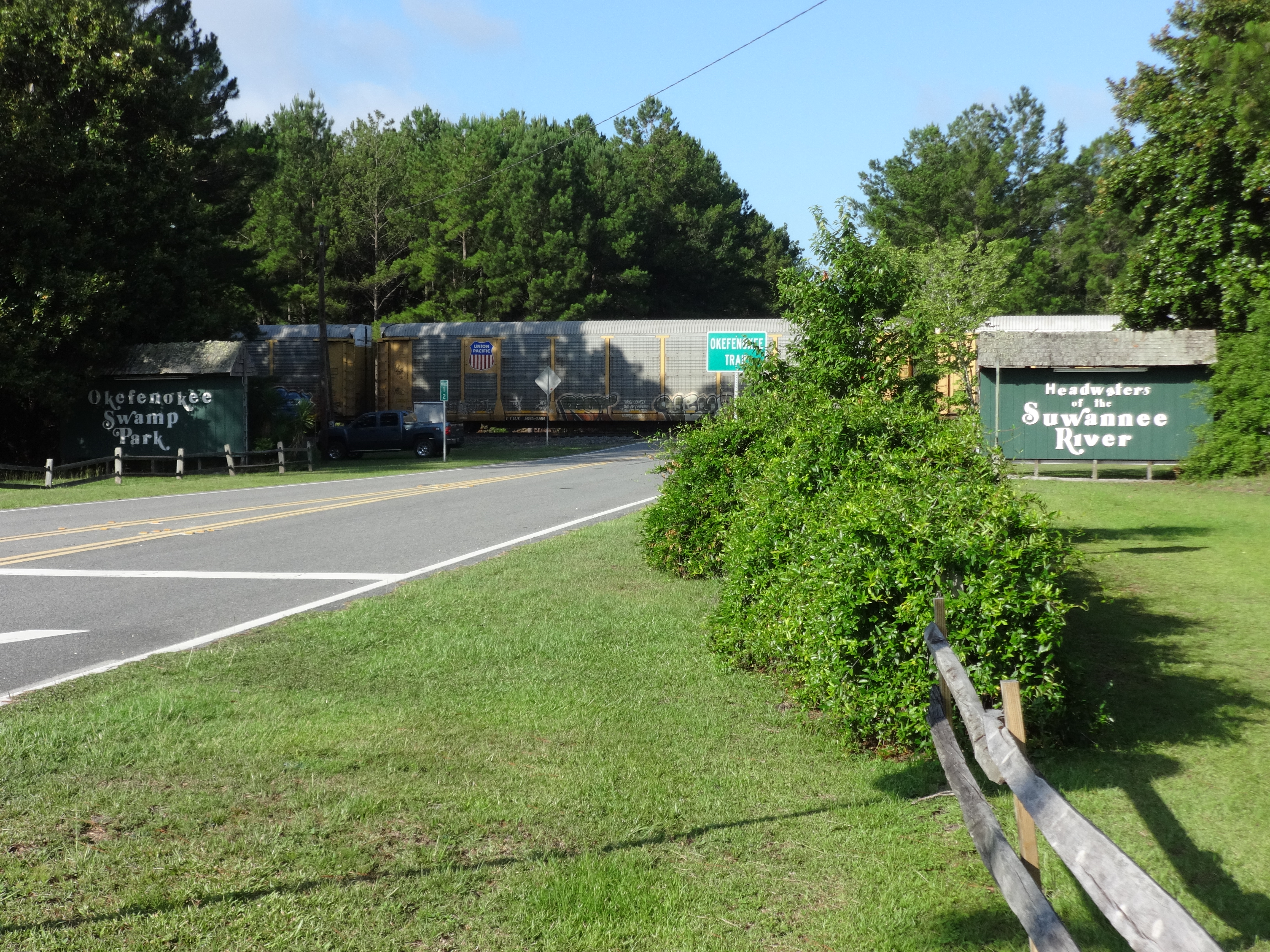
Okefenokee Swamp Park
The water here is the color of strong tea, stained by tannins leaching from centuries of decaying vegetation. This is the Okefenokee -- a name the Creek people gave it meaning "Land of the Trembling Earth," because the peat deposits that form its islands quiver underfoot like a living thing. At 438,000 acres, the Okefenokee Swamp is the most extensive blackwater swamp in North America, and the Okefenokee Swamp Park, twelve miles south of Waycross, Georgia, is its northernmost portal. From the park's 90-foot steel observation tower -- the tallest vantage point in the entire swamp -- visitors look out over a vast, flat wilderness where the horizon dissolves into cypress and Spanish moss, and where alligators outnumber people by a considerable margin.
Land of the Trembling Earth
The Okefenokee sits in a shallow depression that was once part of the Atlantic Ocean floor. Over thousands of years, peat accumulated to depths of fifteen feet or more, creating a landscape that is neither solid land nor open water but something in between. Floating peat islands called "batteries" drift across prairies of lily pads and bladderwort. Bald cypress trees draped in Spanish moss rise from the dark water on buttressed roots. Sandhill cranes, wood storks, and red-cockaded woodpeckers inhabit the canopy, while below the surface, bowfin and chain pickerel navigate the tannin-rich channels. The swamp drains slowly southward, feeding the Suwannee and St. Marys Rivers on their journeys to the Gulf of Mexico and the Atlantic.
Tracks Through the Wilderness
The park owes its existence to the Okefenokee Association, a nonprofit granted a sublease from the U.S. Department of Interior in 1945. The Association built on foundations already laid: Indian waterways dating back centuries, structures erected by the Civilian Conservation Corps in 1937, a game corral from 1938, and boardwalks from 1940 that led to an original 75-foot wooden observation tower. In 1965, a 90-foot steel tower replaced it, pushing the view even higher over the swamp canopy. The park's most distinctive feature arrived in 1999 -- the only railroad permitted to operate within the Okefenokee National Wildlife Refuge. The 1.5-mile train route carries visitors through dense swamp forest, echoing a time in the late nineteenth and early twentieth centuries when loggers, turpentine workers, and track layers harvested the Okefenokee's timber and resin for distant markets.
Pioneer Island and Darker Memories
A stop on the railroad route brings visitors to Pioneer Island, where a recreated swamp homestead is centered around the authentic Highsmith Cabin. Outbuildings cluster around it in the manner of families who once carved a living from this sodden landscape. The Country Store and Museum chronicles the human history of the swamp through photographs and artifacts. But one structure on Pioneer Island carries a heavier weight: a replica of the Wildes Cabin, dedicated in 1988 to mark the 150th anniversary of the Wildes Massacre. In 1838, Seminole warriors killed Maximillian Wildes and his companions here -- the last Indian massacre recorded in the state of Georgia. The cabin stands as a reminder that this swamp, for all its beauty, has always been contested ground.
Where the Wild Things Are
Skull Lake lies within the park's 1,200-acre property, its name hinting at stories long submerged. Alligators are the swamp's most famous residents, and the park once had its own celebrity: Oscar, an alligator who made the park his home until his death in 2007. His reconstructed skeleton now presides over the gift shop. Live animal exhibits, wildlife shows under the name "Eye on Nature," and the Serpentarium offer closer encounters with the swamp's inhabitants. Boat tours push through the dark waterways, where the silence is broken only by the splash of a turtle sliding off a log or the deep bellow of a bull alligator echoing across the prairie. Overhead, ospreys circle -- the namesake of the Osprey Society, the park's volunteer supporters who donate time and money to keep the gates open and the boardwalks sound.
From the Air
Okefenokee Swamp Park sits at 31.06N, 82.27W on the northern edge of the vast Okefenokee National Wildlife Refuge. From the air, the swamp is unmistakable: a dark, flat expanse of wetland stretching to the south and east, sharply different from the surrounding pine flatwoods and agricultural land. The park's observation tower and railroad are visible at low altitude. Waycross, Georgia lies 12 miles to the north. Nearest airports: Waycross-Ware County Airport (KAYS) approximately 12nm north, Folkston (private strips). The terrain is entirely flat; best viewed at 1,500-3,000 feet AGL for swamp detail.